





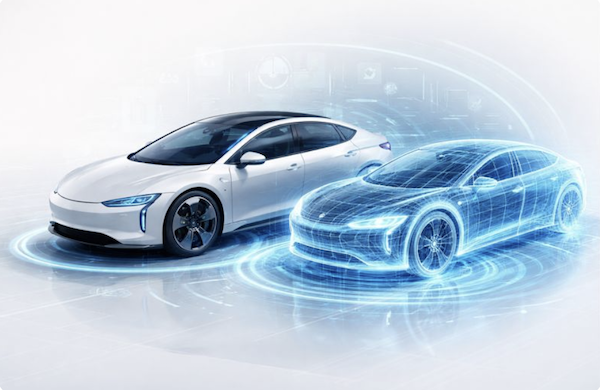
Digital twins are amazing technology, virtual representations mirroring a real physical system. Twin virtual models span software, electrical/electronic and mechanical subsystems, closing the loop with feedback from real physical counterparts. The virtual model calibrates against real sensing feedback gathered in production and prototype testing spanning braking, cornering, road surfaces, weather and traffic conditions, and other factors, all with high fidelity. Digital twins greatly accelerate development, debug, and quality control for the advanced car systems we expect today, now even more essential as these systems become more complex and more safety critical.
David Fritz (VP of Hybrid Virtual and Physical AI Systems at Siemens Digital Industries) told me that, for all their benefits, building a twin by integrating multiple parts from multiple suppliers used to take large teams years. An immense effort, out of reach for most enterprises except for the largest OEMs and Tier1s, and too slow even for them to adapt in fast-moving markets. To deliver on the real time expectation of this promise, Siemens have developed and announced at CES 2026 their “PAVE360 Digital Twin Blueprint”, a fully integrated platform providing a jumpstart not only for large OEMs and Tier1s but also for other innovators in the automotive ecosystem.
Real-time simulation for realistic workloads
Earlier generations of digital twins apparently would run a couple of orders of magnitude slower than real time. Software developers no longer consider that level of performance sufficient for their needs, given that today they must run millions of lines of code together with realistic AI workloads.
Siemens, working with Arm and AWS, announced a new approach last year based on Arm Zena CSS/cloud-native support. This can deliver near real-time performance for those target workloads, within the full scope of the digital twin. That’s a very big deal because developing and exercising ADAS, autonomous driving (AD) and infotainment (IVI) features in the twin requires that level of performance.
Equally important, SDV Digital Twin Blueprint provides a ready-to-deploy reference platform including virtual reference hardware and software stacks (AI functionality also) for ADAS, AD, and IVI. Running on day one, accessible for cloud-based collaboration. As needed you can swap in your own software stacks, replacing corresponding reference stacks. The platform builds on IPs such as Arm Zena CSS and provides mechanisms to connect to real vehicle hardware.
I asked (and I’m sure you wondered also) how AI models run inside this platform, whether cloud-based or on-prem. David said that if GPUs are available, the system will take advantage of them. If not, it will leverage Zena cores, appearing everywhere these days in cloud servers. David can’t share more details on this topic but I’m looking forward to learning more about Arm’s directions in server AI since they have already announced hardware acceleration options for AI in mobile.
Extending opportunity to the larger ecosystem
David said that they are seeing interesting adoption from organizations outside the traditional supply chain, such as engineering service suppliers. These are often OEM-sponsored ventures with trusted, specialized expertise in advanced capabilities that OEMs are targeting for 2030. Such ventures modify PAVE360 Automotive Blueprint with their own stack, to demonstrate to an OEM the value their solution can offer. Better yet, this can drop straight into the OEM’s own development platform if they also use PAVE360.
As one example, Silicon Auto is part of a joint venture with Stellantis and Foxconn, focused particularly on ADAS systems. They used PAVE360 Automotive Blueprint to model the silicon they wanted to build, putting it in the content of a whole vehicle. Silicon Auto systems are now planned to support Stellantis, Foxconn and other customers.
Another example is SAIC (Shanghai Automotive Industrial Corporation) which David calls “the Volkswagen of China”. SAICEC (EC is Engineering Corporation) is another joint venture providing design, system and applications services to SAIC and to the larger automotive industry in China. According to David, they are using Pave 360 in some interesting ways. Some no doubt like the earlier example, others exploring PAVE360 becoming a certification service to OEMs, inside of cloud.
Partnerships in addition these include AWS, AMD and Microsoft, Wipro and Cognizant. I would not be surprised to hear of OEM, Tier1, Cloud Services Provider and other partnerships in the near future.
CES 2026 demo and availability
This story hinges heavily on real time twin performance in the cloud. As proof that this capability is real, Siemens are demoing this capability at CES 2026, featuring a Volkswagen ID.Buzz in their booth connected to the Internet through Wi-Fi, with the brains of the car running in the cloud and controlling the car. You can (though the car) tell it where you want to go and watch it (virtually) navigate there. You can tell it to turn on the AC while the car is virtually enroute. From command, to cloud, back to the car in real time. Pretty impressive.
SDV Digital Twin Blueprint will be available February 2026. You can learn more about Siemens digital twin technology HERE.
Also Read:
Addressing Silent Data Corruption (SDC) with In-System Embedded Deterministic Testing
Podcast EP323: How to Address the Challenges of 3DIC Design with John Ferguson
3D ESD verification: Tackling new challenges in advanced IC design
Share this post via:



Comments
There are no comments yet.
You must register or log in to view/post comments.