




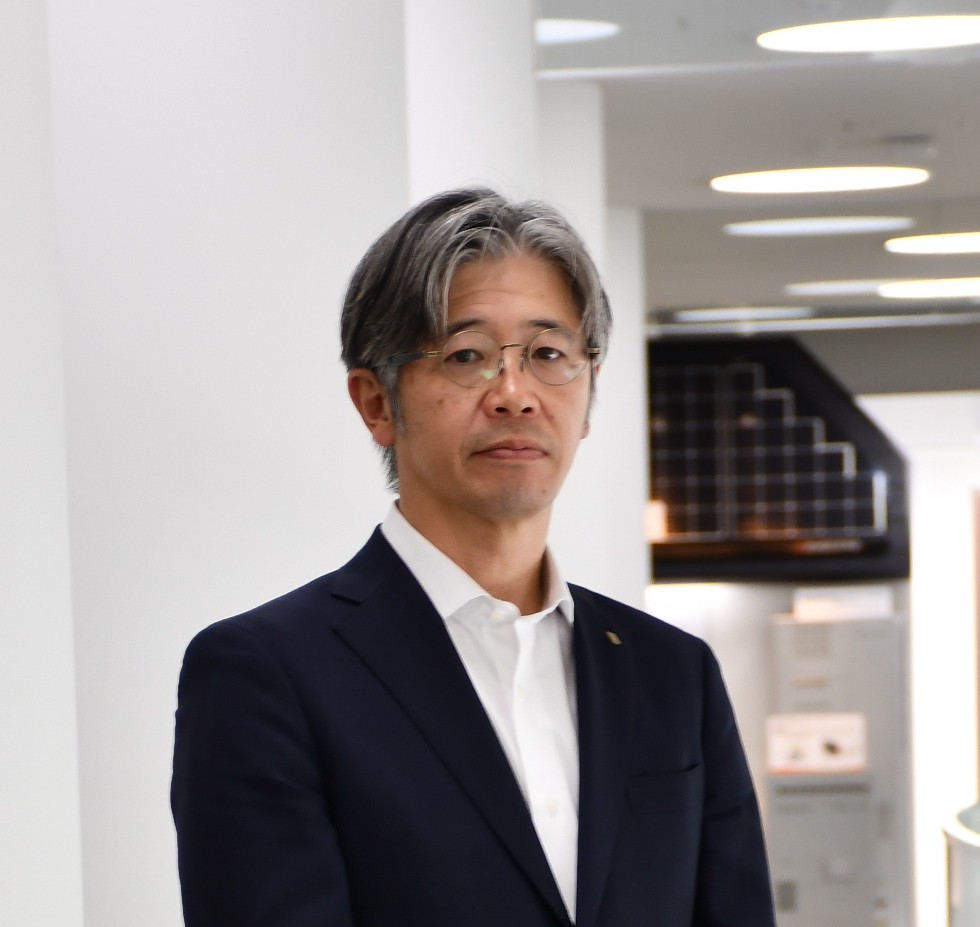


Genta Taniguchi serves as Executive Officer and Head of the Corporate Ceramic Materials Semiconductor Components Group at Kyocera Corporation. He leads initiatives in advanced ceramics and semiconductor-related technologies, supporting the company’s global business in electronic and communication components.
With extensive experience in Kyocera’s core materials and semiconductor businesses, he plays a key role in driving innovation and strengthening the company’s global competitiveness in advanced ceramics and semiconductor packaging solutions.
Tell us about your company.
Kyocera was founded in 1959 in Kyoto, Japan, as a manufacturer of advanced ceramic materials designed to solve specific engineering challenges. Today, Kyocera provides semiconductor, electronic and optical components, communications-related components, machine tools, printing devices and document solutions. Even as the company has grown, advanced ceramics remain our core competency. With more than 73,000 employees across 279 group companies worldwide, Kyocera operates on a global scale.
Kyocera’s first subsidiary outside of Japan, Kyocera International, Inc., was established in Sunnyvale, California in 1969, during the emergence of Silicon Valley. In 1971 we acquired ceramic package manufacturing operations from Fairchild Semiconductor in San Diego, becoming the first Japanese technology company with a manufacturing plant in the State of California.
While Kyocera is widely recognized as a leader in advanced ceramics and holds a leading share of the global ceramic package market, what truly sets us apart is our integrated development and manufacturing infrastructure, spanning materials, design, evaluation and mass production. These foundational technologies are key to maximizing semiconductor performance.
As fields such as AI, data centers, optical communications and mobility continue to evolve, demand is growing for our semiconductor-related technologies, including ceramic packages, semiconductor manufacturing components, substrates, wireless and optical components and assembly services. Through these technologies, Kyocera continues to contribute to the advancement of many industries.
What problems are you solving?
Our engineering solutions focus on the intersection of four major challenges in next-generation electronics: performance, reliability, mass producibility and sustainability. AI semiconductors and optical devices are expected to deliver unprecedented performance improvements, from computational processing to communication speed. In the process, however, challenges like heat generation, increased power consumption, packaging density, signal integrity and long-term reliability are becoming even more severe.
Kyocera addresses these challenges through its ceramic packaging technologies, combining advanced materials, manufacturing processes and high-frequency design expertise. For example, we are developing advanced semiconductor packages for AI data centers, including multilayer ceramic core substrates that provide outstanding rigidity and enable fine wiring.
In next-generation optical communications, we manufacture high-speed communication packages and substrates to support further breakthroughs in data transmission speeds.
Focusing on materials and packaging technologies, our role is to support the evolution of semiconductors and optical devices, contributing to improved performance and reliability.
What application areas are your strongest?
Kyocera’s ceramics deliver a set of mechanical, chemical, thermal and electrical properties not found in any other material. As a result, we can design solutions to solve engineering challenges that conventional materials cannot solve.
Looking ahead, as AI becomes more widespread, advanced semiconductor packaging will be increasingly critical to optimizing computing performance, power efficiency and thermal management. Kyocera’s strength is its ability to provide technologies that address all these areas simultaneously.
What keeps your customers up at night?
Our customers’ main concerns are managing increasingly complex development challenges driven by technological advances and ensuring supply chain stability during mass production.
In AI, data centers, automotive electronics and telecommunications infrastructure, product generations evolve rapidly. Performance requirements rise year after year. At the same time, there can be no compromise on quality, reliability or supply chain stability.
In semiconductors and optical communications, even seemingly minor differences in the characteristics of packages or substrates can significantly affect the final product’s power consumption, thermal performance, signal integrity and manufacturing yield. Customers need partners who can help them solve these challenges with an eye toward next-generation architecture. They need more than components that merely meet specifications.
By integrating our extensive technological capabilities, including materials development, evaluation, analysis and process technologies, we support customers from design to mass production.
What does the competitive landscape look like, and how do you differentiate?
First, Kyocera’s differentiation is in materials technologies, particularly advanced ceramics. We offer different ceramic material formulations, including oxides, non-oxides. Our expertise spans ceramic materials, metallization, heterogeneous material bonding and analysis technologies.
Second, we have extensive experience in semiconductor package design and manufacturing to maximize semiconductor performance.
Third, we have a global manufacturing, sales and technical support infrastructure.
Focusing on an individual differentiator is no longer enough. Kyocera’s business model begins with a deep understanding of the customer’s design philosophy, which allows us to provide comprehensive proposals covering materials, structures, processes and reliability evaluation.
What new features/technology are you working on?
One key area is advanced semiconductor packaging for AI data centers. In April 2026, we announced the development of multilayer ceramic core substrates. These are designed to achieve higher rigidity and enable finer wiring for xPUs, switch ASICs and other advanced semiconductors in development.
At OFC 2026, we exhibited products for the latest high-speed optical communications, including solutions for co-packaged optics (CPO).
How do customers normally engage with your company?
It generally starts by discussing technical challenges. We listen to the latest challenges the customer is confronting. These may involve thermal, mechanical, electrical or optical challenges, not only at the individual device level, but also at the system or module level in terms of how overall requirements are fulfilled. This gives us a foundation to propose the optimal materials, structures, packages and processes for highly individual needs.
Kyocera operates globally. Through our regional sales and technical networks, we engage closely with our customers. Our strength lies in our ability to support every stage of the process: technical consultations, joint development, prototyping, evaluation and mass production. This support also includes direct collaboration between our engineers and those of our customers to solve challenges together.
In semiconductors, optical communications, AI, automotive and industrial equipment, balancing speed of response with quality is critical. Kyocera aims to help our customers commercialize game-changing products. Whether the initial engagement begins through our website, a trade show or a private meeting, we strive to connect from an early stage and support our customers’ long-term technical roadmaps.
Also Read:
CEO Interview with Tom (TJ) Jackson of Softchip
CEO Interview with Yossi Meyouhas of Xsight Labs
CEO Interview with Mark Goranson of EMASS
Share this post via:



Why ASML Is Racing to Build 110 EUV Machines