





The majority of my 40+ year career has been spent managing the relationship between leading-edge semiconductor design and manufacture, working with just about every commercial foundry and top customers in one way or another. It’s my thing—it fascinates me. I’m also a fan of disruption, and the latest disruptions the semiconductor industry has been experiencing are fiercely entertaining.
Which brings us to the Tesla and Samsung relationship update.
In 2025, Tesla and Samsung Electronics announced a deep strategic partnership centered on manufacturing Tesla-designed AI chips used for self-driving vehicles, robotics, and AI infrastructure. The partnership is expected to evolve across multiple hardware generations and already includes one of the largest semiconductor supply agreements ever signed by an automaker. Below is a breakdown of the relationship covering its history, the technical structure of the chips, the manufacturing arrangements, and the strategic reasons behind the partnership.
Key Takeaways
The Tesla–Samsung relationship is a strategic semiconductor alliance built around three core elements:
- Fabless model: Tesla designs AI chips; Samsung manufactures them.
- Massive manufacturing deal: A $16.5 billion multiyear contract centered on Tesla’s AI6 chips.
- AI ecosystem support: Chips produced by Samsung power Tesla’s vehicles, robots, and AI data centers.
The partnership also reflects a broader trend: automakers becoming major semiconductor designers as vehicles increasingly rely on AI and custom compute hardware.
Now let’s look at the relationship from the perspective of a working semiconductor professional—based on observations, experiences, and opinions from inside the industry.
Samsung Foundry Background
Samsung truly became a player in the foundry business through its early partnership with Apple. Early Apple iProducts were manufactured in partnership with Samsung Foundry.i knew some people on the team and it went very well.
Samsung Foundry operates as an IDM-style foundry, unlike pure-play foundries such as TSMC or GlobalFoundries. Some of the Samsung content in the iProduct BoMs were from Samsung directly. I am only speaking about the SoC that apple designs and manufactures at a foundry.
Years ago, I served as Director of Foundry Relationships at an IP company, which meant spending a significant amount of time in South Korea, Taiwan, and China. Even though the companies were in the same market segment, doing business with different companies in different countries —especially when compared to working with a U.S.-based foundry was a big challenge.
From my personal experience with Samsung Foundry, I can say I worked with some extremely intelligent engineers developing bleeding-edge technology at a break neck pace. The teams worked incredibly hard and achieved a reasonable amount of market success.
However, there was one consistent challenge: transparency. Samsung Foundry often struggled with openness when issues arose—particularly if those issues might bring embarrassment to the company. Yield challenges are a classic example.
Now mix that culture with Elon Musk’s operating style and you can probably imagine the potential for a highly combustible situation—which is where we are today. Among many colleagues I’ve spoken with, very few believed this partnership had a strong probability of long-term success.
Delays and Industry Reality
Delays with Tesla’s AI6 chip have begun surfacing, and Samsung is—unsurprisingly—being blamed, as every foundry tends to be when a chip misses its schedule. From what I hear, however, the delays are occurring on both sides, so the finger-pointing continues.
This dynamic is nothing new in the semiconductor world. Chip programs are extraordinarily complex, and when schedules slip, the tension between design teams and manufacturing teams can escalate quickly.
And now we have Elon Musk talking about building Mega Fabs.
The Mega Fab Idea
The “Mega Fab” concept refers to a proposed large-scale semiconductor manufacturing facility dedicated to producing AI chips for Tesla. Musk has suggested that Tesla may eventually build its own advanced chip fabrication plant to support the enormous computing demand required for autonomous driving, robotics, and AI training.
By the way, those of us inside the semiconductor industry would simply call that an IDM mega fab.
And who is the most dominant semiconductor IDM in the history of the industry?
Intel Foundry
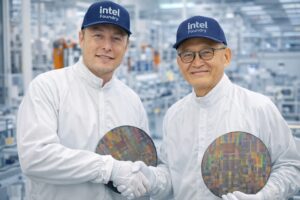
If Elon Musk does not work with Lip-Bu Tan and Intel on a project like this, I would give the effort a very small chance of success, absolutely.
Come on, Elon. The Silicon Heartland project in Ohio is ready for mega fabs. America is ready to lead semiconductor manufacturing again.
Let’s get this done before you see something shiny and wander away.
I will write more about a Tesla and Intel relationship next.




Things From Intel 10K That Make You Go …. Hmmmm