





The SPIE Advanced Lithography + Patterning Symposium recently concluded. This is a popular event where leading researchers gather. Challenges such as optical and EUV lithography, patterning technologies, metrology, and process integration for semiconductor manufacturing and adjacent applications are all covered. This was the 50th anniversary event and it was held in San Jose.
Synopsys had a major presence at the event, but the company went a step further by holding a special Lithography VIP Symposium coinciding with the show. Synopsys and its industry partners gave several excellent presentations on EUV mask making and computational lithography. More on that in a moment. The event concluded with a spirited panel discussion that explored how much of AI/ML for mask making is real today and what the practical impact could be. I was honored to host the panel, AI/ML in Mask Synthesis: Hype vs. Reality for Manufacturing. Let’s review how Synopsys explores AI/ML impact on mask synthesis at SPIE 2026.
The Panel
The panel was composed of senior executives from photomask operations, wafer fabs, and EDA. Together, these folks represent a substantial cross-section of the supply chain for advanced mask making. The panelists were:
Representing photomask
- Dr. Kent Nakagawa, Technology Marketing Director, Tekscend Photomask US Inc.
- Dr. Arvind Sundaramurthy, Technology Development and Yield Manager, Intel Mask Operations
Representing wafer fab
- Dr. Hyung-Joon Chu, Technical Vice President, Foundry OPC Samsung Electronics Device Solutions Division
- Dr. Dan J. Dechene, Director of Technology Readiness & Digital Transformation, IBM
- Dr. Seung-Hune Yang, Master, VP of Technology, Optical Proximity Correction Samsung Electronics
Representing EDA for manufacturing
- Dr. Larry Melvin, Senior Director of Technical Product Management, Synopsys
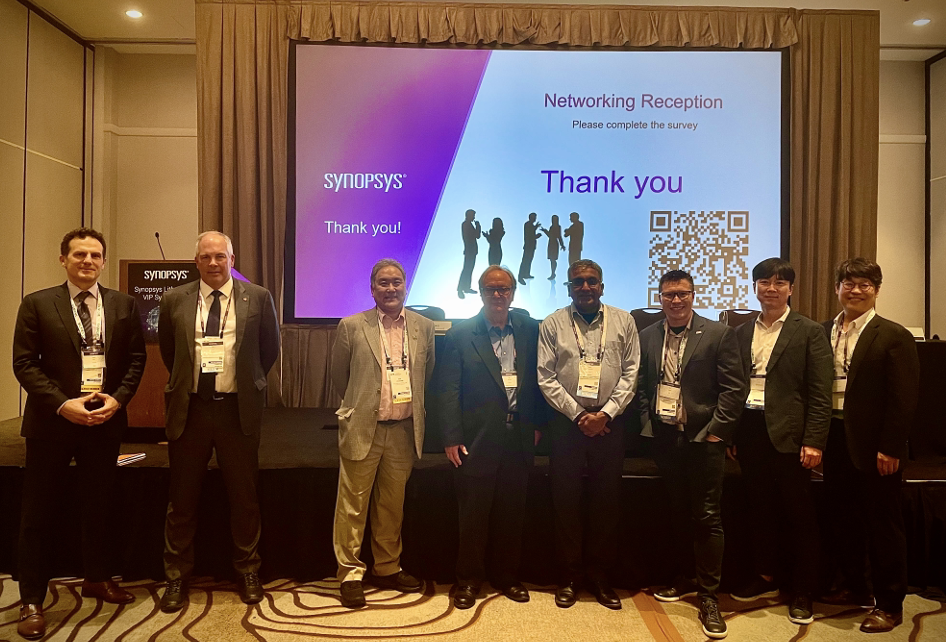
The panelists are shown below.

This is a formidable group of highly technical and very smart people. When we were done with the introductions, I resisted the temptation to say, is there a doctor in the house? The comments these panelists made over the course of about an hour taught me a lot and gave me great hope for the future.
The Discussion
To kick things off, I asked, What are the most valuable applications in mask solutions and design enablement that AI and GPUs can unlock? I specifically referenced GPUs in the question. Advanced hardware is the key to making all AI relevant in the real world and I wanted to introduce that reference early.
Kent kicked off the panel with a discussion of the exploding complexity of mask requirements, not just at high NA EUV, but also standard EUV and leading-edge immersion technologies. The new structures that are needed for advanced AI create this challenge. He went on to say that these requirements are often unique to each customer design, so the complexity is driven by designs and not fab processes. Managing all this to deliver high precision masks requires a new approach, and that’s where AI and special purpose hardware will be needed to move forward.
Arvind went next, and he focused on how GPUs are used in the mask shop to enable the required, highly complex processes such as optical simulation for mask defect prediction. The challenges here include data complexity of course, but also data consistency. He said it wasn’t possible to imagine dealing with these problems just a few years ago. GPUs have been instrumental in paving the way forward.
As Hyung-Joon spoke, a pattern began to emerge. He also focused on the critical requirements of complexity management. He explained that when he onboards new staff members, he tells them that OPC (optical proximity correction) really stands for optimization, prediction and correction. He went on to discuss some of the substantial challenges advanced technology presents. He felt AI and GPUs hold the key to deal with these challenges. He also discussed functional AI (e.g., things like resist and etch models) and agentic AI (to automate the process).
He felt today that a solid base of functional AI was most important. He mentioned the significant challenges posed by changes such as moving from conventional OPC to advanced inverse lithography technology (ILT) and dealing with stochastic vs. deterministic models. Agentic will add efficiency later.
Dan observed a different aspect of the problem. He discussed the move to 3D design and the substantial challenges required to tame 3D metrology. AI and GPUs again were cited as the way forward. Dan also brought in the importance of collaboration across the supply chain. He pointed out that every company represented on the panel had a piece of the budget required to solve this problem. If the supply chain could collaborate to understand the details of the 3D stack, all involved would benefit and stay in business for a very long time.
Seung-Hune focused on the difficulties of delays in production cycle time. Items such as reticle issues can take a long time (months) to correct. So, using AI and GPUs to increase the maturity of the design would have a significant impact.
Larry stepped back and characterized the problem in a fundamental way. He focused on the requirements of model accuracy in the sub-nanometer range. This physically represents two crystal lattice lengths of silicon. Looking closer, we’re attempting to control many atoms on a layer, all going to the same place at the same time thousands of times per hour. To collect, process and analyze the massive amount of data required to achieve this can only be done with advanced AI algorithms running on the most advanced hardware. He went on to point out that all this information must be shared up and down the supply chain from design to manufacturing. This is the only way to achieve enough understanding of the whole process to make it work.
I provided all the details of these responses to paint a picture of the overall mood of the panel. It was one of substantial reliance on advanced AI and the associated GPU hardware to continue moving forward. That flattens the question of hype vs. reality for AI/ML in mask synthesis. The panel agreed the technology is real and increasingly necessary, particularly at the leading edge.
My second question examined collaboration aspects: What role do partnerships between EDA vendors, fabs, and equipment suppliers play in accelerating AI/ML innovation for mask solutions and design enablement?
The response from all panelists was quite consistent here. The overall sentiment was that complexity drives the need for more collaboration and partnerships are critical. Recall the group already focused on the need for end-to-end analysis of data. This is only achievable with substantial efforts across the supply chain. A more direct way to say this is: what are the pain points you have associated with AI and how can we verify what we are doing? That is, what are we getting out of the AI?
The problem of highly sensitive fab data (think defect density) was also brought up. There was a genuine focus on how to minimize this problem. That is, how to make sure AI models are trained with accurate data. Otherwise, the usefulness of these models is quite limited. Think garbage in, garbage out. Having lived in semiconductors and EDA for many years, the tone of this discussion was quite uplifting for me. This group truly believed that better collaboration is a must to tame the substantial problems before us. I can tell you it wasn’t always like this.
I’ll conclude with the overall response to my last question, How will Al/ML impact mask and lithography workflows over the next five years?
While panelists approached the problem from different parts of the value chain, there was strong alignment on direction and priorities. Impact always starts at the leading edge. There is an overall conservative attitude in this group. The stakes are too high to do it any other way. This means the leading edge will see benefit in the next five years, but broader impact will likely take longer. In terms of the technology, the feeling was that generative AI will enable better understanding of the models and result in a wider impact, and so that will lead the way. Agentic AI will face larger deployment challenges and will come later.
It was a genuine pleasure to lead this panel discussion. I believe we all came away with an optimistic view of the future. A future where the impact of AI was understood and valued, and the importance of collaboration was also understood and valued. Below is a photo of the panel and our executive host from Synopsys, Dr. Kostas Adam (far left).
The Rest of the Session
The Synopsys Lithography VIP Symposium also contained several excellent technical presentations. Here is a summary:
- Enabling the Future: How GPUs are reshaping computational lithography. Michael Lam, Senior Director of Modeling at Synopsys.
- Advances in EUV Mask Manufacturing. Arvind Sundaramurthy, Head of Integration and Yield at Intel.
- The Dimensional Explosion: Navigating Super-Linear Computational Complexity in Semiconductor Scaling. Ryoung-Han Kim, Litho Program Director at imec.
- Automating EDA with AI – Are agents going to replace engineers? Thomas Andersen, VP Engineering, AI and Innovation at Synopsys.
To Learn More
Synopsys offered many presentations at the SPIE Advanced Lithography + Patterning Symposium. You can see a summary of those presentations here. And that’s how Synopsys explores AI/ML impact on mask synthesis at SPIE 2026.
Also Read:
Agentic AI and the Future of Engineering
Ravi Subramanian on Trends that are Shaping AI at Synopsys
Efficient Bump and TSV Planning for Multi-Die Chip Designs
Share this post via:



Comments
There are no comments yet.
You must register or log in to view/post comments.