






As heterogeneous multi-die design becomes more prevalent, the focus on advanced analysis has predictably shifted in that direction. While these challenges are important to overcome, we shouldn’t lose sight of how complete systems are built. Short and long reach communication channels, system-level power management and the all-important PCB are still fundamental building blocks for every complex system.
Siemens Digital Industries Software takes a broad and holistic view of system design, and a recent white paper is a great example of that perspective at work. The paper is titled How long is that trace? and it illustrates the complexity of PCB analysis and why it’s so important to get it right. If you are engaged in delivering complex systems, this white paper provides important information to ensure a successful project. A download link is coming but first let’s examine some of the topics covered when Siemens EDA illuminates the complexity of PCB design.
Getting it Right – Signal Analysis
Measuring and matching propagation delay for complex signal traces is both critical for performance and quite challenging to accomplish. The white paper points out that:
To match the signal propagation time of two traces, PCB designers make the length of the two traces match down to a few thousandths of an inch (mils). While this is a good place to start, other factors influence the delay of the signal.
The impact of how high frequency signals and vias affect propagation delay is discussed in some detail. The piece explains how to use phase angle to calculate trace delay for example. The question is posed:
Since different frequencies propagate at different speeds, how does that speed difference affect a digital signal that is not a sine wave?
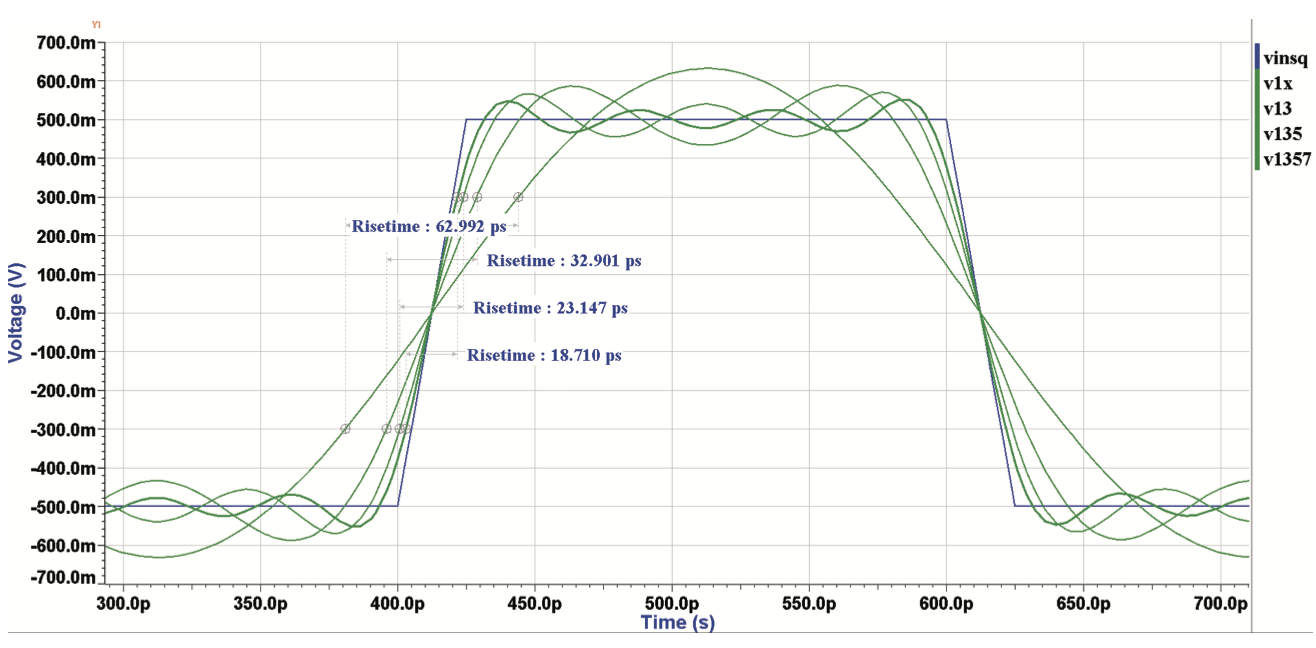
Fourier analysis is used to show how digital signals containing high frequency components are affected by the interconnect. The relationship of magnitude and phase is discussed across a spectrum of the harmonic frequencies of the signals involved. The figure below is an example of a plot to examine the composition of a digital signal. There is a lot more to getting this right than you may think. This white paper does a great job explaining what’s involved.
Getting it Right – Via Design
The white paper also discusses how vias impact the edge rate and thus the trace delay. The piece explains an important point related to this issue:
If vias passed all frequencies of a signal equally, their impact would not be as significant. But vias impact some frequencies more than others, so via characteristics also affect signal delay.
There is a lot of rich and relevant detail presented regarding how via design impacts trace delay. Slightly different via geometries are analyzed in detail. It turns out that via geometry can have significant and non-intuitive impact on overall trace delay and thus overall system performance.
Again, frequency analysis and harmonics play a role in finding the right answers. The impact of various via return paths are also examined. The detail presented will get your attention.
To Learn More
After reading this white paper you will realize that copper length is not the only factor impacting the performance of a PCB trace. It is pointed out that vias have an inherent delay due to their span, but other characteristics add delay and distortion to the signal. The bottom line is the time it takes a signal to rise above the switching threshold at the driver to the time it takes to cross the switching threshold at the receiver.
Edge rate is key. The piece points out that the signal edge is composed of a fundamental sine wave and multiple higher frequency harmonics, all of which must have a certain amplitude and phase to reproduce the signal. When you want to know what the final performance will be, using a simulator is the best way. To find out more about this important system level analysis and optimization process download your copy of the Siemens Digital Industries white paper here. And that’s how Siemens EDA illuminates the complexity of PCB design.
Also Read:
Siemens and NVIDIA Expand Partnership to Build the Industrial AI Operating System
Automotive Digital Twins Out of The Box and Real Time with PAVE360
Addressing Silent Data Corruption (SDC) with In-System Embedded Deterministic Testing
Share this post via:



Comments
There are no comments yet.
You must register or log in to view/post comments.