






There is a new breed of EDA emerging. Until recently, EDA tools were focused on building better chips, faster and with superior quality of results. Part of that process is verifying and debugging the resultant design. Thanks to ubiquitous AI workloads and multi-chip architectures, the data to be verified and debugged is exploding, along with the scope of the specs and test plans. The size of the resultant datasets and the complexity of the relationships to be explored is a task that is simply too large for a design team of any size to handle in a time frame of relevance.
As observed by me and many others, AI turns out to be the problem and the solution for several classes of problems. This is one of them. A new company called Bronco AI focuses on end-to-end design verification with a new breed of AI that can be deployed in an existing design flow and alleviate the verification problem on day 1. No lengthy startup. Bronco’s technology can tackle a specific problem and easily scale for the entire enterprise. And the technology gets better over time in a unique way that protects the customer’s proprietary design knowledge.
I recently had the opportunity to get an overview of what Bronco AI can do, along with a live demonstration. This discussion was truly a new and unique experience. Superhuman AI for design verification, delivered at scale.
Here are some of the details of what I learned.
Who is Bronco AI?

I spoke with David Zhi LuoZhang, co-founder & CEO of Bronco AI. David has a computer science degree from the University of Pennsylvania and an economics degree from The Wharton School. Before co-founding Bronco AI, David was working on AI Fighter Jets at Shield AI, training human-beating F-15s and F-16s on efficient hardware. He then turned down a role at SpaceX working on Starlink embedded algorithms to start Bronco AI. David is something of a renaissance person. He has a knack for seeing problems differently from the rest of us and developing unexpected solutions. I thoroughly enjoyed our meeting.
As I mentioned, Bronco accelerates the end-to-end design verification flow, from specification analysis to verification planning, test bench bring-up, and simulation debug. This process represents a combination of complex planning tasks in the early design phase and a series of highly complex analysis and debug tasks as the design matures. The time and effort required for this work is substantial. Some of the debug tasks require highly detailed analysis of massive data sets with huge numbers of subtle interactions. Bronco has focused on a very real problem here.
Before getting into the demo, I explored some of the things that make Bronco AI unique with David. An important one is securing the customer’s IP. David explained that Bronco’s customers have invested substantial resources building proprietary AI models and flows. These capabilities represent the company’s competitive edge and so must be protected behind the company’s firewall. David went on to point out that Bronco’s tools can operate in the customer’s environment and Bronco never trains on the customer’s data. This approach ensures private data stays private.
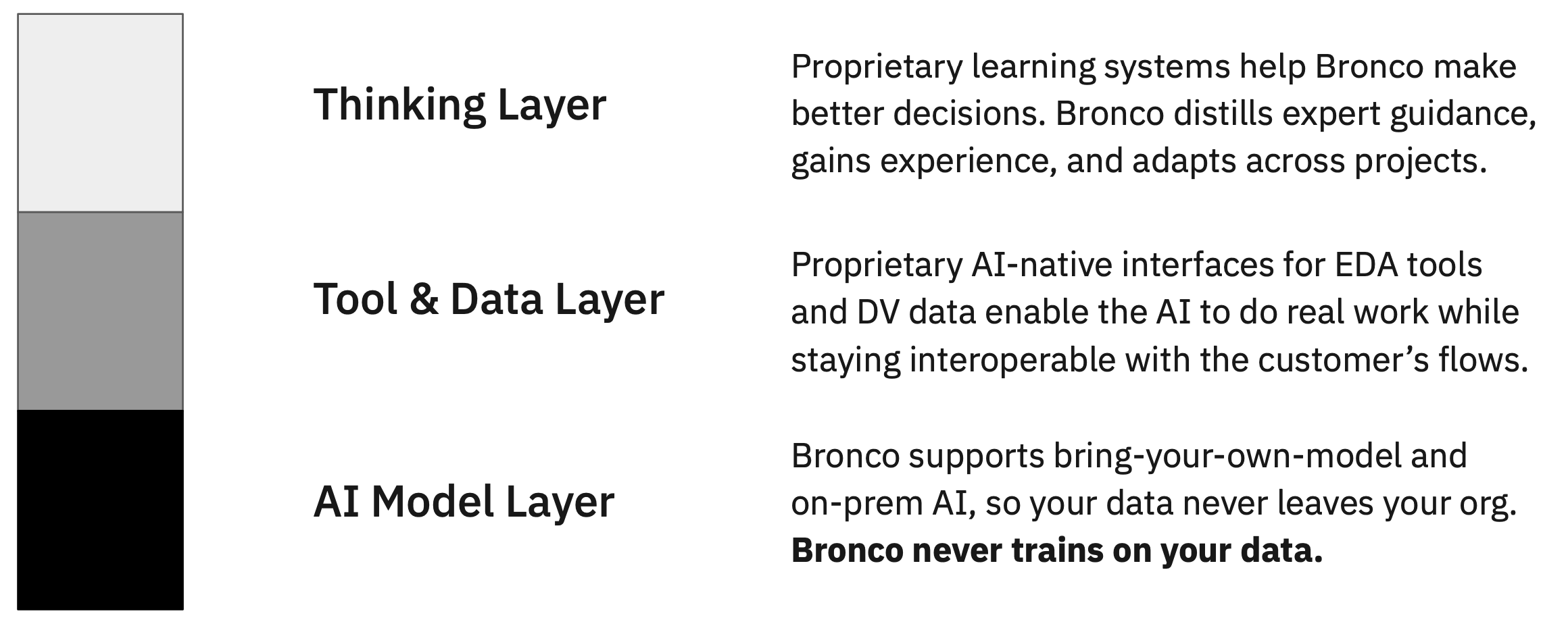
Another one is that Bronco’s platform continues to learn and improve as it solves more problems, making it more powerful and valuable over time, just like an expert human design verification engineer, but far more scalable. David explained that Bronco’s architecture facilities this learning and scalability.
A common AI foundation and a unified data model help the system to learn by optimizing the parameters that control the AI for the specific problems of a given customer. This optimization is unique for each customer and is shared across all the tools in the platform. This adaptability is quite challenging to accomplish in the context of agentic AI systems. It turns out that both David and his co-founder Jeffrey Pan had previously done research on interpretability and robustness of AI algorithms. This background is the foundation for some of Bronco AI’s differentiation.
The diagram below provides some visibility into the how the AI agents are organized, enabling the system to improve over time, easily bolt into existing flows, and protect the customer’s sensitive data along the way.
David also explained another important attribute of how Bronco’s tools are used. The system doesn’t take the quality of design data for granted. Rather it can analyze and improve the quality and completeness of all inputs before they are used for subsequent training and optimization. This is the AI era version of preventing garbage in, garbage out.
The Demo
The demo illustrated how Bronco AI performs debug. David explained that debug is one of the most complex and data intensive parts of design verification. So, this is a good pressure test of the entire system.
The example design was an open-source network on chip (NoC) application. David explained that some of Bronco’s customers have similar subsystems or use the same standards in their designs, so a real, mainstream application was being debugged. He began by describing the high-level process Bronco AI uses to perform debug.
All of the existing information about the design is presented to the tool – simulation runs, waveforms, logs, design files, specs, etc. and a description of the problem. This is communicated easily in natural language. Bronco AI then makes a playbook of how it will approach the debug task
This playbook is quite detailed and provides substantial documentation about the design and its issues. The tool then analyzes observed behavior, looking for anomalies and potential root causes. The playbook informs a lot of this work. The system continues its work until either a root cause is found, or the problem is localized to the point where a ticket can be created to point an engineer to the location requiring further analysis. This process is summarized in the diagram below.
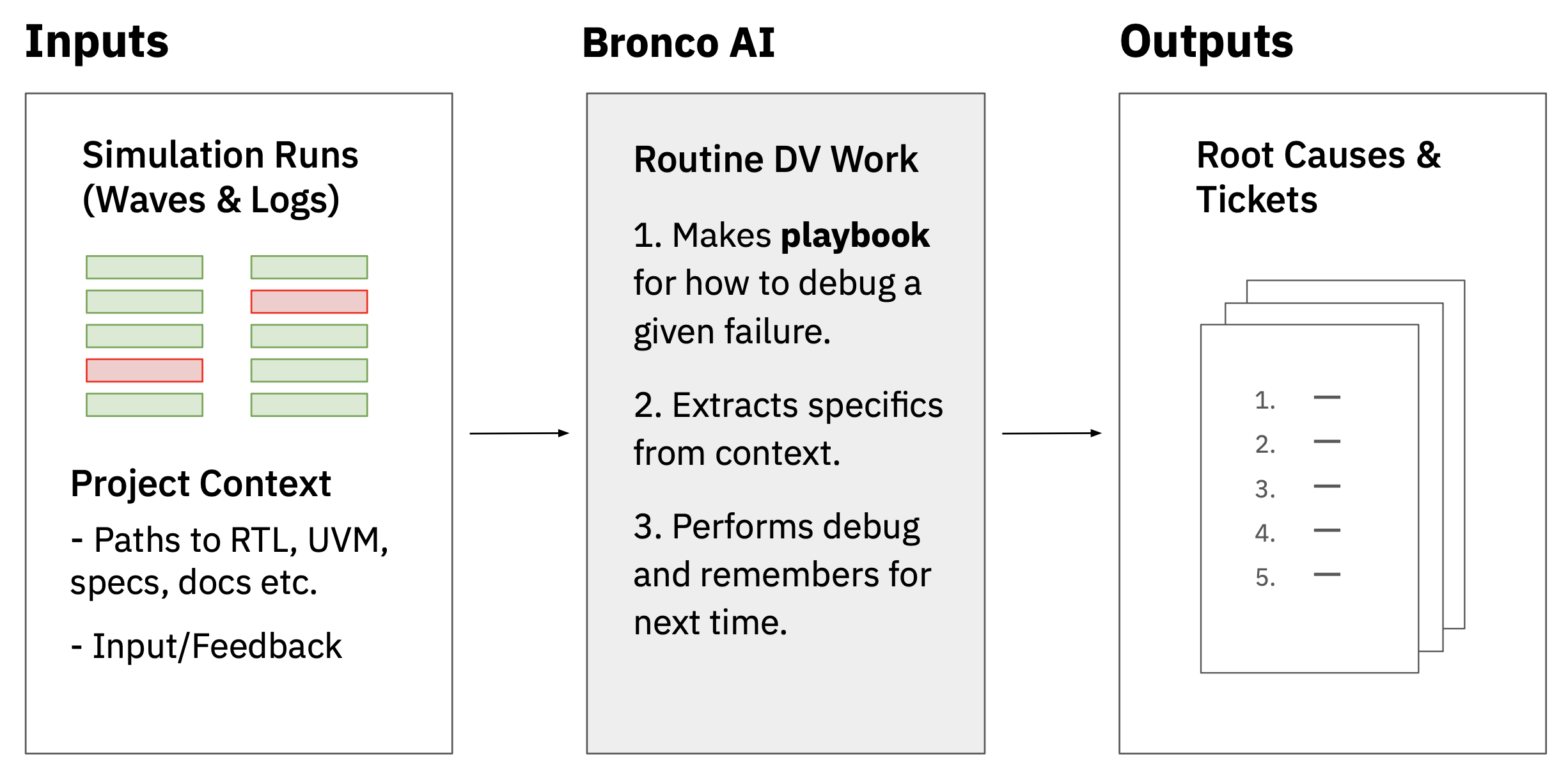
The specific debug task was to find the reason for a time-out that was observed in a regression run. David explained that this bug was chosen since time-out problems are particularly difficult to debug since they provide very little information. David specified the location for the design files (the Inputs block above) in then simply typed:
Why is my NoC hanging/timing out? Please debug.
I then watched as the tool built a detailed playbook of how to approach the debug task. There was clearly a lot of analysis going on in real-time regarding elements such as router blocks, network interfaces and hand-shaking protocols. The tool continued to analyze the circuit in greater detail, running multiple processes in parallel.
After about 25 minutes of elapsed time, the tool localized the root cause and presented three best explanations that covered both testbench and RTL issues. David explained the tool indeed got the right answer in its list of explanations.
Without a tool like this, the design team would come to work after a night of regression runs and begin sifting through mountains of data to find the anomalies and begin the debug process. This contrasts with arriving at work and being presented with a detailed playbook for each problem found and a localized root cause for each problem. At that point, the power of this tool became quite clear to me.
David shared a quote from one of Bronco’s customers, etched, a well-funded startup building data center AI ASICs on TSMC 4nm. That really drove home the value.
“Bronco helps our DVs get a head start on their work and helps us bank institutional knowledge, automate tasks and elevate DVs to be like scientists.”
To Learn More
If you want to elevate your design verification team to improve design quality and time-to-market, you should seriously consider adding Bronco AI. This tool will vastly improve your design verification efficiency and quality and get better at it over time.
You can request your own private demo and see the tool for yourself. Just go to the Bronco AI webpage and click on Request a Demo in the upper right. And that’s how you can get superhuman AI for design verification, delivered at scale.
Share this post via:



Comments
There are no comments yet.
You must register or log in to view/post comments.