





As artificial intelligence systems become larger and more demanding, memory is becoming one of the most important constraints in server design. Modern AI workloads do not only require powerful GPUs and accelerators; they also require enormous amounts of data to move quickly and efficiently between memory and compute engines. Every transfer of model weights, activations, and key-value cache data consumes power. As a result, memory bandwidth and memory power efficiency are now central concerns for data center architects.
SOCAMM2, or Small Outline Compression Attached Memory Module, is emerging as a practical answer to this challenge. It brings the advantages of LPDDR5X memory into a form factor better suited for servers. LPDDR has traditionally been used in mobile devices because it provides high bandwidth at low signaling voltage, reducing the amount of power needed for each bit transferred. These characteristics are attractive for AI workloads, where bandwidth and energy efficiency often matter as much as raw compute performance.
However, traditional LPDDR creates a problem in server environments because it is usually soldered close to the processor. That approach can work well in compact consumer electronics, but it limits flexibility in the data center. If soldered memory fails, the entire board may need to be replaced. Capacity is fixed at manufacturing time, which makes supply planning less flexible and prevents upgrades later in the system’s life. Repairs can require more downtime, more labor, and higher operating costs.
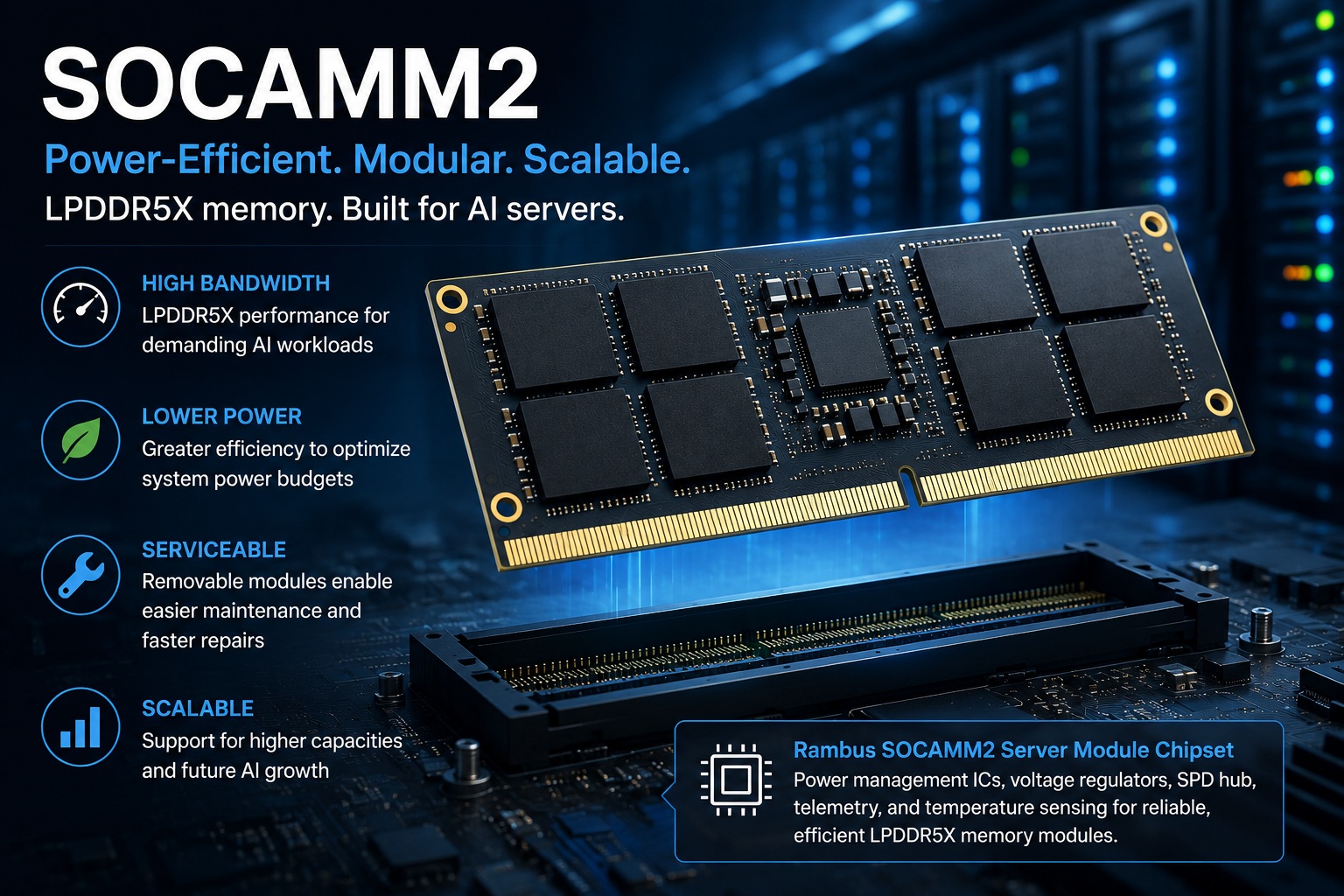
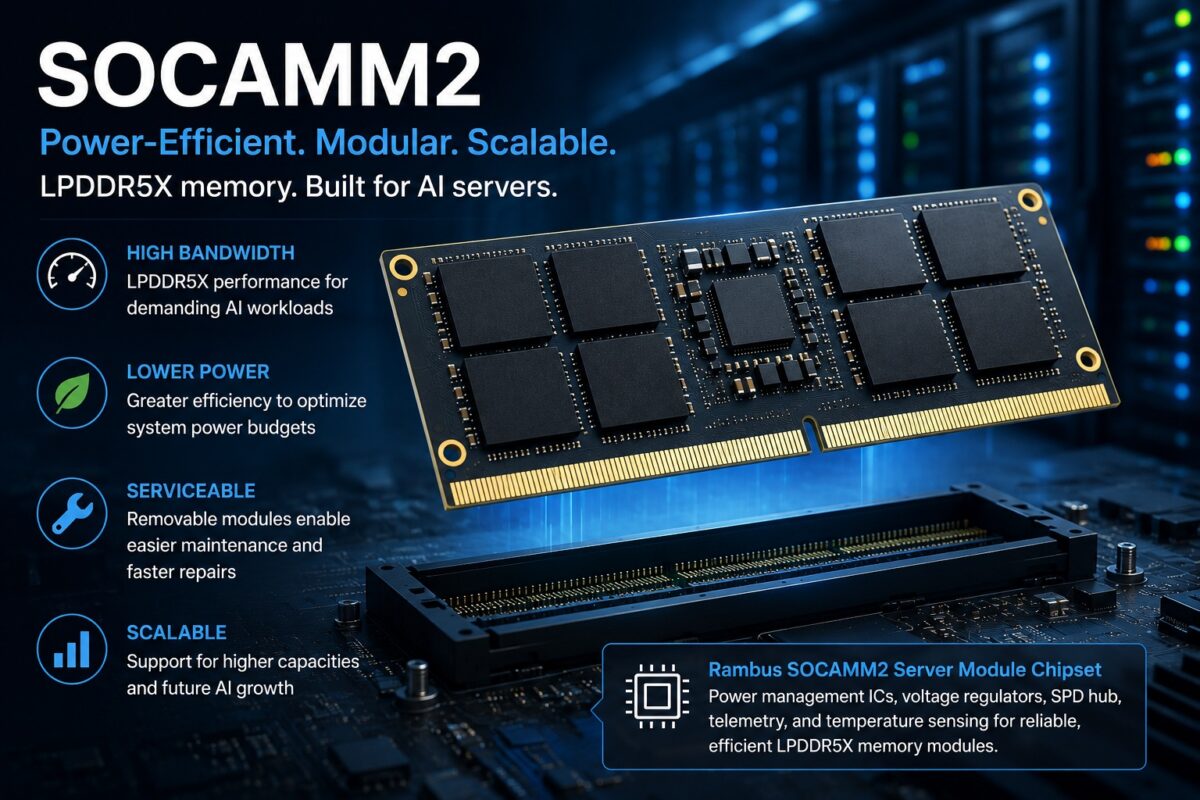
SOCAMM2 addresses these limitations by placing LPDDR5X on a removable, server-grade module. Instead of permanently attaching memory to the motherboard, system designers can use a modular architecture while preserving many of LPDDR’s performance and efficiency benefits. The module sits flat on the motherboard and uses a compression-attached design, helping support signal integrity while fitting within the tight physical and electrical requirements of AI servers.
The benefits are especially relevant for scalable AI infrastructure. First, SOCAMM2 offers high bandwidth with lower power consumption compared with more traditional server memory approaches. That matters because power budgets in AI systems are already stretched by accelerators, networking, cooling, and storage. Reducing memory power can help improve system-level efficiency and may allow designers to allocate more power to compute.
Second, SOCAMM2 improves serviceability. A failed memory module can be replaced without discarding the entire board, reducing downtime and simplifying maintenance. In large data centers, even small improvements in repairability can have meaningful operational and cost benefits.
Third, SOCAMM2 supports scalability. AI systems need increasing memory capacity around processors and accelerators, but signal integrity becomes harder as designs grow more complex. SOCAMM2 is intended to support larger and more flexible memory configurations while maintaining the electrical characteristics needed for reliable operation.
Fourth, the flat module design can improve cooling options. AI servers generate significant heat, and memory placement affects airflow and liquid-cooling design. By using a compact compression-attached form factor, SOCAMM2 can help designers create more efficient thermal layouts.
Rambus supports this ecosystem with a SOCAMM2 server module chipset. Its offering includes on-module power management ICs, voltage regulators optimized for LPDDR5X, an SPD hub for configuration and presence detection, telemetry support, and integrated temperature sensing. Together, these components help module makers and server designers build reliable, power-efficient SOCAMM2 memory solutions.
The broader significance of SOCAMM2 is that it combines two goals that have often been difficult to achieve together: LPDDR-style efficiency and data-center-grade modularity. For AI servers, this combination can improve power efficiency, reduce total cost of ownership, simplify repairs, and give system designers more flexibility as model sizes and memory requirements continue to grow.
Ask the Experts: SOCAMM2 Server Memory Module Chipsets
Also Read:
Rambus Delivers Complete DDR5 Client Chipset for High-Speed CUDIMM and CSODIMM Memory Modules
WEBINAR: HBM4E Advances Bandwidth Performance for AI Training
How Memory Technology Is Powering the Next Era of Compute
Share this post via:



Comments
There are no comments yet.
You must register or log in to view/post comments.