





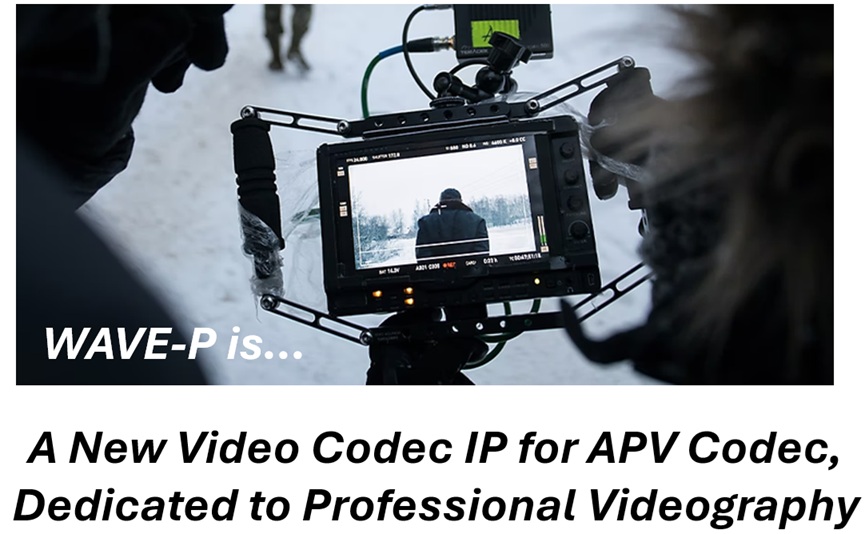
Professional video workflows demand a difficult combination of image quality, editing responsiveness, high throughput, and manageable silicon cost. Chips&Media’s WAVE-P addresses that combination as a dedicated hardware IP core for the Advanced Professional Video, or APV, codec. Designed for professional and prosumer imaging systems, WAVE-P brings APV encoding and decoding into a compact, low-power implementation suitable for cameras, mobile devices, production equipment, and media-processing systems-on-chip.
APV is an intra-frame codec, meaning each frame is coded independently rather than relying on references to earlier or later frames. This is important in editing because systems can seek, cut, decode, and re-encode individual frames without reconstructing a long group of pictures. The codec targets perceptually lossless quality, supports chroma formats from 4:2:2 to 4:4:4, and handles high bit depths from 10 to 16 bits. It also supports HDR10, HDR10+, extensible metadata, multiview content, and auxiliary planes such as depth and alpha. According to the supplied material, APV delivers an average 19.3 percent BD-rate improvement over a conventional professional video codec in tested 2K and 4K 4:2:2 sequences.
WAVE-P implements this codec in hardware with both encoding and decoding support. A single core is specified for 8K video at 30 frames per second at 500 MHz in a 4:4:4 12-bit profile. The design supports APV profiles including 4:0:0, 4:2:2, and 4:4:4 at 10 bits, plus 4:2:2 and 4:4:4 at 12 bits. It also supports OpenAPV constant-bit-rate and constant-frame-rate encoding, input and output dimensions up to 64K by 64K, and integrated functions such as color-space conversion and cropping.
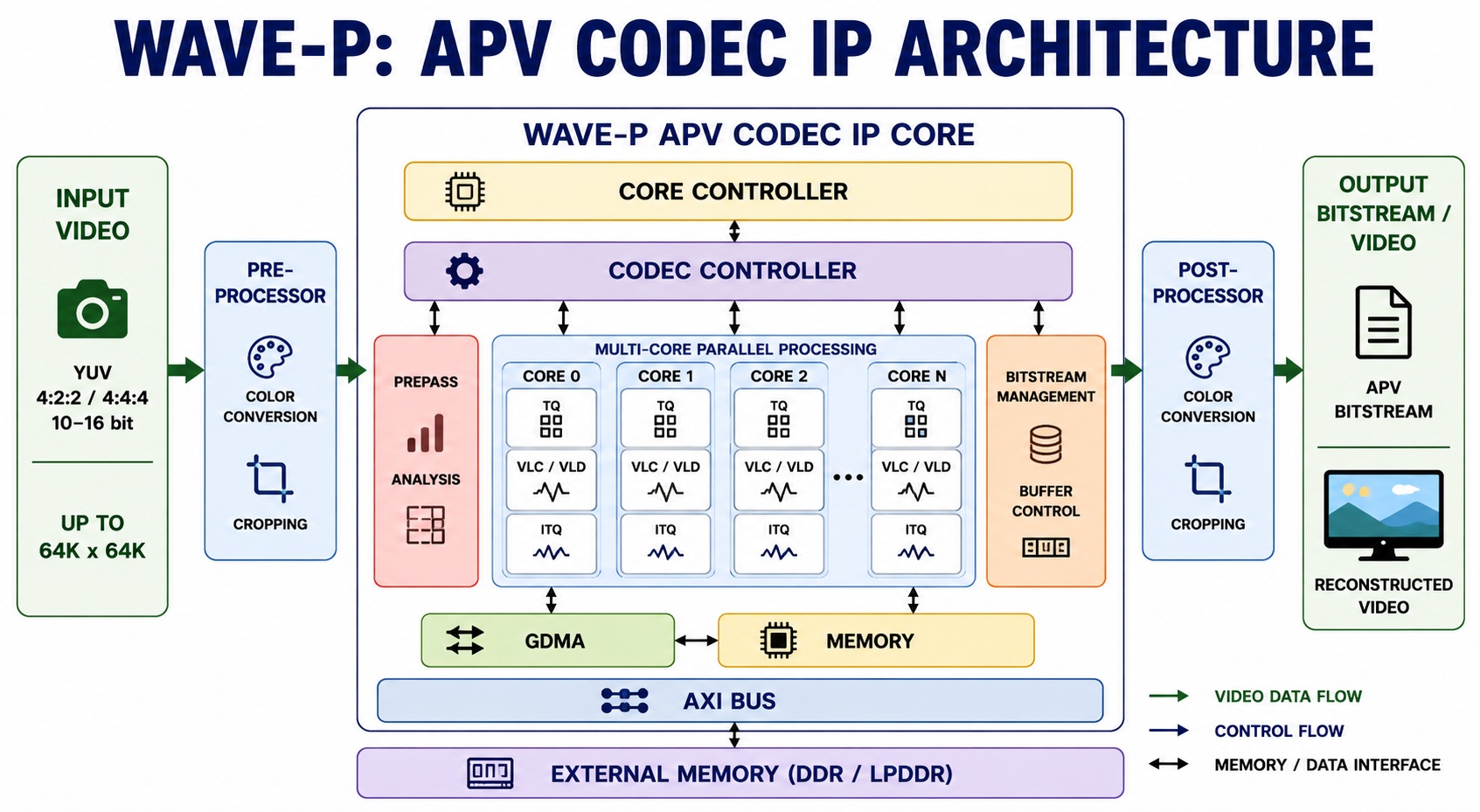
Architecturally, WAVE-P combines a core controller, codec controllers, transform and quantization engines, variable-length coding and decoding blocks, bitstream buffering, DMA, preprocessing, and post-processing. Its multi-core scalability and tile-based processing are especially relevant for high-resolution workloads because tiles can be processed in parallel. This allows system designers to increase throughput without redesigning the entire pipeline.
The architecture also minimizes host-CPU involvement, reducing software overhead and freeing general-purpose processors for application logic, user interfaces, or AI tasks. Flexible pixel layouts for YUV, RGB, and ARGB further simplify integration with image sensors, display pipelines, graphics engines, and existing memory architectures. Future profile support is anticipated for additional bit depths, protecting SoC designs against evolving production requirements. That flexibility can extend product life and reduce redesign costs.
The performance figures are notable. At 500 MHz, simulated encoding throughput reaches approximately 1.07 gigapixels per second for 4:4:4 video in one sample format, while decoding reaches roughly 1.05 gigapixels per second. For 7680-by-4320 video, the reported results are about 32 frames per second for 4:4:4 encode and decode, meeting practical 8K30 requirements. Power estimates are approximately 14.7 mW for encoding and 14.6 mW for decoding under the stated 7 nm test conditions. The full codec configuration is estimated at 657,000 logic gates plus 12.93 KB of memory, for a total equivalent area of 887,000 gates.
Why does this matter? Professional-quality video is moving into smaller, battery-powered devices, while resolutions, frame rates, color fidelity, and metadata complexity continue to increase. Software-only processing can struggle to sustain these workloads efficiently. A dedicated codec engine provides predictable real-time performance, lower energy per frame, and reduced memory and CPU pressure.
Bottom line: WAVE-P represents more than a faster codec block. It is an enabling technology for 8K cameras, smartphones, broadcast systems, immersive media, and cloud-edge production tools that need high-quality intermediate video without the cost and inefficiency of traditional professional formats. By combining APV’s editing-friendly compression with scalable hardware acceleration, WAVE-P could help make professional-grade capture and post-production capabilities practical across a much broader range of devices.
Also Read:
Chips&Media Strengthens Codec Leadership With Next-Gen AV2 Licensing Deal
Chips&Media’s Next-Generation Video CODEC IP Powers Ambarella’s Expanding Edge AI Portfolio
CFrame60: Rewriting the Rules of Frame Compression
Share this post via:



Comments
There are no comments yet.
You must register or log in to view/post comments.