Array
(
    [content] => 
    [params] => Array
        (
            [0] => /forum/threads/ai-starting-to-hit-office-space-market.24540/
        )

    [addOns] => Array
        (
            [DL6/MLTP] => 13
            [Hampel/TimeZoneDebug] => 1000070
            [SV/ChangePostDate] => 2010200
            [SemiWiki/Newsletter] => 1000010
            [SemiWiki/WPMenu] => 1000010
            [SemiWiki/XPressExtend] => 1000010
            [ThemeHouse/XLink] => 1000970
            [ThemeHouse/XPress] => 1010570
            [XF] => 2030970
            [XFI] => 1060170
        )

    [wordpress] => /var/www/html
)

AI starting to hit office space market

Arthur Hanson

Well-known member
AI is just starting to lower the demand for office space market as it's starting to replace people. This is just the very beginning of changes AI is going to make in just about every aspect of the world as we know it. Any thoughts, comments or additions sought and welcomed.
 
AI is just starting to lower the demand for office space market as it's starting to replace people. This is just the very beginning of changes AI is going to make in just about every aspect of the world as we know it. Any thoughts, comments or additions sought and welcomed.
So if AI is replacing people and lowering the amount of people in jobs, then employment (not unemployment) must be down. How much has the number of people employed decreased since 2023?
 
So if AI is replacing people and lowering the amount of people in jobs, then employment (not unemployment) must be down. How much has the number of people employed decreased since 2023?
perhaps a too early optimistic view, how many new category of jobs created by AI enabled work flow
 
So if AI is replacing people and lowering the amount of people in jobs, then employment (not unemployment) must be down. How much has the number of people employed decreased since 2023?
Here's a one year perspective from BLS. Most every industry shed employees YoY or remained flat, except for "Private Education and Healthcare", and "Leisure and Hospitality". Both those are total laggards in AI and the least automated. But I'm pretty sure that WFH / COVID already laid a big hit on office space demand, through we're beginning to see it reshape in a new post-COVID model.

employment-change-by-ind.png
 
If offices are not needed, what happens to the value of the land?

That would impact a lot of budgets if suddenly no takers.

Here in Singapore "office space" and the building and renting of such is a big part of the economy. We shall see if there is actually any impact at all.

At the minute , I dont see any.
 
Less office space needed might be real. But Employement is not down.

I think we do have to be watchful of the jobs numbers, especially with deportations, and revisions to jobs numbers because many of the survey techniques used pre-COVID aren't working as well anymore. Plus we have to be very aware of specific industry demographics - almost al the growth in the January "bonanza" came from healthcare.
Screenshot 2026-02-13 at 9.25.02 AM.png
 

From Software to Real Estate, U.S. Sectors Under the Grip of AI Scare Trade​

Feb 13 (Reuters) - Wall Street is in the grip of disruption worries from AI. ⁠It ⁠first started with investors dumping shares of software companies but ⁠soon spread to sectors seen as vulnerable to automation, driving sharp losses in U.S. stocks this week.

The AI scare trade did not spare even sectors such as private credit, real estate brokers, data analytics, legal services and insurers.

Global tech stocks took the hit after Anthropic unveiled a legal AI plug-in. But soon the investor unease deepened following a flurry of AI model ‌upgrades and fresh releases.

"With fear driving market sentiment, investors remain ‌in 'sell first think later' mode, asking 'who is next' and showing no mercy for anything remotely seen as an AI loser," Barclays equity strategist Emmanual Cau said.

Here's a look at how various sectors were impacted by the ⁠selloff:

The ⁠S&P 500 Software & Services index has lost about $2 trillion in value since its peak in October. Half of the losses came in the past two weeks, on concerns that fast-advancing AI tools could upend traditional subscription and enterprise tools.

So far this year, the worst-performing Nasdaq 100 stocks include Atlassian down 47%, Intuit down 40% and Workday, which has lost a third of its value.

 
BTW, my anecdotal view on Silicon Valley commercial tells me that we're in weird in‑between moment: a lot of empty space and painful write‑downs due to WFH and headcount reductions on one side, but also targeted bets on top‑tier offices and big housing/mixed‑use conversions on the other.

* Vacancies and discounts
Office vacancy is now in the mid‑ to high‑teens, and total availability (including sublease) is over 20%—the highest since the dot‑com era. Older, generic office buildings are getting hit hardest, with owners taking real haircuts while better‑located, newer campuses hold up comparatively better. At the same time, cash‑rich giants (Apple, NVIDIA, others) are quietly scooping up space near their existing hubs at much lower prices than a few years ago.

* Flight to quality and HQ gravity
Many big companies like Apple and NVIDA are consolidating into their strongest nodes, not spreading out; Santa Clara and Sunnyvale‑Cupertino Class A space is expected to recover faster than the broader market. Yet AI‑heavy firms, like NVIDIA and OpenAI, are also adding “outrigger” offices in places separated from the main campuses, like San Francisco and Mountain View mainly to reach talent.

* From office parks to places to live
On the land‑use side, the big action is conversion. Formerly all‑commercial areas—Google’s North Bayshore, SRI in Menlo Park, and the USGS campus site in Menlo Park—are being reimagined as mixed‑use districts with substantial housing layered onto former job‑only land. Other sites are going further and dropping office altogether: parts of Whisman in Mountain View, 68 Willow in Menlo Park, and CityView Plaza in downtown San José are pivoting from office to 100% residential, especially near transit.

In short, the Valley is shedding a lot of mediocre office space, doubling down on a few best‑in‑class buildings, and quietly turning a surprising amount of old commercial land into housing and mixed‑use neighborhoods.

 
From what I am seeing, it's a tough job market for software engineers and creative professions. But on the other side of the coin, I'm hearing that things have almost never been better for electricians, plumbers, and HVAC technicians - in part due to the data center boom.
 
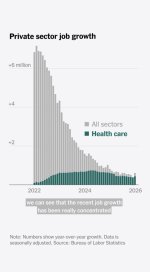
One more view on just the private sector. So the only type of commercial real estate likely to see occupancy pressure is doctors offices, clinics and hospitals.
 

Attachments

  • IMG_0379.jpeg
    IMG_0379.jpeg
    109.3 KB · Views: 7
exactly. History tells us that the Jobs change, they do not go away. But since people keep saying jobs are going away, I think they should show the actual data.
AI definitely feels like "the second computer revolution". Remember how unemployment has been 50% since computers took over the world and replaced jobs in the 70s, 80s, and 90s? me neither.
 
Back
Top