





Array
(
    [content] => 
    [params] => Array
        (
            [0] => /forum/threads/why-intel-still-trails-tsmc-in-the-high-stakes-foundry-race.25161/
        )

    [addOns] => Array
        (
            [DL6/MLTP] => 13
            [Hampel/TimeZoneDebug] => 1000070
            [SV/ChangePostDate] => 2010200
            [SemiWiki/Newsletter] => 1000010
            [SemiWiki/WPMenu] => 1000010
            [SemiWiki/XPressExtend] => 1000010
            [ThemeHouse/XLink] => 1000970
            [ThemeHouse/XPress] => 1010570
            [XF] => 2031070
            [XFI] => 1060170
        )

    [wordpress] => /var/www/html
)

Why Intel Still Trails TSMC In The High Stakes Foundry Race

Daniel Nenni

Founder
Staff member
1779831277694.png


Intel (INTC) shares have surged 3x year-to-date due to increasing CPU demand and heightened optimism regarding its foundry operations. Investors are starting to recognize Intel Corporation as more than just a cyclical PC manufacturer. The market is beginning to factor in the likelihood that Intel could become a significant alternative source for cutting-edge semiconductor production, alongside Taiwan Semiconductor Manufacturing Company.

A portion of this optimism is driven by geopolitical factors.

Both governments and hyperscalers are keen on establishing more advanced chip fabrication within the United States, especially for AI infrastructure and military-related computing. Intel’s manufacturing presence positions it centrally within that transition.

However, being situated in the U.S. has its limitations.

The critical factor is whether Intel can compete effectively on technology, yields, manufacturing scale, and production economics. More crucially, can Intel establish itself as a foundry that major external clients can depend on consistently for leading-edge nodes?

A rule-based investing strategy provides the objective framework necessary to navigate volatile turnaround stories like Intel, safeguarding portfolios against steep foundry execution and yield risks through systematic, data-driven asset allocation.

Intel Has Closed The Technology Gap

Intel’s 18A process signifies the company's most significant manufacturing advancement in years, which is a major factor in the increasingly positive perceptions toward the foundry business. Throughout much of the last decade, Intel was seen as structurally trailing TSMC in advanced chip manufacturing.

This gap has now narrowed considerably.

Intel’s latest manufacturing technology aims to enhance chip performance while reducing power consumption—two critical metrics in AI infrastructure and advanced computing systems where energy and cooling expenses are becoming significant constraints.

While TSMC still has a lead in manufacturing efficiency and transistor density, enabling clients to create smaller and more energy-efficient chips, Intel’s forthcoming 14A process is anticipated to adopt next-generation High-NA EUV lithography prior to TSMC’s equivalent future nodes. If executed properly, this could provide Intel with a temporary technological edge at the forefront, despite substantial execution risks.

Scale And Customer Confidence Still Favor TSMC
The financial and operational disparity between the two foundries is still vast.

TSMC reported $35.9 billion in foundry revenue in the first quarter of 2026, juxtaposed with Intel Foundry’s $5.4 billion. Nearly all of TSMC’s revenue was sourced from external clients, while Intel Foundry earned only about $174 million from outside customers, accounting for roughly 3% of total foundry revenue. The remainder primarily reflects Intel manufacturing chips for its internal product divisions.

This distinction is crucial because foundry economics benefit from scale, utilization, and customer diversity. TSMC’s operating margin reached 58.1% in the quarter, bolstered by a high demand for advanced AI and high-performance computing chips. Technologies at 7nm and below represented approximately 74% of TSMC’s wafer revenue, with 3nm alone contributing 25%.

Scale also reinforces TSMC’s manufacturing ecosystem. The company operates at a significantly larger scale, with capacities covering manufacturing, packaging, IP libraries, and customer integration developed over decades. Its execution track record and mature yields have established it as the industry’s default manufacturing partner for Apple (AAPL), Nvidia (NVDA), AMD (AMD), and Qualcomm (QCOM).

Intel is operating in a very different phase of its cycle. The company is still managing substantial fab construction and tooling expenses while increasing advanced-node production. The foundry division recorded a loss exceeding $10 billion in the last quarter. In comparison, Intel Foundry remains considerably smaller, even with significant investments in Arizona and other U.S. facilities.

Yield Is The Crucial Test
Leadership in technology alone does not dictate foundry success. Yield and execution are more critical.

Yield measures the percentage of chips on a wafer that operate correctly after manufacturing. At advanced nodes, wafers can surpass $30,000 before the packaging and testing phases, indicating that even slight yield variations can significantly influence profitability.

Intel’s 18 A yield reportedly rose from around 50% to 55% by mid-2025, with internal aspirations of reaching 65% to 70% by year-end. TSMC’s N2 yields were estimated at approximately 65% and climbed to around 70% by early 2026, with anticipated maturity yields of about 75%.

This 10 to 15% point difference is commercially important because higher yields reduce the cost per usable chip. For clients, improved yields can also mitigate production risks and enhance the reliability of scaling large AI deployments on schedule.

The Bottom Line
Business expectations remain exceptionally high. Intel’s price-to-sales ratio has soared from roughly 1.6x a year ago to almost 10x currently, reflecting increasing investor assurance that the company can serve as a credible second source for advanced semiconductor manufacturing in the United States. However, maintaining this optimism will necessitate more than a restored technology strategy. (See how Intel’s margins compare with peers) Intel must now demonstrate its capacity to manufacture advanced chips at scale, with competitive yields, trustworthy execution, and the consistency that major customers expect from a premier foundry.

 
Intel’s 18 A yield reportedly rose from around 50% to 55% by mid-2025, with internal aspirations of reaching 65% to 70% by year-end. TSMC’s N2 yields were estimated at approximately 65% and climbed to around 70% by early 2026, with anticipated maturity yields of about 75%.
This is a little incorrect. Obviously the % depends on design and chip size etc. But the yields were obviously below 50-55% in mid 2025. LBT mentioned that yields increased significantly between May 2025 and May 2026 and is now on track for target yield by end of 2026

Intel will solve the yield challenges.... now they need to solve the volume challenges (which is much harder). forcing people off Intel 7 to 18A is a good start (Wildcat will help). I believe the inflection point in the ramp is this quarter.... so we will also see the impact on financials for IFS

Quiz: if die yields are low, does that affect IFS margins or product group margins .... assuming Intel follows accounting they presented a few years ago?
 
This is a little incorrect. Obviously the % depends on design and chip size etc. But the yields were obviously below 50-55% in mid 2025. LBT mentioned that yields increased significantly between May 2025 and May 2026 and is now on track for target yield by end of 2026

Intel will solve the yield challenges.... now they need to solve the volume challenges (which is much harder). forcing people off Intel 7 to 18A is a good start (Wildcat will help). I believe the inflection point in the ramp is this quarter.... so we will also see the impact on financials for IFS
this is quite difficult considering the delays in DCAI roadmap if DMR/CWF launched on time that would have helped.
Quiz: if die yields are low, does that affect IFS margins or product group margins .... assuming Intel follows accounting they presented a few years ago?
Well you can sell binned die for lower cost and max out your wafer utilization some money is better than no money and offset some loss of the margin.
 
Last edited:
I give my opinion to these statements
This gap has now narrowed considerably.
Nope the gap is not only narrowed but is widen into Intel's favour, Intel 18A will be in every measure better than TSMC N2 (timing - 6 months ahead, Yield (look at Macbook Neo for N3E i.e. N3E initial yield is <60%, Density still 0.021um^2 with BSPD advance, Power BSPD, performance (switch speed) nmos and pmos GAA not only nmos GAA vs N2) In my opinion, with limited transistor count increase, the Lunar Lake with a integrated RAM advantage and Panther Lake is still outperforming N3B by ~15%.

enhance chip performance while reducing power consumption—two critical metrics in AI infrastructure and advanced computing systems

Nope, Looking at the increase battery life of laptop, as a customer, reducing power consumption is not only for advance computing, it is a computing is general improvement


Scale And Customer Confidence Still Favor TSMC
This scale will kill TSMC not favor it, the scale meant they have more capacity i.e. more Low NA EUV machine, this is the problem, even the total number of FAB site / machine count favour TSMC, but TSMC advance node need Quad Patterning, i.e. 4 times as many scanners, compare to 1 High NA EUV patterning plus Applied Materials Sculpta.

Intel alone as it sole customer is already way bigger than AMD + Qualcomm combine.

The point is not scale as if how many machines, it is more like machine with a good balance mix, i.e. you needed a top end High NA EUV to perform the most advance layers (3-5 layers), then Low NA EUV will perform (3-5) and DUV to perform the low tech layer e.g. Backside lines. Because TSMC did not, and can not now, go to get the High NA EUV, the mix is totally off, the scale will kill TSMC, i.e. the current machine they are installing when people understand that Qual Patterning will not work will be a huge depreciation write-off line just like a 10B lost that Intel has when Brain and Bob was the CEO and under depreciated it.

TSMC’s operating margin reached 58.1% in the quarter, bolstered by a high demand for advanced AI and high-performance computing chips.
It is reported that Apple new deal with Intel is a 25% discount of TSMC N2 prices, this margin mentioned can be evaporated like the next day. OPEX US/Ireland vs Taiwan/Japan, nowadays - a lot of the manufacturing process is automated, so Electricity is also a main OPEX cost, Taiwan needed to import expensive LNG from Australia vs Local LNG + Solar of the US, the economic favour US and not Taiwan.

Scale also reinforces TSMC’s manufacturing ecosystem. The company operates at a significantly larger scale, with capacities covering manufacturing, packaging, IP libraries, and customer integration developed over decades.
Intel foundry is in every single bit just as strong as TSMC, look at the recent partnership of packaging with SK Hynix and Intel. Their packaging some mentioned is more advance than TSMC.

Being a foundry and being integrated has an advantage and disadvantage, if you are Samsung and Intel, you can launch a product when it is already, while if you are TSMC you can only launch a product on your customer schedule. for example, Intel can paper launch a product in January 2026 and product availability on March 2026, while no matter what TSMC can only launch a product in February since Apple new line always only available Sep/Oct.

There is not that much customer can help TSMC to launch an advance node i.e. AMD, Qualcomm, Apple, MediaTek, Google (mobile), Samsung and Intel; customer that is not going to help you to launch a product is nVidia, the size and the D0 < 0.1 will not work out for such a launch. At the end, Intel and Samsung will not be a customer will not be any TSMC Launch customer, on the other hand AMD (desktop), MediaTek, Google (mobile) and Qualcomm is so small in compare that can only be acting as the single Apple / Intel / Samsung (memory) customer combined.

At the end, there is so little option and whether to provide such a scale in house i.e. Intel / Samsung or external i.e. TSMC is not that important.


Technologies at 7nm and below represented approximately 74% of TSMC’s wafer revenue, with 3nm alone contributing 25%.
% of node is another point, since that is a lot of packaging and I/O die is still using a lot of capacity for intel, doing I/O, Wifi, will quickly absorb the more mature capacity easily, the point is going forwards, once SpaceX megafab is planned, will spaceX design the satellite communication chip using Intel foundry, that is not an advance node requirement, rather a mature node. That is the test that LPT needed to pass.


Yield Is The Crucial Test
Intel’s 18 A yield reportedly rose from around 50% to 55% by mid-2025, with internal aspirations of reaching 65% to 70% by year-end. TSMC’s N2 yields were estimated at approximately 65% and climbed to around 70% by early 2026, with anticipated maturity yields of about 75%.
It is widely reported that N3B was a paid for good chip to Apple, the yield is bad, very bad.
TSMC N3E which widely praise internally and external as "High Yield" at the end the Macbook Pro just show that the yield should be more realistically be 60%.

The N2 Yield with reasonable assumption is at most 60%, as it was below TSMC N3E. While Intel 18A is currently enjoying an 80% yield after 1 year.

Why N2 Yield is at most 60%, iPhone sales is not forecast to be dramatically increase, it normally take 6 months from HVM to market, why TSMC needed the extra 3-4 months, the "Truth" yield is so bad i.e. max 60% if not <50%.

Fact that Intel is pushing Wildcat lake indicated the Yield is not bad for 18A, it is not a strip down from panther lake and with all the handheld gaming absorb strip down the initial yield loss, the market is not that big and is a strategy to give pressure to Steam / Sony to showcase its success.

The Bottom Line
The Bottom line is that Intel Valuation is so trash that it set a very low bar to start off with, even with a 4 - 5 times valuation increase, there is still a lot of room to grow.
Intel as the 80% market share of Laptop i.e. most of the PC volume, with 50% server market share, with a 90% vRAN server market, where telco is going to convert to Clearwater Forest in 2026/27 for advance 5G, clearly the situation will be improved.
X86 is still very flexible and if it is not the AI workload, ARM server can only be use as Web Server and a lot of things like Business software still run only in X86 only.
TSMC is a $2T company and AMD is 600M ~= to Intel.
Might be AMD will have a 10% premium over Intel but that is it. Laptop market is 10x more stable than Server and it should have its premium having lower risk.
Therefore even using today's valuation, you are buying Intel as a share you get a company comparable to AMD plus you get TSMC tech for "FREE".
Please don't use current P/E. Using Forecast Free Cash Flow.
 
I give my opinion to these statements

Nope the gap is not only narrowed but is widen into Intel's favour, Intel 18A will be in every measure better than TSMC N2 (timing - 6 months ahead, Yield (look at Macbook Neo for N3E i.e. N3E initial yield is <60%, Density still 0.021um^2 with BSPD advance, Power BSPD, performance (switch speed) nmos and pmos GAA not only nmos GAA vs N2) In my opinion, with limited transistor count increase, the Lunar Lake with a integrated RAM advantage and Panther Lake is still outperforming N3B by ~15%.

Based on what I have seen with the first big wave of 2nm design starts: TSMC will have 90%+ and the remaining 10% will be split between Samsung, Intel Foundry, and Rapidus, similar to what happened at 3nm. I am not counting the Intel internal products or the Samsung internal products.

TSMC was first with the N2 PDK and by first I mean the first solid working PDK, not a press release PDK. TSMC also had the N3 ecosystem fully support N2. The TSMC N3 ecosystem was the largest I have seen and that went straight to TSMC N2. No other foundry has anything even close to what TSMC N2 has and this includes packaging.

The next big battle will be at 1.4nm which should be settled in 1H 2027. Thus far there is a lot of activity with Intel 14A, that is what Lip-Bu is out selling. Samsung is busy with 2nm yield but last I heard is making good progress. The Samsung SAFE event is today (I was not invited :ROFLMAO:) but from what I have been told the Samsung 1.4 process has been delayed due to 2nm yield learning.
The question is: How big will the 1.4 NOT TSMC market be?

I think it will double or triple from 10% due to supply chain diversification issues if and only if the Intel 14A PDK is successfully launched in Q1 2027. If there are delays or problems (like what happened with Intel 18A) TSMC will again have 90%+ market share. Just my opinion of course.
 
Intel made money from being first, and having the best device. TSMC makes money, well from being highly profitable, regardless of node, or its position in the node race. Even their 180 service is likely making more than even most premium mainstream 180 offers from mainland foundries, while dwarfing them volume-wise at the same time.
 
Intel made money from being first, and having the best device. TSMC makes money, well from being highly profitable, regardless of node, or its position in the node race. Even their 180 service is likely making more than even most premium mainstream 180 offers from mainland foundries, while dwarfing them volume-wise at the same time.

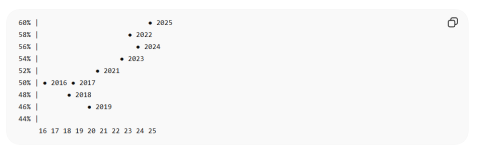
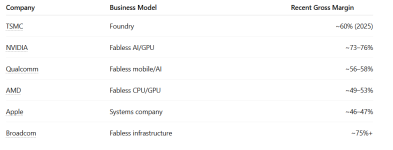
TSMC's gross margins were historically lower than their customers but have been improving over the last five years under CC Wei:

1780064896058.png


1780065117214.png
 

Attachments

  • 1780064781655.png
    1780064781655.png
    13.5 KB · Views: 13
  • 1780064928138.png
    1780064928138.png
    22.6 KB · Views: 14
In my opinion TSMC makes money because customers and partners trust them to deliver wafers as promised. Today TSMC is the only leading edge foundry that can say that.
Intel has a N2 like technology and chose TSMC N2 for nova lake for PPAC reasons, not capacity (per Intel)

The two questions that need to get answered:

Can Intel get external customers as needed to pay for development (2B per year next year, needs to be 15B per year in 2032) (per Intel)
Can Intel make money on foundry in the mean time. (break even by mid 2028). (2027 per Intel)

Since the major customers are working with multiple foundries now, we wont know based on "plans" and "engagements", Intel had 50 plans and engagements in 2021. only the USG one led to a contract and that doesnt ramp until 2030.
 
Intel has a N2 like technology and chose TSMC N2 for nova lake for PPAC reasons, not capacity (per Intel)

The two questions that need to get answered:

Can Intel get external customers as needed to pay for development (2B per year next year, needs to be 15B per year in 2032) (per Intel)
Can Intel make money on foundry in the mean time. (break even by mid 2028). (2027 per Intel)

Since the major customers are working with multiple foundries now, we wont know based on "plans" and "engagements", Intel had 50 plans and engagements in 2021. only the USG one led to a contract and that doesnt ramp until 2030.

Agreed, N2, S2, and 18A is competitive with PPA. I feel TSMC has the advantage in Power for sure and maybe Performance but it is single digit so it can be overlooked in most cases for the NOT TSMC market. The problem is that S2 and 18A were delayed for external customers so TSMC N2 won the node.

The big question that haunts me, and it was from you: When will IFS be profitable?

TSMC is so good right now they get premium wafer pricing. Samsung is so bad they undercut TSMC 20%. Where does IFS fit in here? Can they get TSMC pricing or Samsung pricing or somewhere in between. More importantly, when will IFS show a profit from external customers?
 
Agreed, N2, S2, and 18A is competitive with PPA. I feel TSMC has the advantage in Power for sure and maybe Performance but it is single digit so it can be overlooked in most cases for the NOT TSMC market. The problem is that S2 and 18A were delayed for external customers so TSMC N2 won the node.

The big question that haunts me, and it was from you: When will IFS be profitable?

TSMC is so good right now they get premium wafer pricing. Samsung is so bad they undercut TSMC 20%. Where does IFS fit in here? Can they get TSMC pricing or Samsung pricing or somewhere in between. More importantly, when will IFS show a profit from external customers?
You nailed it..... that is exactly the challenge IMO. they need billions more in revenue and competitive wafer costs. Intel understands this challenge and knows the exact numbers needed to be successful.
.... no one is sure if they can hit them but we will see
 
Quiz: if die yields are low, does that affect IFS margins or product group margins .... assuming Intel follows accounting they presented a few years ago?

Intel Foundry will take the first hits and shoulder as much of the blame as possible because Intel has only one stock symbol and reports its results through a single consolidated financial statement. Since the majority of Intel's revenue is generated by Intel Products, Intel must keep the Products segment "looking" stronger in order to preserve the company's credibility.
 
The big question that haunts me, and it was from you: When will IFS be profitable?

Alternatively, if Intel were to allocate more expenses to Intel Products, would Intel Foundry become profitable much more quickly?

As an integral part of Intel's IDM business model, does it make sense to publicly report Intel Foundry's profit and loss separately in its current form?

In my opinion, Intel needs a much stronger Intel Products division to grow revenue and profit before it can solve Intel Foundry's issues. The collapse of Intel Products' revenue and profitability is the single most dangerous situation Intel is facing.

In the worst-case scenario, even without a competitive Intel Foundry, Intel Products could still survive by using TSMC as a manufacturing partner. However, without competitive products, neither Intel Products nor Intel Foundry will survive.
 
In my opinion, Intel needs a much stronger Intel Products division to grow revenue and profit before it can solve Intel Foundry's issues. The collapse of Intel Products' revenue and profitability is the single most dangerous situation Intel is facing.
Well growing product will solve foundry issue automatically if the product use IFS and the issue with Intel Product Especially DCAI is the biggest one.
 
Well growing product will solve foundry issue automatically if the product use IFS and the issue with Intel Product Especially DCAI is the biggest one.

Intel Products is facing fierce competition from all directions, including AMD, Nvidia, Apple, Broadcom, MediaTek, Qualcomm, Microsoft, Amazon, Google, and Meta, to name just a few. If Intel Foundry lacks the capacity, facilities, competitive costs, technical expertise, or financial viability required to support Intel Products, then Intel Products should be free to utilize all available internal and external resources to capture market opportunities.

Intel's potential customers cannot wait for Intel to find a solution. They will choose whatever Intel or non-Intel solution best meets their needs because they themselves are facing intense competition.

Likewise, Intel's competitors will not wait for Intel to figure out how to manufacture a better product in-house before competing against it. The market is evolving too quickly for Intel Products and Intel Foundry to operate under the traditional IDM model.

On May 27, Nvidia CEO Jensen Huang stated at an event in Taiwan that Nvidia's annual expenditures in Taiwan have increased dramatically, from approximately $10–15 billion just four or five years ago to a target of $100–150 billion in 2026.

Nvidia's projected spending in Taiwan in 2026 is already roughly two to three times Intel's total 2025 revenue of $52.9 billion. The market is changing rapidly, and the opportunities are enormous.

Given these conditions, why shouldn't Intel allow Intel Product division greater freedom to pursue market opportunities wherever they exist, generating the cash flow needed to support both the short term recovery and long term growth of Intel Foundry?
 
Back
Top