






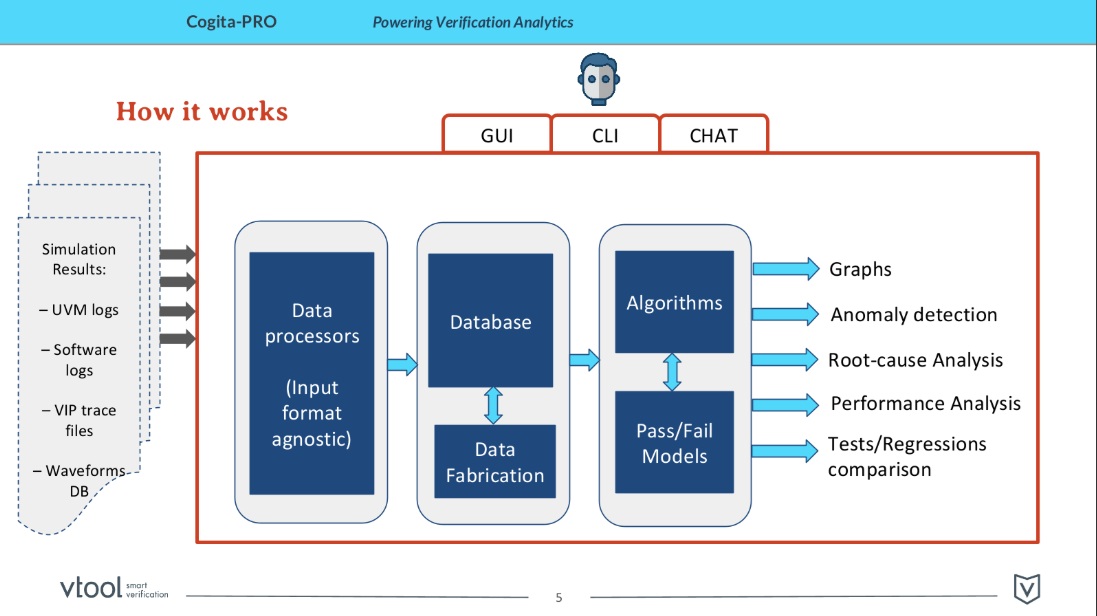
Cogita-PRO, developed by Vtool, introduces a transformative approach to design verification by treating it as a big data challenge rather than a traditional debugging exercise. Released in February 2026, this tool shifts the focus from manual log and waveform inspection to advanced verification analytics powered by data processing, AI, and algorithmic insights.
In conventional verification flows, engineers write testbenches and tests, then spend considerable time running simulations, debugging failures with waveforms and logs, fixing bugs in RTL or testbench code, and chasing coverage closure. This process often proves inefficient, especially in the final stages where the last few percent of coverage consumes disproportionate effort. Checkers may miss subtle legal-yet-problematic corner cases, and the sheer volume of data from gigabytes of logs makes gaining a holistic view difficult.
Cogita-PRO redefines this second phase as Verification Analytics. After initial sanity checks, it ingests simulation outputs including UVM logs, software logs, VIP traces, and waveform databases. Input format remains agnostic thanks to flexible data processors. These feed into a central smart database where raw information transforms into structured occurrence tables.
Key concepts include nodes (recurring log messages or sampled waveform signals), data fields (variables like addresses, IDs, or priorities), and routes (sequences linking related nodes to represent transaction lifecycles). Users can perform data fabrication to derive new metadata, calculate values, or label entries without rerunning simulations. This enriched dataset enables powerful analytics.
The tool delivers multiple layers of insight. Visualization features show routes evolving over time or outstanding transactions per master, offering immediate clarity on system behavior. Blind combination algorithms detect anomalies and perform root-cause analysis by highlighting outlier routes, nodes, or data fields with anomaly probability scores. For instance, multiple methods might converge on a specific address causing a NoC deadlock.
Route shape analysis examines sequence patterns, durations, and field variations. Pass/fail modeling constructs profiles from known good tests, then flags deviations in failing runs, such as altered node orders or unexpected durations in NoC packet routes. These techniques uncover hidden bugs, performance issues, and unintended behaviors that traditional methods overlook.
Cogita-PRO supports three usage models. The first accelerates individual debugging and closure through a GUI, chat interface, or CLI, with optional LLM assistance for setup and exploration. The second scales to regressions, teams, and organizations by exporting understandings like processed data, models, and algorithms for reuse across tests, IPs, subsystems, SoCs, and future projects. The third embraces agentic AI, positioning Cogita-PRO as a debugging agent within multi-agent systems, potentially collaborating with RTL or testbench generative agents while maintaining human-in-the-loop oversight.
Overall, Cogita-PRO promises faster convergence toward tapeout with predictable readiness. It catches elusive logic and performance problems early, reduces reliance on manual sifting through massive datasets, and scales effectively across projects. Vtool encourages early adopters to conduct one-week on-site trials with real data to demonstrate measurable value and train initial users.
Bottom line: By applying visualization, anomaly detection, comparison, and analytics inspired by fields like fraud detection (where false positives are preferable to missed threats), Cogita-PRO empowers verification teams to achieve deeper understanding with less effort.
Also Read:
Formal Verification Best Practices
AI-Driven Automation in Semiconductor Design: The Fuse EDA AI Agent
Agentic AI and the Future of Engineering
Share this post via:



Musk’s Orbital Compute Vision: TERAFAB and the End of the Terrestrial Data Center