





Undo provides runtime context for AI agents and engineers working on complex software in system verification workflows, virtual platforms, fast functional models, HLS, and EDA applications.
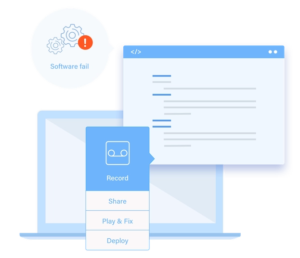
Its technology records complete program execution – including control flow, data flow, memory state and thread interactions – allowing engineers and AI agents to understand exactly what happened during execution rather than inferring behavior from source code, logs or waveforms alone.
Originally known for its time travel debugging technology, Undo has evolved into a runtime context platform used to accelerate automated root cause analysis across complex software systems, virtual models, and verification environments.
Semiconductor Applications
Modern semiconductor development increasingly depends on complex software throughout the chip design process. Engineers develop and debug SystemC models, virtual platforms, firmware, software stacks and large system verification environments long before silicon is available.
Failures can arise from intricate interactions across software components, architectural models and verification infrastructure, making root cause analysis slow and difficult.
Undo enables engineers and AI agents to understand exactly how a failure occurred by recording complete program execution, dramatically reducing the time required to diagnose regressions and complex system-level defects.
Typical use cases include:
- System Verification: up to 75% faster regression debug, enabling shorter verification cycles
- System Architecture: rapid functional defect debug, enabling increased simulation coverage and more robust chip design
EDA Applications
Electronic Design Automation (EDA) software is among the world’s most complex software, with millions of lines of highly concurrent C++ code executing long-running, compute-intensive workloads.
Diagnosing failures inside EDA applications is often challenging because defects may depend on specific execution histories, thread interactions or customer designs that are difficult to reproduce.
Undo provides complete runtime context for both engineers and AI agents, enabling rapid investigation of crashes, regressions and correctness issues without relying solely on logs, core files or repeated executions.
Typical use cases include:
- Debug non-deterministic issues in complex C++ EDA applications
- Rapid root cause analysis of customer issues
AI-Assisted Root Cause Analysis
As AI agents become increasingly capable of analysing software, one remaining limitation is access to runtime behavior.
Source code, logs and stack traces rarely contain enough information for an AI model to accurately determine why a complex failure occurred.
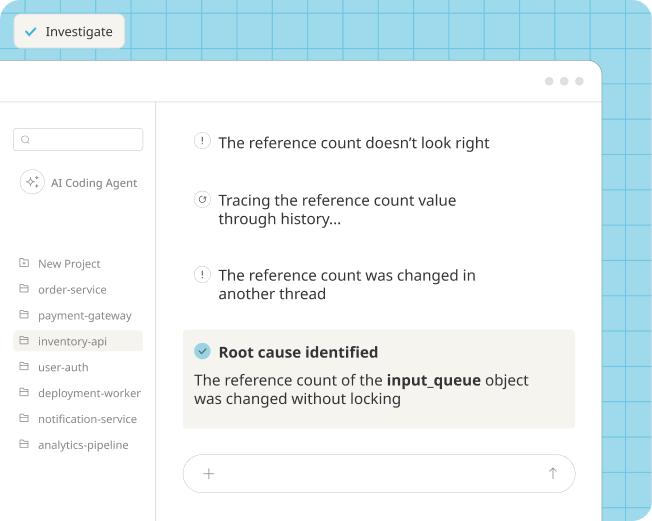
Undo provides AI agents with deterministic runtime context, enabling automated root cause analysis of failures that would otherwise require significant manual investigation.
Rather than reasoning from incomplete information, agents can inspect the actual execution history to understand:
- which execution path was taken
- how program state evolved
- why incorrect behaviour occurred
- where the defect originated
This approach is particularly valuable for large C/C++ and SystemC codebases commonly found throughout semiconductor development and EDA/Computational software.




Comments
There are no comments yet.
You must register or log in to view/post comments.