
For a decade we have ranked AI processors by peak FLOPS. The bigger the compute engine, the better the chip. That made sense when the defining workload was training. It makes much less sense now that the economics of AI have shifted to inference, because inference is not a lighter version of training. It is a different job altogether.… Read More
Tag: VSORA
Built to Deliver the Answer, Not to Train the Model
How VSORA rebalances memory and compute for AI inference in the data center and at the edge
For more than a decade, the AI hardware industry focused mainly on model training, while inference represented a smaller share of overall demand. That balance is changing as trained models are deployed widely in recommendation engines, … Read More
Silicon Valley, à la Française – One Year On
One Year Later — September 2026
When this piece first ran a year ago, VSORA was the quiet outsider, a company with a bold architecture and no Silicon Valley address. One year on, the thesis has held up better than even its author expected. In January 2026, Sandra Rivera, former CEO of Altera and, before that, a two-decade Intel veteran… Read More
Rethinking AI Chips: How VSORA Redesigned the Hardware That Runs AI
Instead of tweaking existing designs, VSORA built an AI chip from scratch to fix the real bottleneck: moving data fast enough to keep the math circuits busy.
There’s a version of the AI hardware story that everyone in the chip industry has heard a hundred times. A startup raises money on a clever chip design, promises to topple… Read More
An AI-Native Architecture That Eliminates GPU Inefficiencies
A recent analysis highlighted by MIT Technology Review puts the energy cost of generative AI into stark perspective. Generating a simple text response from Llama 3.1-405B—a model with 405 billion parameters, the adjustable “knobs” that enable prediction—requires on average 3,353 joules, nearly 1 watt-hour (Wh). Once cooling… Read More
VSORA Board Chair Sandra Rivera on Solutions for AI Inference and LLM Processing
Sandra Rivera, a Silicon Valley veteran who is the former CEO of Altera, an Intel FPGA spinout, and long-time Intel executive, recently became Chair of the Board of Directors of Paris-based VSORA. VSORA, a technology leader redefining AI inference for next-generation data centers, cloud infrastructure and edge, is focused … Read More
Inference Acceleration from the Ground Up
VSORA, a pioneering high-tech company, has engineered a novel architecture designed specifically to meet the stringent demands of AI inference—both in datacenters and at the edge. With near-theoretical performance in latency, throughput, and energy efficiency, VSORA’s architecture breaks away from legacy designs optimized… Read More
Silicon Valley, à la Française
Since the fall of the Roman Empire, France has played a defining role in shaping Western civilization. In the 9th century, Charlemagne—a Frank—united much of Europe under one rule, leaving behind a legacy so profound he is still remembered as the “Father of Europe.” While Italy ignited the Renaissance, it was 16th-century France… Read More
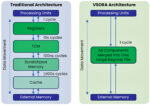
Beyond the Memory Wall: Unleashing Bandwidth and Crushing Latency
VSORA AI Processor Raises $46 Million to Fast-Track Silicon Development
We stand on the cusp of an era defined by ubiquitous intelligence—a stone’s throw from a tidal wave of AI-powered products underpinned by next-generation silicon. Realizing that future demands nothing less than a fundamental rethink of how we design semiconductors… Read More
The Double-Edged Sword of AI Processors: Batch Sizes, Token Rates, and the Hardware Hurdles in Large Language Model Processing
Unlike traditional software programming, AI software modeling represents a transformative paradigm shift, reshaping methodologies, redefining execution processes, and driving significant advancements in AI processors requirements.
Software Programming versus AI Modeling: A Fundamental Paradigm Shift
Traditional… Read More