





Array
(
    [content] => 
    [params] => Array
        (
            [0] => /forum/threads/vera-rubin-%E2%80%93-extreme-co-design-an-evolution-from-grace-blackwell-oberon.24621/
        )

    [addOns] => Array
        (
            [DL6/MLTP] => 13
            [Hampel/TimeZoneDebug] => 1000070
            [SV/ChangePostDate] => 2010200
            [SemiWiki/Newsletter] => 1000010
            [SemiWiki/WPMenu] => 1000010
            [SemiWiki/XPressExtend] => 1000010
            [ThemeHouse/XLink] => 1000970
            [ThemeHouse/XPress] => 1010570
            [XF] => 2030970
            [XFI] => 1060170
        )

    [wordpress] => /var/www/html
)

Vera Rubin – Extreme Co-Design: An Evolution from Grace Blackwell Oberon

user nl

Well-known member

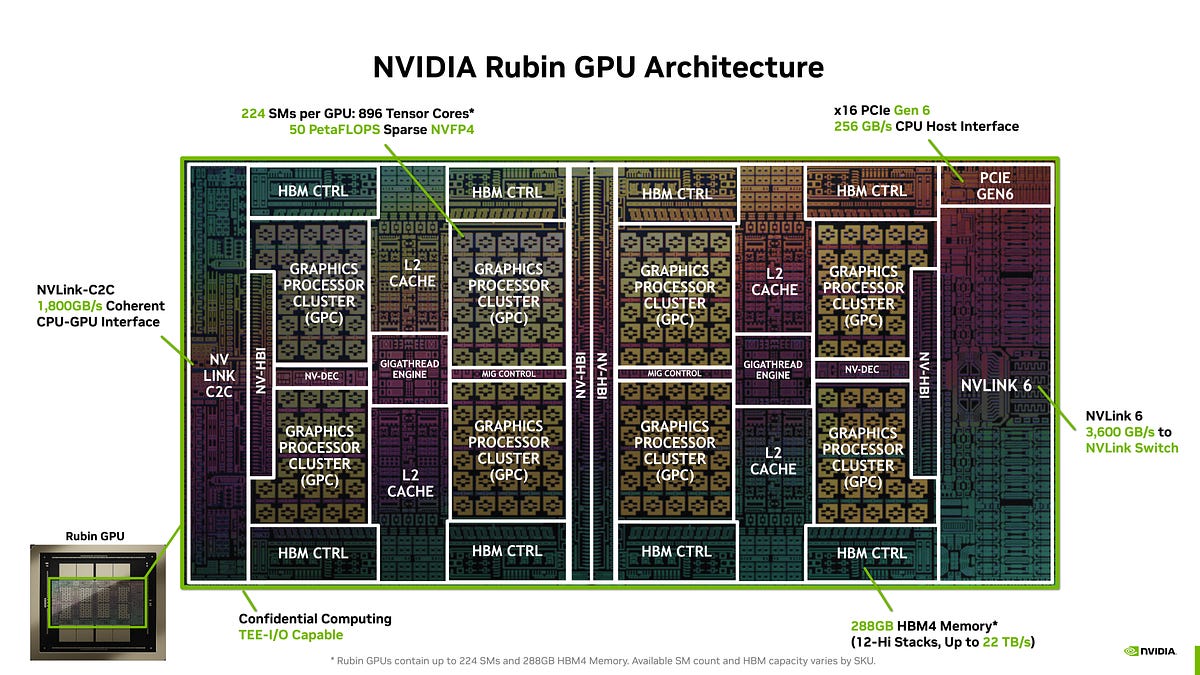
At CES 2026, Nvidia officially announced in detail all 6 Rubin platform products: the Rubin GPU, Vera CPU, NVLink 6 Switch, ConnectX-9, BlueField-4, and Spectrum-6. VR NVL72 is the second generation of Nvidia’s rack scale Oberon architecture that takes the stage. With competition catching up on rack scale game, Trainium 3 in the Gen2 UltraServer, AMD MI450X Helios Racks, and Google’s TPU which was at rack scale even before GB200, Nvidia answers with “extreme co-design” supremacy. With extreme co-design, Nvidia takes rack scale integration to the next level. Rack system becomes a unit of compute, a single distributed accelerator, and Nvidia designs the system.

See also:
 
Last edited:

At CES 2026, Nvidia officially announced in detail all 6 Rubin platform products: the Rubin GPU, Vera CPU, NVLink 6 Switch, ConnectX-9, BlueField-4, and Spectrum-6. VR NVL72 is the second generation of Nvidia’s rack scale Oberon architecture that takes the stage. With competition catching up on rack scale game, Trainium 3 in the Gen2 UltraServer, AMD MI450X Helios Racks, and Google’s TPU which was at rack scale even before GB200, Nvidia answers with “extreme co-design” supremacy. With extreme co-design, Nvidia takes rack scale integration to the next level. Rack system becomes a unit of compute, a single distributed accelerator, and Nvidia designs the system.


See also:
Which shows what you can do given pretty much unlimited resources and budget... ;-)
 
Which shows what you can do given pretty much unlimited resources and budget... ;-)

Yes, if you can operate with 75% gross margin with an annual (guided) run rate revenue of > 4*78 B$ = 312 B$ you can spend a lot of money on R&D.


This is how Gemini summarizes it:

1. The FCF Numbers (Fiscal Year 2026)​

NVIDIA’s ability to generate cash is driven by its 75% gross margins and its "fabless" model, which allows it to avoid the multi-billion dollar factory costs that TSMC or Intel must bear.

Metric Q4 FY2026 (Single Quarter) Full Year FY2026 (Total)
Operating Cash Flow $36.2 Billion $102.7 Billion
Capital Expenditures
~$1.3 Billion ~$6.1 Billion
Free Cash Flow (FCF) $34.9 Billion ~$96.6 Billion

2. Strategic Context: What is NVIDIA doing with $96B?​

NVIDIA’s FCF is so high that it is actually outstripping the company's ability to spend it on internal R&D alone.

  • Shareholder Returns: In FY2026, NVIDIA returned $41.1 Billion to shareholders through buybacks and dividends. Even after this, they still have $58.5 Billion remaining in their buyback authorization.

  • Securing the Supply Chain: Unlike traditional Capex (buying buildings), NVIDIA is using its cash for "Inventory and Purchase Obligations." As of Jan 2026, they have committed over $50 Billion in advance payments to TSMC and HBM suppliers (SK Hynix/Micron) to ensure they aren't "boxed out" by competitors like AMD.
  • The "Net Cash" War Chest: NVIDIA ended the fiscal year with a net cash position of $51.5 Billion (including leases). This gives them the power to acquire almost any AI software or robotics startup without needing to borrow money.

3. Comparison: NVIDIA vs. The World​

To understand the scale of $34.9 Billion in quarterly FCF:

  • It is nearly 3x higher than TSMC’s quarterly FCF (~$11.9B), despite TSMC being the one actually building the chips.
  • It is more than the annual FCF of most Fortune 500 companies.
  • For every $100 in revenue NVIDIA brings in, approximately $51 drops straight into its bank account as pure, spendable cash.

4. 2027 Outlook​

Analysts expect NVIDIA's FCF to cross the $120 Billion mark for Fiscal Year 2027. The main driver will be the transition from Blackwell to Vera Rubin, where the higher ASP (Average Selling Price) of the Rubin Ultra racks is expected to pad margins even further.

Key Takeaway: NVIDIA is currently in a "virtuous cycle." Its cash flow is so dominant that it can effectively "pre-buy" the world's most advanced manufacturing capacity for the next two years, making it nearly impossible for rivals to catch up in volume.
 
Is there point where it would make sense to build own specialty or packaging capacity?

Because we remember that stock buybacks can be addictive.
 
Is there point where it would make sense to build own specialty or packaging capacity?

Because we remember that stock buybacks can be addictive.

My feeling is that TSMC and NVIDIA have clearly divided their tasks and "empires". TSMC has claimed the Foundry + Advanced Packaging market. NVIDIA designs the chips, builds the "racks" and the AI-compute. Similar to how Apple builds their iPhones, iPads, laptops and other devices.

TSMC starts to operate more like an IDM-3.0, a virtual IDM, where many engineers of Apple and NVIDIA are located in Taiwan, tightly integrated in the manufacturing and packaging R&D and Fabs of TSMC.

Apple and NVIDIA prepay a lot of the TSMC Fab and Packaging buildout, so that they actively steer TSMC to operate as an virtual integrated IDM-3.0 partnership.
In a few years the Arizona Gigafab will provide an even closer site for Apple, NVIDIA (and others like AMD) engineers for operating their Virtual IDM.

Will be interesting to see if INTEL will also become such a VIDM in 5-10 years......Still a long way to go
 
Back
Top