






It is expected to rise another 5-10% next year; MSCI's semi-annual adjustment will take effect on the 29th, with TSMC becoming the stock with the largest increase in weighting in the Taiwan Index.
The AI era has fully entered a phase where "whoever controls production capacity controls the market." Supply chain sources indicate that TSMC will raise its 3nm prices again in the second half of the year, with an increase of up to 15%, and a further increase of 5% to 10% next year. Industry insiders point out that with the simultaneous surge in demand for AI accelerators, customized ASICs, flagship mobile phone chips, and high-performance computing (HPC), 3nm production capacity continues to be fully utilized, making advanced processes the most crucial strategic resource in global semiconductor competition.
Furthermore, MSCI's latest semi-annual adjustment officially took effect after the market closed on the 29th. TSMC became the stock with the largest increase in weighting in the MSCI Taiwan Index, with its weighting increased by 0.56 percentage points, bringing its weighting to 58.33%. Foreign investors currently hold a 70.35% stake in TSMC, and have sold a net 573,000 shares this year. The market interprets this as a sign that with the continued return of passive foreign funds, TSMC is expected to see another wave of capital inflows.
On the same day, Morgan Stanley will also invite TSMC to participate in an investor briefing; then the shareholders' meeting will be held on June 4, where Chairman C.C. Wei is expected to "clearly explain" the AI demand, advanced processes and overseas layout, which has made the market pay close attention to TSMC's future.
ASIC manufacturers point out that this wave of 3nm price increases is not driven by a single customer's rush order, but rather by a fundamental change in the overall supply and demand structure of advanced processes. In the past, 3nm was mainly supported by smartphone SoCs, but with the start of the AI server platform update cycle, companies including Nvidia, AMD, Google, AWS, and many cloud service providers have accelerated the adoption of 3nm, driving a rapid increase in demand for wafer fabrication.
Supply chain sources indicate that TSMC's main 3nm fab, Fab 18, is maintaining high capacity utilization, and customer backlogs have not eased significantly. Based on wafer starts, monthly 3nm capacity was approximately 130,000 wafers at the beginning of the year, gradually increasing to 160,000 to 175,000 wafers in the second quarter. However, even with continued capacity expansion, AI demand growth is still far exceeding market expectations.
Market analysis suggests that as the global AI computing power race intensifies, advanced process technologies have shifted from a simple technological competition to a comprehensive contest encompassing production capacity, yield, and supply chain integration capabilities. In particular, large cloud providers have been actively investing in developing their own ASICs in recent years, hoping to reduce their reliance on general-purpose GPUs and further expand their sources of demand for 3nm chips, keeping the supply of advanced process technologies consistently tight.
Furthermore, with rising costs of setting up factories overseas, increased depreciation pressure from advanced processes, and the continued ramp-up of yield rates in the early stages of 2nm mass production, the market believes that TSMC's price increase for 3nm will also help support gross margin performance. Analysts point out that 3nm has now become the most mature and stable mass production node for AI chips, offering greater advantages in mass production and cost compared to 2nm, which is still in its early stages of ramp-up.
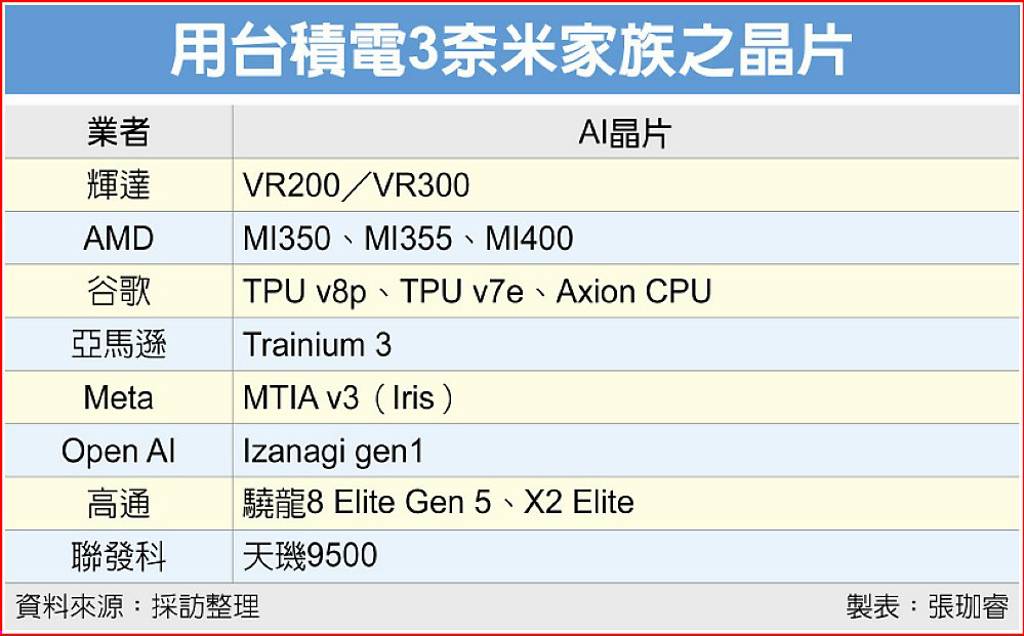
Using TSMC's 3nm family of AI chips
獨家》台積3奈米下半年喊漲15% 明年恐再漲10% 魏哲家股東會將「說清楚、講明白」
AI時代全面進入「得產能者得天下」。供應鏈傳出,台積電下半年將再度調漲3奈米報價,漲幅上看15%,明年亦可能再漲5%至10%。業界指出,隨AI加速器、客製化ASIC、旗艦手機晶片與高效能運算(HPC)需求同步湧入,3奈米產能持續滿載,先進製程已是全球半導體競爭最核心的戰略資源。 此外,MSCI最新半...
 www.ctee.com.tw