





Array
(
    [content] => 
    [params] => Array
        (
            [0] => /forum/threads/tsmc-q1-2026-revenue-increased-40-6-year-over-year.24948/
        )

    [addOns] => Array
        (
            [DL6/MLTP] => 13
            [Hampel/TimeZoneDebug] => 1000070
            [SV/ChangePostDate] => 2010200
            [SemiWiki/Newsletter] => 1000010
            [SemiWiki/WPMenu] => 1000010
            [SemiWiki/XPressExtend] => 1000010
            [ThemeHouse/XLink] => 1000970
            [ThemeHouse/XPress] => 1010570
            [XF] => 2031070
            [XFI] => 1060170
        )

    [wordpress] => /var/www/html
)

TSMC Q1 2026 Revenue Increased 40.6% Year-Over-Year!!!!!

user nl

Well-known member
1776318053821.jpeg


https://investor.tsmc.com/english/quarterly-results/2026/q1

At 8 am CET investor webcast.
 
TSMC Q1 2026 Results SemiWiki.jpg


HSINCHU, Taiwan, R.O.C., Apr. 16, 2026 -- TSMC (TWSE: 2330, NYSE: TSM) today announced consolidated revenue of NT$1,134.10 billion, net income of NT$572.48 billion, and diluted earnings per share of NT$22.08 (US$3.49 per ADR unit) for the first quarter ended March 31, 2026.

Year-over-year, first quarter revenue increased 35.1%, while net income and diluted EPS both increased 58.3%. Compared to fourth quarter 2025, first quarter results represented an 8.4% increase in revenue and a 13.2% increase in net income. All figures were prepared in accordance with TIFRS on a consolidated basis.
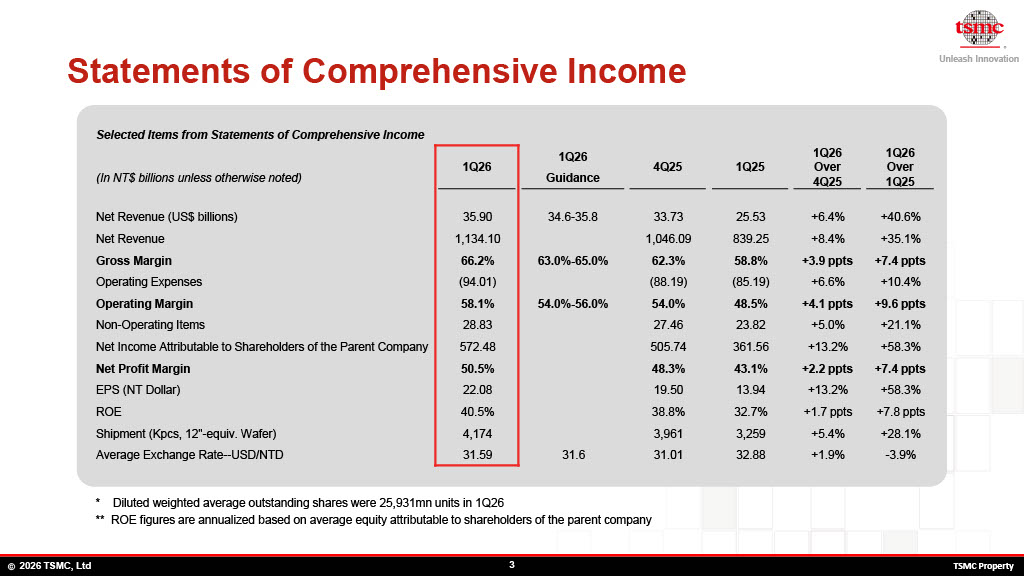
In US dollars, first quarter revenue was $35.90 billion, which increased 40.6% year-over-year and increased 6.4% from the previous quarter.

Gross margin for the quarter was 66.2%, operating margin was 58.1%, and net profit margin was 50.5%.

In the first quarter, shipments of 3-nanometer accounted for 25% of total wafer revenue; 5-nanometer accounted for 36%; 7-nanometer accounted for 13%. Advanced technologies, defined as 7-nanometer and more advanced technologies, accounted for 74% of total wafer revenue.
TSMC Reports First Quarter EPS of NT$22.08

TSMC Spokesperson​

Wendell Huang
Senior Vice President & Chief Financial Officer

TSMC Deputy Spokesperson​

Nina Kao
Public Relations Division

TSMC Media Contact​

press@tsmc.com
 
You can't get 66% margins at mature nodes. This really is an amazing thing CC Wei and his crew are doing. Talk about disruptive!?!?!?!?

CC Wei uses the jargon "our wafer prices are value based", since some quarters in their investor calls. That is the same language that ASML also for many years used to justify increasing tool ASPs (e.g. when the source power went up and thus the wafers/hr throughput), and their margins to their customers was slowly rising from mid-40% towards 50%.

ASML had a gross margin of only 53% in Q1-2026, as reported yesterday.

We do not hear currently anymore that TSMC complains about the rather high ASPs of ASML's EUV-tools.
 
CC Wei uses the jargon "our wafer prices are value based", since some quarters in their investor calls. That is the same language that ASML also for many years used to justify increasing tool ASPs (e.g. when the source power went up and thus the wafers/hr throughput), and their margins to their customers was slowly rising from mid-40% towards 50%.

ASML had a gross margin of only 53% in Q1-2026, as reported yesterday.

We do not hear currently anymore that TSMC complains about the rather high ASPs of ASML's EUV-tools.

Nvidia does not complain about wafer prices anymore either. Times sure have changed.
 
Nvidia does not complain about wafer prices anymore either.

JH during the last year orso publicly said that because of the high value of TSMC's wafers, they should increase their ASPs !!

Remember NVIDIA is still the KING with 75% gross margin !!

It seems now more of a race to the top with gross margins than the usual race to the bottom with ASPs to compete :ROFLMAO:
 
Because of its quasi-monopoly (or "natural monopoly") status before the 1984 breakup, AT&T used its long-distance operations to deliberately maintain high, above-cost rates to subsidize other areas of its business.

Key Pricing Actions Under the Monopoly:
  • High Long-Distance Rates (Cross-Subsidization): AT&T intentionally kept long-distance rates artificially high, sometimes costing over $3 a minute (in 2020 dollars) to call between states in the 1970s.
  • Lowered Local Service Costs: These high profits were used to subsidize local telephone rates, keeping them artificially low and affordable, which allowed AT&T to argue its monopoly benefited the public by guaranteeing universal access.
  • Rural Service Subsidies: The high-profit, high-traffic long-distance routes funded the higher costs of providing service to rural and less-populated areas.
  • Slowed Price Reductions: As a regulated monopoly, AT&T lacked the competitive incentive to lower long-distance prices until forced to by antitrust action.
Post-Monopoly Shift:
After the 1984 divestiture (the breakup of "Ma Bell"), this model was dismantled. Long-distance rates plummeted due to competition, while local rates began to rise, reflecting their actual cost
 
In B2B these quasi monopolies of NVIDIA, TSMC and ASML, especially now with them controlling the production capacity of the 21st Century oil, will not be dismantled so quickly as the barrier to entry is so high, and the demand for tokens is just sky-high.
 
It was before my time, but I heard the stories about 1995, is 2026 like 1995 again? Asking someone who remembers what the growth in semiconductors was like back then.
 
CC Wei uses the jargon "our wafer prices are value based", since some quarters in their investor calls. That is the same language that ASML also for many years used to justify increasing tool ASPs (e.g. when the source power went up and thus the wafers/hr throughput), and their margins to their customers was slowly rising from mid-40% towards 50%.

ASML had a gross margin of only 53% in Q1-2026, as reported yesterday.

We do not hear currently anymore that TSMC complains about the rather high ASPs of ASML's EUV-tools.
What is preventing ASML from generating higher margins? The entire stack of products doesn't exist without them at this point.
 
It was before my time, but I heard the stories about 1995, is 2026 like 1995 again? Asking someone who remembers what the growth in semiconductors was like back then.

The 1990s in general were choppy -- some boom and bust cycles, though overall a boom. Memory was all over the place, pricing-wise in the 1990s. The internet ultimately ensured everything semi-related (hardware and software) became well funded. The fear of the Y2K bug caused massive over investment in software rewrites and hardware purchases.

The 2020s feels very similar - COVID certainly caused a boom then a contraction in a few markets -- but the money shifted elsewhere mostly. The current AI and infrastructure boom feels similar to the internet buildup, and like the 1990s - it was unclear at the time what the technology world would be like 10 years later.

..

One big difference though, was (I think) that the world economy was generally healthier overall in the 1990s. Today, semi is doing a lot better than the general economy, relatively speaking. Last, but not least -- the world was more peaceful in the 1990s.. Globalization was still on the rise, rather than the decline.
 
What is preventing ASML from generating higher margins? The entire stack of products doesn't exist without them at this point.
I have the same question. I understand that TSMC can delay the introduction of High NA to gain leverage in price negotiations. However, for Low NA, why is it not able to achieve higher margins?
 
Nvidia does not complain about wafer prices anymore either. Times sure have changed.

Nvidia and Jensen Huang may still raise concerns about pricing, terms, capacity, or relationship in private meetings with TSMC. They behave like any normal business that prefers to keep these kinds of discussions or disagreements behind the scenes. Talking about them publicly would be counterproductive.
 
CC Wei: Thank you, Wendell. Good afternoon, everyone. First, let me start with our near-term demand outlook. We concluded our first quarter with revenue of USD35.9 billion, slightly above our guidance in US Dollar terms, driven by strong demand for our leading-edge process technologies. Moving into second quarter 2026, we expect our business to be supported by continued strong demand for our leading-edge process technologies. Looking ahead, we are very mindful of the impact of rising component prices, especially in consumer and price-sensitive end market segment.

 
Back
Top