






- Currently, 95 percent of the world’s robot “brains” are manufactured by Taiwan Semiconductor Manufacturing Co (TSMC), TSMC chairman C.C. Wei (魏哲家) said yesterday.
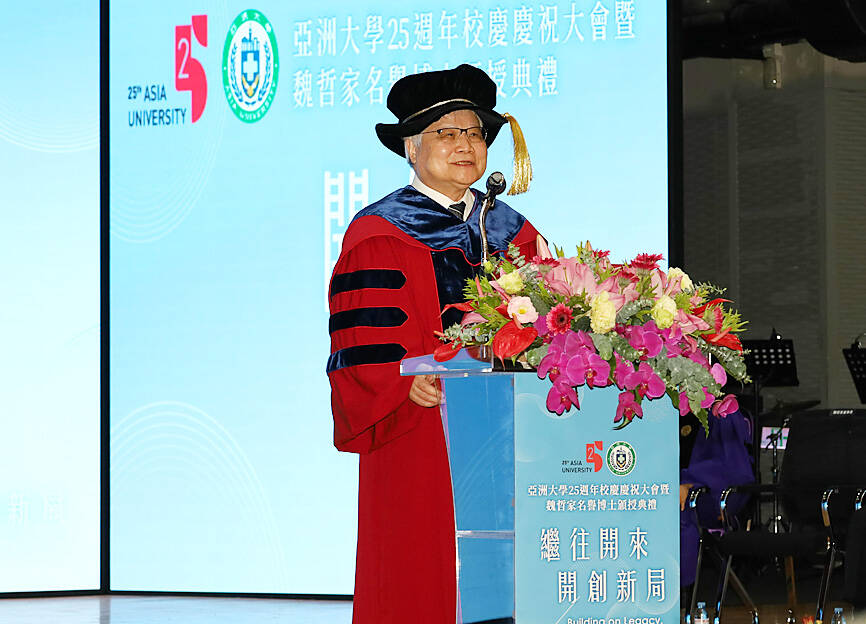
- Wei made the remarks after being awarded an honorary doctorate by Asia University yesterday for his long-standing leadership of the company and his significant contributions to the global semiconductor industry.
- In his speech, Wei expressed gratitude to his family and to TSMC founder Morris Chang (張忠謀) for their influence and support while modestly saying that his own contributions to TSMC were limited.
He credited the company’s achievements to the foundation laid by Chang and the efforts of its employees, adding that he felt somewhat unworthy of the honor.
Speaking about the surge in artificial intelligence (AI), he said that when he joined TSMC in 1998, the company’s technology was at 0.25-micron nodes, but today it has reached 2-nanometer technology. Over the past 20 years, TSMC’s technology has improved a hundredfold, providing the foundation for the rapid development of AI today, it said.
He said that as Taiwan enters an aging society, every household might need robots, making AI technology extremely important.
Technology allows robots to detect light and objects, but they must gather vast amounts of information and transmit it to their “brains” in order to serve humans, he said.
This requires not only visual sensors but precise pressure and temperature sensors to ensure that robots do not cause harm when interacting with or assisting older adults, he said.
Seeing China manufacture robots that can jump and perform flashy tricks, he said: “It’s useless — just for show.”
To be truly functional, robots need vast amounts of information to operate their “brains,” he said.
Companies such as Nvidia, AMD and other US firms design these brains, but 95 percent of them are manufactured by TSMC, he said.
He said that he hopes all the transistors are made by TSMC, because the “reliability of robots cannot be compromised.”
 www.taipeitimes.com
- Wei made the remarks after being awarded an honorary doctorate by Asia University yesterday for his long-standing leadership of the company and his significant contributions to the global semiconductor industry.
- In his speech, Wei expressed gratitude to his family and to TSMC founder Morris Chang (張忠謀) for their influence and support while modestly saying that his own contributions to TSMC were limited.
Taiwan Semiconductor Manufacturing Co chairman C.C. Wei speaks after being awarded an honorary doctorate by Asia University in Taichung yesterday.
Photo: Chen Chien-chih, Taipei TimesHe credited the company’s achievements to the foundation laid by Chang and the efforts of its employees, adding that he felt somewhat unworthy of the honor.
Speaking about the surge in artificial intelligence (AI), he said that when he joined TSMC in 1998, the company’s technology was at 0.25-micron nodes, but today it has reached 2-nanometer technology. Over the past 20 years, TSMC’s technology has improved a hundredfold, providing the foundation for the rapid development of AI today, it said.
He said that as Taiwan enters an aging society, every household might need robots, making AI technology extremely important.
Technology allows robots to detect light and objects, but they must gather vast amounts of information and transmit it to their “brains” in order to serve humans, he said.
This requires not only visual sensors but precise pressure and temperature sensors to ensure that robots do not cause harm when interacting with or assisting older adults, he said.
Seeing China manufacture robots that can jump and perform flashy tricks, he said: “It’s useless — just for show.”
To be truly functional, robots need vast amounts of information to operate their “brains,” he said.
Companies such as Nvidia, AMD and other US firms design these brains, but 95 percent of them are manufactured by TSMC, he said.
He said that he hopes all the transistors are made by TSMC, because the “reliability of robots cannot be compromised.”
TSMC chair gets honorary degree - Taipei Times
Bringing Taiwan to the World and the World to Taiwan
www.taipeitimes.com