As semiconductor systems continue scaling into heterogeneous integration, chiplet partitioning, advanced packaging, and AI/HPC architectures, the industry is discovering that convergence problems no longer stop at tapeout. Increasingly, firmware behavior, runtime policies, and operational telemetry are becoming part of the physical convergence problem itself.
Historically, firmware and Board Support Packages (BSP) have been viewed primarily as enablement layers: necessary for bring-up, validation, configuration, and field operation, but largely separate from the core physical convergence architecture. In simpler systems, that separation was often acceptable. In advanced heterogeneous systems, however, the boundary between logical behavior and physical behavior is becoming increasingly coupled.
A firmware decision can now influence current density, thermal distribution, PDN behavior, signal integrity margins, workload migration, lane stability, and even EM corridor continuity across package and board interfaces. Power-management policy, dynamic workload scheduling, retraining sequences, and adaptive correction logic can all produce measurable physical consequences within the system.
This creates an important architectural shift.
Firmware is no longer only “software running on hardware.” It is increasingly part of the system convergence loop.
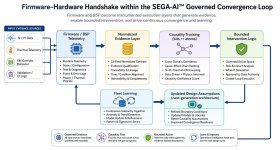
Within the SEGA-AI™ framework, this concept evolves into what can be described as the Firmware–Hardware Handshake: a governed relationship between logical system behavior and physical system response.
The key idea is not autonomous control or AI replacing engineering judgment. The key idea is governed evidence continuity.
In this model, firmware and BSP layers become instrumented execution interfaces capable of generating normalized engineering evidence through telemetry, validation traces, stress results, configuration states, error signatures, and runtime operational data. That evidence can then feed causality tracking, bounded intervention logic, and Fleet Learning within a governed orchestration architecture.
Importantly, this goes beyond conventional telemetry collection.
Traditional telemetry systems often focus on monitoring and reporting. Governed convergence requires something more structured: evidence that is causally traceable, bounded, decision-qualified, and connected to system-level readiness.
This distinction matters because interoperability and observability alone do not guarantee convergence.
A modern heterogeneous system may successfully exchange data across tools, firmware stacks, and operational environments while still lacking causal continuity between logical decisions and physical outcomes. A workload-management change may alter thermal loading. Thermal loading may shift package mechanical behavior. That mechanical shift may perturb return-path continuity or EM behavior inside the package-to-board corridor. The resulting instability may only appear later as degraded eye margin or intermittent field behavior.
From a conventional perspective, these events may appear unrelated.
From a governed convergence perspective, they represent a connected causality chain spanning firmware, power policy, thermal behavior, package mechanics, and high-speed electrical performance.
This is where the Firmware–Hardware Handshake becomes strategically important.
Firmware telemetry becomes more than operational logging. It becomes part of a continuous evidence loop capable of refining assumptions, updating boundary conditions, and improving future convergence behavior across the engineering fleet.
This also changes the meaning of Fleet Learning.
Fleet Learning is not simply collecting historical debug information. It becomes the process by which real-world operational evidence feeds back into future architecture readiness. Runtime behavior observed across thousands of deployed systems can help refine the assumptions, causal models, and convergence boundaries used in the next generation of package, board, PDN, and firmware co-design.
In that sense, the convergence loop no longer ends at design release. It continues through operational telemetry, firmware interaction, bounded corrective action, and fleet-scale learning.
The larger implication is significant.
The industry has spent years focusing on interoperability and data continuity across fragmented engineering ecosystems. Those efforts are necessary and valuable. But interoperability alone cannot guarantee deterministic convergence across increasingly coupled logical and physical systems.
The next layer above interoperability may therefore be governed convergence: architectures capable of preserving evidence continuity, causality traceability, bounded intervention, and decision authority across both design-time and runtime system behavior.
That is where the Firmware–Hardware Handshake fits within the broader SEGA-AI™ architecture.
It is not replacing engineering expertise. It is extending governed convergence beyond static design closure into continuous system learning.
The future convergence loop may not end at tapeout.
It may continue through firmware, telemetry, operational evidence, and fleet-level learning long after the first silicon ships.
Historically, firmware and Board Support Packages (BSP) have been viewed primarily as enablement layers: necessary for bring-up, validation, configuration, and field operation, but largely separate from the core physical convergence architecture. In simpler systems, that separation was often acceptable. In advanced heterogeneous systems, however, the boundary between logical behavior and physical behavior is becoming increasingly coupled.
A firmware decision can now influence current density, thermal distribution, PDN behavior, signal integrity margins, workload migration, lane stability, and even EM corridor continuity across package and board interfaces. Power-management policy, dynamic workload scheduling, retraining sequences, and adaptive correction logic can all produce measurable physical consequences within the system.
This creates an important architectural shift.
Firmware is no longer only “software running on hardware.” It is increasingly part of the system convergence loop.
Within the SEGA-AI™ framework, this concept evolves into what can be described as the Firmware–Hardware Handshake: a governed relationship between logical system behavior and physical system response.
The key idea is not autonomous control or AI replacing engineering judgment. The key idea is governed evidence continuity.
In this model, firmware and BSP layers become instrumented execution interfaces capable of generating normalized engineering evidence through telemetry, validation traces, stress results, configuration states, error signatures, and runtime operational data. That evidence can then feed causality tracking, bounded intervention logic, and Fleet Learning within a governed orchestration architecture.
Importantly, this goes beyond conventional telemetry collection.
Traditional telemetry systems often focus on monitoring and reporting. Governed convergence requires something more structured: evidence that is causally traceable, bounded, decision-qualified, and connected to system-level readiness.
This distinction matters because interoperability and observability alone do not guarantee convergence.
A modern heterogeneous system may successfully exchange data across tools, firmware stacks, and operational environments while still lacking causal continuity between logical decisions and physical outcomes. A workload-management change may alter thermal loading. Thermal loading may shift package mechanical behavior. That mechanical shift may perturb return-path continuity or EM behavior inside the package-to-board corridor. The resulting instability may only appear later as degraded eye margin or intermittent field behavior.
From a conventional perspective, these events may appear unrelated.
From a governed convergence perspective, they represent a connected causality chain spanning firmware, power policy, thermal behavior, package mechanics, and high-speed electrical performance.
This is where the Firmware–Hardware Handshake becomes strategically important.
Firmware telemetry becomes more than operational logging. It becomes part of a continuous evidence loop capable of refining assumptions, updating boundary conditions, and improving future convergence behavior across the engineering fleet.
This also changes the meaning of Fleet Learning.
Fleet Learning is not simply collecting historical debug information. It becomes the process by which real-world operational evidence feeds back into future architecture readiness. Runtime behavior observed across thousands of deployed systems can help refine the assumptions, causal models, and convergence boundaries used in the next generation of package, board, PDN, and firmware co-design.
In that sense, the convergence loop no longer ends at design release. It continues through operational telemetry, firmware interaction, bounded corrective action, and fleet-scale learning.
The larger implication is significant.
The industry has spent years focusing on interoperability and data continuity across fragmented engineering ecosystems. Those efforts are necessary and valuable. But interoperability alone cannot guarantee deterministic convergence across increasingly coupled logical and physical systems.
The next layer above interoperability may therefore be governed convergence: architectures capable of preserving evidence continuity, causality traceability, bounded intervention, and decision authority across both design-time and runtime system behavior.
That is where the Firmware–Hardware Handshake fits within the broader SEGA-AI™ architecture.
It is not replacing engineering expertise. It is extending governed convergence beyond static design closure into continuous system learning.
The future convergence loop may not end at tapeout.
It may continue through firmware, telemetry, operational evidence, and fleet-level learning long after the first silicon ships.