





Array
(
    [content] => 
    [params] => Array
        (
            [0] => /forum/threads/more-clients-leads-to-80-utilization-at-samsung-foundry-in-1q2026.24627/
        )

    [addOns] => Array
        (
            [DL6/MLTP] => 13
            [Hampel/TimeZoneDebug] => 1000070
            [SV/ChangePostDate] => 2010200
            [SemiWiki/Newsletter] => 1000010
            [SemiWiki/WPMenu] => 1000010
            [SemiWiki/XPressExtend] => 1000010
            [ThemeHouse/XLink] => 1000970
            [ThemeHouse/XPress] => 1010570
            [XF] => 2030970
            [XFI] => 1060170
        )

    [wordpress] => /var/www/html
)

More Clients Leads to 80% Utilization at Samsung Foundry in 1Q2026

benb

Well-known member
Key Customer Wins (2025-2026):
  • Tesla: Secured a major contract to produce next-generation AI6 chips, seen as a crucial deal for boosting credibility and profitability.
  • Intel: Reportedly secured an 8nm order for PCH chips.
  • AMD: Nearing a potential 2nm foundry deal.
  • Other: Secured orders from AI startups such as Charbright (4nm) and Anaplash (28nm).
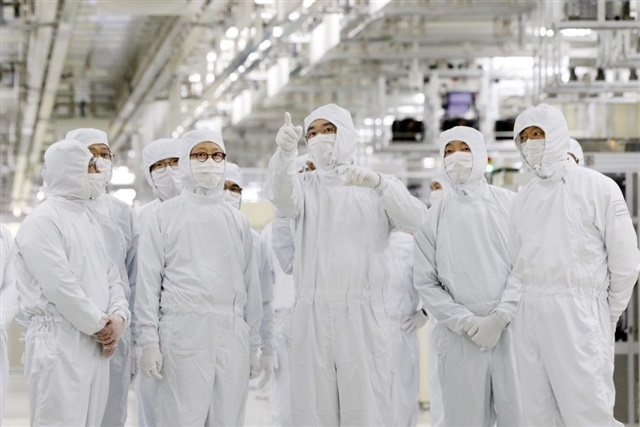
Based on recent reports from early 2026, Samsung Foundry is experiencing a significant recovery, with utilization rates exceeding 80% in Q1 2026, marking a one-year high and a potential turnaround in profitability. The company is aggressively targeting the AI and high-performance computing (HPC) markets with advanced 2nm and HBM4 technologies, while expanding its client base to include Tesla, Intel, and others to reduce its reliance on, and competition with, major customers.
  • 2nm and 1.4nm Roadmap: Samsung is focusing heavily on 2nm Gate-All-Around (GAA) technology, with yields reportedly reaching 55-60% by late 2025. The company is targeting 1.4nm mass production by 2029.
  • US Expansion: The Taylor, Texas, foundry plant remains on track for operations, with setup, including EUV equipment, progressing for a 2026 start.
  • Profitability Targets: Samsung aims to achieve 20% market share by 2027 and turn its foundry business profitable within two years.
Strategic Moves
  • "Turnkey" Strategy: Leveraging its ability to provide memory (HBM4), logic foundry, and advanced packaging in a single solution, particularly for AI clients.
  • No Spin-off: Contrary to rumors, Samsung has no plans to spin off its foundry division, aiming instead for growth and deep integration.
  • Overcoming Yield Issues: After struggling with 3nm yields, early deployment of GAA in 3nm and advancements in 2nm are being used to challenge TSMC's dominance.

 
Best news here is AMD potentially joining Tesla at 2nm.

No mention of Apple. Apple previously announced a US manufacturing initiative that included Samsung. But since the announcement, no further news, suggesting the negotiations between Samsung and Apple may be a little difficult.
 
Samsung Foundry sells on price, which is good, but now they also sell on capacity since TSMC capacity is tight. Even so, I am not seeing any design wins below 4nm. Most are at 7nm. Samsung 2nm is still a ways out so we shall see. The huge increase in 2026 TSMC CAPEX is a big tell. If you compare that to Samsung's logic CAPAEX the gap is staggering. Even if Samsung Foundry is at 80% utilization it really is not a big deal for TSMC.

I certainly hope we will have three foundry choices in the near future but given the design wins I see TSMC will own 2nm as they did/do 3nm. I'm betting on Intel Foundry for the #2 spot and Samsung #3.

The next TSMC Tech Symposium will be one of the best yet, absolutely:


The rumors about AMD and Apple using Samsung Foundry appear every year and I will tell you now what I told you then, it will not happen. Apple will use Intel before Samsung and AMD will not use either while Nvidia could use all three. Exciting times in the semiconductor industry, absolutely.
 
Best news here is AMD potentially joining Tesla at 2nm.

No mention of Apple. Apple previously announced a US manufacturing initiative that included Samsung. But since the announcement, no further news, suggesting the negotiations between Samsung and Apple may be a little difficult.

Tesla is using both Samsung and TSMC. I do hope Elon Musk is working with Lip-Bu Tan but I hear that the AI6 chip is in trouble. The question is: Can Tesla make better AI chips faster than Nvidia? Will Alon Musk risk his AI business on Samsung chips? My guess is that Elon will follow OpenAI and others by spreading the business around to keep a strong supply chain. That is what I would do, absolutely.
 
Back
Top