





Array
(
    [content] =>
    [params] => Array
        (
            [0] => /forum/threads/lex-fridman-a-2-5-hour-conversation-with-jensen-huang-nvidia.24809/
        )

    [addOns] => Array
        (
            [DL6/MLTP] => 13
            [Hampel/TimeZoneDebug] => 1000070
            [SV/ChangePostDate] => 2010200
            [SemiWiki/EmailDomainReplace] => 1000010
            [SemiWiki/Newsletter] => 1000010
            [SemiWiki/WPMenu] => 1000010
            [SemiWiki/XPressExtend] => 1000010
            [ThemeHouse/XLink] => 1000970
            [ThemeHouse/XPress] => 1010570
            [XF] => 2031070
            [XFI] => 1060170
        )

    [wordpress] => /var/www/html
)
Guests have limited access.
Join our community today!
Join our community today!
You are currently viewing SemiWiki as a guest which gives you limited access to the site. To view blog comments and experience other SemiWiki features you must be a registered member. Registration is fast, simple, and absolutely free so please, join our community today!
You are using an out of date browser. It may not display this or other websites correctly.
You should upgrade or use an alternative browser.
You should upgrade or use an alternative browser.
Lex Fridman - a 2.5 hour conversation with Jensen Huang, Nvidia
- Thread starter Xebec
- Start date

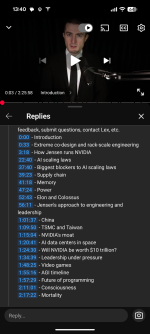

ChatGPT 500 Word Summary:
Visionary Leadership and the Engineering of the AI Future
The rapid advancement of artificial intelligence has been shaped not only by technological breakthroughs but also by visionary leadership and strategic decision-making. A conversation between Lex Fridman and Jensen Huang, CEO of NVIDIA, highlights how bold bets, systems thinking, and collaborative engineering have driven the AI revolution. Huang emphasizes that building the future of computing requires more than creating powerful chips—it demands designing entire ecosystems that integrate hardware, software, networking, and organizational structure into a unified whole.
One of Huang’s key ideas is “extreme co-design,” which involves optimizing across every layer of technology simultaneously. As AI models grow larger and more complex, no single computer or GPU can handle the workload alone. Instead, problems must be distributed across thousands of systems, requiring coordination among CPUs, GPUs, networking, memory, and power infrastructure. This complexity means that performance improvements depend on solving bottlenecks across the entire stack, not just accelerating computation. Huang describes this as a massive computer science challenge that requires collaboration among specialists and generalists working together in real time.
Leadership, according to Huang, is inseparable from this engineering philosophy. He structures NVIDIA so that experts from multiple domains collaborate continuously, ensuring that decisions in one area do not create inefficiencies in another. Rather than relying on isolated meetings, problems are presented to groups, encouraging interdisciplinary solutions. This collaborative culture mirrors the co-design approach applied to technology: the organization itself becomes a system optimized for innovation.
Another crucial theme in Huang’s perspective is the importance of long-term vision and risk-taking. He recounts NVIDIA’s decision to invest heavily in CUDA, a computing platform that initially increased costs and reduced profits. Despite the financial risk, the company believed that building a large developer ecosystem would eventually transform GPUs into general-purpose computing tools. This gamble proved foundational for modern AI, demonstrating how strategic foresight can outweigh short-term financial concerns.
Huang also highlights the concept of “scaling laws” in AI, noting that intelligence grows with increased data, computation, and system complexity. As models evolve, new challenges emerge, including energy consumption, supply chain limitations, and hardware requirements. To address these issues, NVIDIA collaborates closely with industry partners, shaping not only its own products but also the broader technological landscape. This approach reflects a systems-level understanding of innovation: progress in AI depends on coordination across industries, from semiconductor manufacturing to energy infrastructure.
Ultimately, Huang’s philosophy blends engineering rigor with visionary thinking. He argues that leaders must reason from first principles, anticipate future needs, and gradually shape the beliefs of their teams and partners. By aligning organizational structure, technological design, and long-term strategy, NVIDIA has positioned itself at the center of the AI revolution. The conversation illustrates that breakthroughs in artificial intelligence are not solely the result of algorithms or hardware, but of holistic thinking—where leadership, collaboration, and systems engineering converge to create transformative innovation.
Visionary Leadership and the Engineering of the AI Future
The rapid advancement of artificial intelligence has been shaped not only by technological breakthroughs but also by visionary leadership and strategic decision-making. A conversation between Lex Fridman and Jensen Huang, CEO of NVIDIA, highlights how bold bets, systems thinking, and collaborative engineering have driven the AI revolution. Huang emphasizes that building the future of computing requires more than creating powerful chips—it demands designing entire ecosystems that integrate hardware, software, networking, and organizational structure into a unified whole.
One of Huang’s key ideas is “extreme co-design,” which involves optimizing across every layer of technology simultaneously. As AI models grow larger and more complex, no single computer or GPU can handle the workload alone. Instead, problems must be distributed across thousands of systems, requiring coordination among CPUs, GPUs, networking, memory, and power infrastructure. This complexity means that performance improvements depend on solving bottlenecks across the entire stack, not just accelerating computation. Huang describes this as a massive computer science challenge that requires collaboration among specialists and generalists working together in real time.
Leadership, according to Huang, is inseparable from this engineering philosophy. He structures NVIDIA so that experts from multiple domains collaborate continuously, ensuring that decisions in one area do not create inefficiencies in another. Rather than relying on isolated meetings, problems are presented to groups, encouraging interdisciplinary solutions. This collaborative culture mirrors the co-design approach applied to technology: the organization itself becomes a system optimized for innovation.
Another crucial theme in Huang’s perspective is the importance of long-term vision and risk-taking. He recounts NVIDIA’s decision to invest heavily in CUDA, a computing platform that initially increased costs and reduced profits. Despite the financial risk, the company believed that building a large developer ecosystem would eventually transform GPUs into general-purpose computing tools. This gamble proved foundational for modern AI, demonstrating how strategic foresight can outweigh short-term financial concerns.
Huang also highlights the concept of “scaling laws” in AI, noting that intelligence grows with increased data, computation, and system complexity. As models evolve, new challenges emerge, including energy consumption, supply chain limitations, and hardware requirements. To address these issues, NVIDIA collaborates closely with industry partners, shaping not only its own products but also the broader technological landscape. This approach reflects a systems-level understanding of innovation: progress in AI depends on coordination across industries, from semiconductor manufacturing to energy infrastructure.
Ultimately, Huang’s philosophy blends engineering rigor with visionary thinking. He argues that leaders must reason from first principles, anticipate future needs, and gradually shape the beliefs of their teams and partners. By aligning organizational structure, technological design, and long-term strategy, NVIDIA has positioned itself at the center of the AI revolution. The conversation illustrates that breakthroughs in artificial intelligence are not solely the result of algorithms or hardware, but of holistic thinking—where leadership, collaboration, and systems engineering converge to create transformative innovation.