






A new supply chain report has revealed what appears to be Intel’s processor roadmap through 2028, outlining several upcoming CPU architectures including Nova Lake, Razor Lake, Titan Lake, and Moon Lake. According to the report, Intel plans to return to a yearly release cadence for new CPU microarchitectures beginning in 2026 as part of a broader strategy to strengthen its position against AMD and Qualcomm across desktop and mobile markets. The roadmap suggests Intel believes its internal restructuring efforts and manufacturing schedules are stabilizing after multiple years of delays and roadmap adjustments. Supply chain sources reportedly claim Intel no longer expects major disruptions to future product launches as newer process technologies continue maturing.
Nova Lake is expected to become the first major platform under this renewed execution strategy. Scheduled for the second half of 2026, Nova Lake-S desktop processors are rumored to use Coyote Cove performance cores alongside Arctic Wolf efficiency cores. Intel is also expected to increase both total core counts and cache capacity significantly, with flagship desktop models reportedly reaching up to 288MB of cache. The platform will likely continue Intel’s hybrid architecture design combining P-Cores and E-Cores for gaming and productivity workloads.
Razor Lake is then expected to arrive during the fourth quarter of 2027. Reports indicate the architecture will introduce Griffin Cove P-Cores and Golden Eagle E-Cores while focusing heavily on IPC improvements. One notable detail from the leak is claimed pin compatibility between Razor Lake and Nova Lake platforms, potentially allowing motherboard reuse across generations and simplifying desktop upgrades.
The largest architectural transition may arrive with Titan Lake in 2028. According to current rumors, Intel is exploring a unified core architecture known as Copper Shark that would eliminate the distinction between P-Cores and E-Cores entirely. Such a move would represent a major shift away from the hybrid big.LITTLE strategy Intel introduced with Alder Lake.
Titan Lake is also rumored to feature a collaboration with NVIDIA through the integration of an RTX GPU tile directly into the processor package. If accurate, the platform would compete more directly against AMD’s Strix Halo APUs that combine large CPU and GPU resources into a single package for high-performance mobile systems.
Separately, Intel is reportedly preparing Moon Lake, an E-Core-only platform aimed at entry-level notebooks, low-power laptops, and Chromebook-class devices. Moon Lake is expected to prioritize power efficiency and lower manufacturing costs rather than maximum performance.
Although Intel has not officially confirmed the roadmap details, the report indicates the company is preparing a significantly more aggressive CPU rollout strategy over the next several years as competition across the PC market continues intensifying.
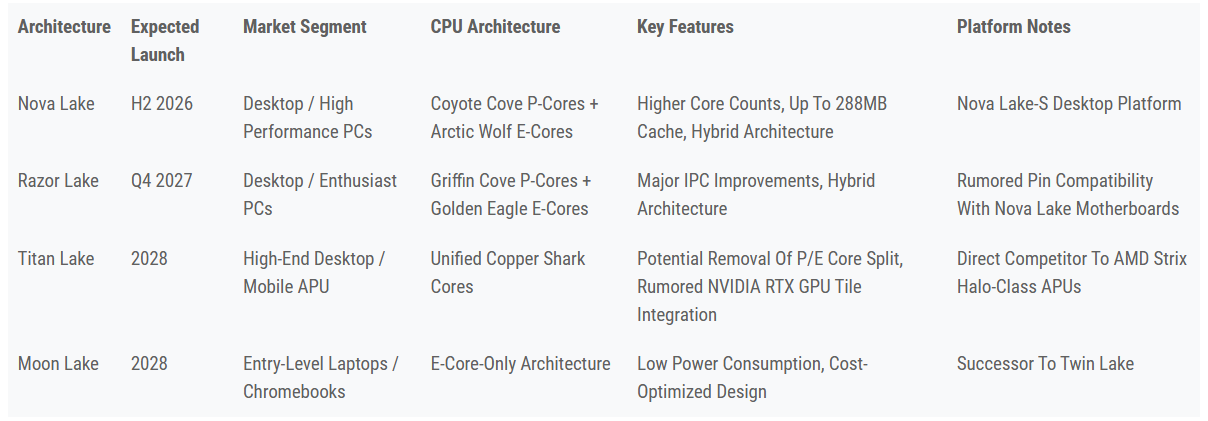
Nova Lake is expected to become the first major platform under this renewed execution strategy. Scheduled for the second half of 2026, Nova Lake-S desktop processors are rumored to use Coyote Cove performance cores alongside Arctic Wolf efficiency cores. Intel is also expected to increase both total core counts and cache capacity significantly, with flagship desktop models reportedly reaching up to 288MB of cache. The platform will likely continue Intel’s hybrid architecture design combining P-Cores and E-Cores for gaming and productivity workloads.
Razor Lake is then expected to arrive during the fourth quarter of 2027. Reports indicate the architecture will introduce Griffin Cove P-Cores and Golden Eagle E-Cores while focusing heavily on IPC improvements. One notable detail from the leak is claimed pin compatibility between Razor Lake and Nova Lake platforms, potentially allowing motherboard reuse across generations and simplifying desktop upgrades.
The largest architectural transition may arrive with Titan Lake in 2028. According to current rumors, Intel is exploring a unified core architecture known as Copper Shark that would eliminate the distinction between P-Cores and E-Cores entirely. Such a move would represent a major shift away from the hybrid big.LITTLE strategy Intel introduced with Alder Lake.
Titan Lake is also rumored to feature a collaboration with NVIDIA through the integration of an RTX GPU tile directly into the processor package. If accurate, the platform would compete more directly against AMD’s Strix Halo APUs that combine large CPU and GPU resources into a single package for high-performance mobile systems.
Separately, Intel is reportedly preparing Moon Lake, an E-Core-only platform aimed at entry-level notebooks, low-power laptops, and Chromebook-class devices. Moon Lake is expected to prioritize power efficiency and lower manufacturing costs rather than maximum performance.
Although Intel has not officially confirmed the roadmap details, the report indicates the company is preparing a significantly more aggressive CPU rollout strategy over the next several years as competition across the PC market continues intensifying.