





Array
(
    [content] => 
    [params] => Array
        (
            [0] => /forum/threads/elon-musks-spacex-set-to-go-public-in-1-trillion-share-listing.24876/
        )

    [addOns] => Array
        (
            [DL6/MLTP] => 13
            [Hampel/TimeZoneDebug] => 1000070
            [SV/ChangePostDate] => 2010200
            [SemiWiki/Newsletter] => 1000010
            [SemiWiki/WPMenu] => 1000010
            [SemiWiki/XPressExtend] => 1000010
            [ThemeHouse/XLink] => 1000970
            [ThemeHouse/XPress] => 1010570
            [XF] => 2031070
            [XFI] => 1060170
        )

    [wordpress] => /var/www/html
)

Elon Musk's SpaceX set to go public in $1 trillion share listing

Daniel Nenni

Founder
Staff member
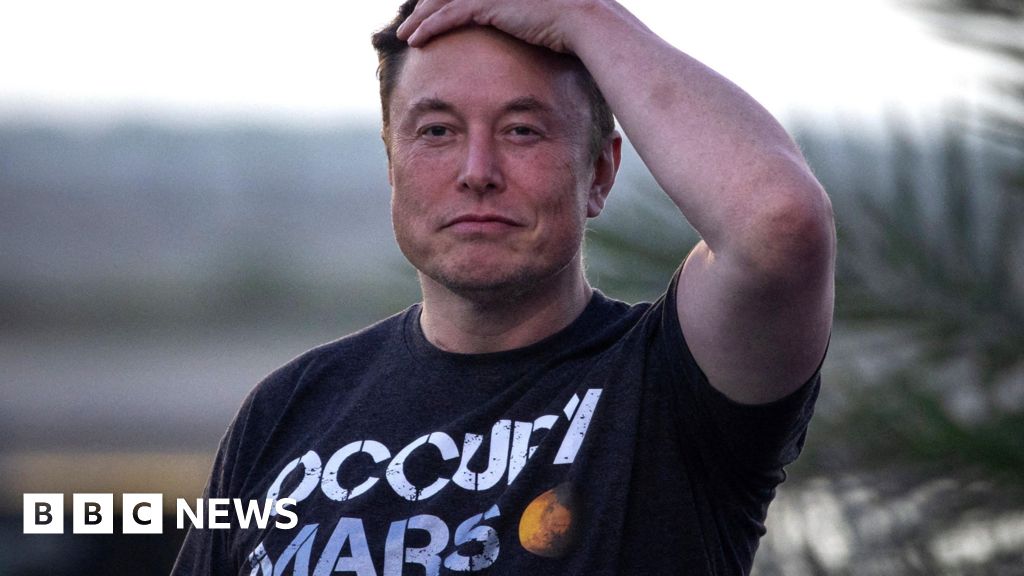
Reuters SpaceX founder Elon Musk wears a dark t-shirt with white lettering reading Occupy Mars next to a picture of a small red planet

Reuters

Elon Musk's SpaceX is poised to become one of the most valuable publicly traded companies in the world.

The firm, which makes rockets, space exploration technology and Starlink satellites, is privately held, but on Wednesday it made a confidential filing with authorities for an initial public offering (IPO), which would allow its shares to be traded on the stock market.

The value of SpaceX expected to surpass $1tn (£751bn) once it goes public.

Musk's own holding in SpaceX would put the billionaire on track to become the world's first trillionaire.

The BBC has contacted SpaceX for comment.

The company is aiming to officially go public sometime in June, according to reports in Bloomberg, Reuters and the New York Times.

A confidential IPO filing with the US Securities and Exchange Commission allows a company to avoid immediately revealing information to the public while it requests feedback from the regulator.

The next step will be for the firm's executives to hold "roadshows", which are meetings with big investors to convince them to buy shares.

By making shares of SpaceX available for purchase by the public, the company is looking to raise $50bn or more, according to reports.

Earlier this year, SpaceX took over xAI, Musk's artificial intelligence venture.

After that all-stock merger, SpaceX is believed to have become the most valuable private company in the world, with an internal valuation of $1.25tn.

Recently, Musk's various companies have been becoming increasingly intertwined.

Last year, xAI, best known for its chatbot Grok, took over X, the social media platform previously known as Twitter that Musk bought in 2022.

Emily Zheng, a senior analyst at Pitchbook, told the BBC that by bringing xAI under SpaceX, Musk could show potential investors that he was consolidating costs and able to easily share resources between his companies.

With its large-scale ambitions, SpaceX is in need of a massive cash infusion that going public can provide, Zheng added. The company is racing to keep up with the "sheer cost of compute, infrastructure, and energy" needed to expand, she said.

Earlier this year, Tesla, Musk's electric vehicle company, revealed it had invested more than $2bn in xAI.

The billionaire said a significant share of Tesla's manufacturing would begin to shift toward building robots, which would make use of xAI technology like Grok.

Grok is already included in some Teslas as an AI assistant.

SpaceX would also partner with Tesla and xAI in the massive chipmaking endeavour Musk announced last month, which he is calling Terafab.

"Tesla, xAI and SpaceX have all done amazing things that people did not think could be done before," Musk said in a March presentation discussing Terafab.

Musk started SpaceX in 2002 with the aim of reducing the cost of launching crafts into space, mainly by making rockets that could be launched more than once. It first contracted with Nasa in 2006.

Today, most of SpaceX's work continues to revolve around rockets and the operation of Starlink, a fleet of satellites offering internet connectivity across the globe.

But Musk often discusses grander ambitions for the company, including putting data centers needed for AI in space and building a self-sufficient city on Mars, which many experts have said could be impossible to realise.
 
Last edited:
Not financial advice - but this may be one of those multi-generational investment things.. Invest at IPO and lose money immediately as company people sell their shares and retire rich. But if they keep going and continue locking in outer space contracts in 20, 30, 40 years..
 
If SpaceX becomes the sole operator for transportation to the New Continent in the long run, will it eventually be state-owned or split up?
 
If SpaceX becomes the sole operator for transportation to the New Continent in the long run, will it eventually be staed-owned or split up?
I think there will always be some competition - governments will steal the IP and make their own designs and still launch domestic stuff.
 
If SpaceX becomes the sole operator for transportation to the New Continent in the long run, will it eventually be staed-owned or split up?
I think there will always be some competition - governments will steal the IP and make their own designs and still launch domestic stuff.
You’re all very optimistic.

With corporations of this power controlling sectors of such importance being run by a single man who is going to have a net worth of more than $1 trillion Dollars, and a government that can be legally purchased by unlimited campaign and lobbying money, the future is not that SpaceX is broken up it will be that the government will be broken up and reformed to just be an extension of said corporations.
 
Is SpaceX a Hegemony?

Where SpaceX looks hegemonic:

SpaceX has strong dominance in some launch markets:
  • It flies a huge share of U.S. orbital launches
  • Its reusable rockets lowered launch costs
  • Competitors often adjust pricing and designs in response
  • Its Starlink network is one of the largest satellite constellations ever
In those areas, you could say SpaceX has hegemonic influence — it shapes industry norms.

Why SpaceX is NOT a full hegemony:
  • It doesn’t control space policy (governments do)
  • It still has competitors, like:
    • Blue Origin
    • United Launch Alliance
    • NASA (not a competitor exactly, but a major player)
  • It doesn’t dominate every part of space (e.g., deep space science, regulation, etc.)
 
You’re all very optimistic.

With corporations of this power controlling sectors of such importance being run by a single man who is going to have a net worth of more than $1 trillion Dollars, and a government that can be legally purchased by unlimited campaign and lobbying money, the future is not that SpaceX is broken up it will be that the government will be broken up and reformed to just be an extension of said corporations.

China and Russia aren't going to give any substantial launch business to SpaceX. The EU and India are also likely to split business for both national prestige and "supply chain" reasons. Not optimism..

P.S. I think the US federal government already is an extension of said corporations. More regulations = makes it harder for competition to rise, hence large corporations are happy to have more regulation.. :) OT though.
 
Last edited:
Is SpaceX a Hegemony?

Where SpaceX looks hegemonic:

SpaceX has strong dominance in some launch markets:
  • It flies a huge share of U.S. orbital launches
  • Its reusable rockets lowered launch costs
  • Competitors often adjust pricing and designs in response
  • Its Starlink network is one of the largest satellite constellations ever
In those areas, you could say SpaceX has hegemonic influence — it shapes industry norms.

Why SpaceX is NOT a full hegemony:
  • It doesn’t control space policy (governments do)
  • It still has competitors, like:
    • Blue Origin
    • United Launch Alliance
    • NASA (not a competitor exactly, but a major player)
  • It doesn’t dominate every part of space (e.g., deep space science, regulation, etc.)

The original competition SpaceX faced:

- Was used to guarenteed cost-plus contracts
- Received a $1B annual retainer even if they launched zero rockets (ULA -- joint Boeing/LM venture)
- Had cultures that completely discouraged "risk taking" like re-usable rockets, because reduced costs meant less profit (less to multiply) and it also meant going through a crazy requirements changing process with your customer

I think Blue Origin has a good chance of providing some alternative options for launch vehicles. BO is also focusing on some different markets than SpaceX. ULA is the old guard that needs to go away.. (and maybe be reborn as a commercial entity).
 
You’re all very optimistic.

With corporations of this power controlling sectors of such importance being run by a single man who is going to have a net worth of more than $1 trillion Dollars, and a government that can be legally purchased by unlimited campaign and lobbying money, the future is not that SpaceX is broken up it will be that the government will be broken up and reformed to just be an extension of said corporations.
Unlikely, as long as there is a US Congress. Money can influence individual candidates, but you can't buy a Congressional majority, or a Senate supermajority, even if you're a trillionaire. A more realistic scenario is that eventually the US does formally declare against war against some country or group of countries. If Congress declares war the US President gets extraordinary war powers to seize certain properties or industrial infrastructure, or even nationalize companies. Presidential power in the event of a declared war is almost certainly why the US hasn't declared war since Pearl Harbor. But in the event of a catastrophe like a nuclear or chemical attack, all bets are off, and space launch capabilities could be critical. So the more likely reality, IMO, is the opposite of what you're saying.
 
Back
Top