





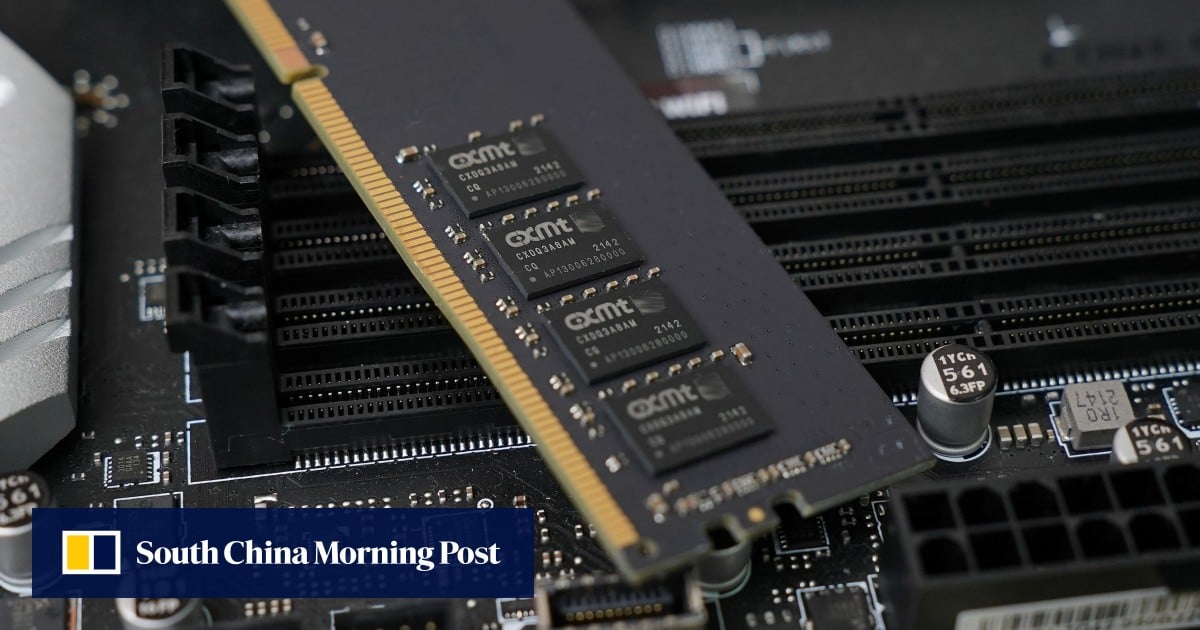
Founded in 2016, CXMT is widely regarded as China’s only domestic DRAM maker to have achieved mass production
Howard Liuin Beijing
Published: 7:30am, 14 May 2026
Chinese memory module manufacturers are accelerating the release of consumer and enterprise storage products powered by domestic DDR5 chips, as breakthroughs by ChangXin Memory Technologies (CXMT), the nation’s leading memory chipmaker, filter through the supply chain.
Powev, one of China’s major memory module vendors, recently said its Sinker-branded DDR5 server memories had entered mass production and delivery. The 64GB DDR5-5600 RDIMM product passed testing by multiple major customers and was ready for bulk supply to enterprise clients, channel partners and branded vendors, the firm said.
The company also introduced the Sinker DDR5 memory modules, said to fully use domestic components, while other Chinese vendors, including Comay, have released DDR5 products based on CXMT dies for industrial and enterprise applications.
In the consumer market, Powev’s Gloway and KingBank DDR5 models based on Chinese made DRAM chips were being sold as early as late 2024, marking one of the first visible signs that domestic DDR5 supply was moving beyond demonstration products and into commercial channels.
The downstream push follows CXMT’s official debut of its DDR5 product portfolio in November last year. The Hefei-based company said its DDR5 chips supported speeds of up to 8,000 Mbps (MT/s?) and die densities of 16Gb and 24Gb, targeting servers, workstations and personal computers.
The 24Gb density leaves CXMT roughly one generation behind the most advanced 32Gb DDR5 chips from Samsung Electronics, SK Hynix and Micron Technology, but still represented a significant step forward for China’s domestic DRAM industry.
Founded in 2016 and headquartered in Hefei, Anhui province, CXMT is widely regarded as China’s only domestic DRAM maker to have achieved mass production. Its products span DDR memory used in servers and desktops, as well as LPDDR (Low-power DDR) for smartphones, tablets and wearable devices. Its LPDDR products have entered the supply chains of Chinese electronics makers including Xiaomi, OPPO, Vivo, Transsion and Lenovo.
CXMT is also moving towards a domestic listing to fund further expansion. On December 30, the Shanghai Stock Exchange accepted the company’s application for a Star market initial public offering, with its prospectus showing a planned fundraising of 29.5 billion yuan (US$4.34 billion). The filing showed CXMT’s revenue rose 97.8 per cent year on year to 32.08 billion yuan in the first nine months of 2025, while its net loss narrowed to 5.98 billion yuan from 6.84 billion yuan a year earlier.
The latest product roll-outs come as the global memory industry enters one of its strongest upcycles in years, driven by AI servers, high-bandwidth memory demand and tight conventional DRAM supply. A recent China Merchants Securities report described the sector as entering an AI-driven “structural supercycle”, with supply tightness likely to continue into 2027, while module makers were increasing inventories to secure supply.
That shortage has created a favourable window for Chinese vendors. As overseas memory suppliers prioritise AI-related demand and contract prices continue to rise, domestic module makers have stronger incentives to secure alternative sources of DRAM and turn China-made chips into commercial products across PCs, servers and enterprise storage system, according to China Merchants Securities.
The DRAM market, however, remains heavily concentrated. TrendForce data showed that Samsung, SK Hynix and Micron together controlled more than 90 per cent of global DRAM shipments in the fourth quarter of last year, with shares of 32.6 per cent, 33.2 per cent and 25.7 per cent, respectively.
China’s broader storage ecosystem is also moving towards higher-end domestic substitution. On May 13, Sugon launched its FlashNexus 9000 high-end all-flash storage system, claiming to use 100 per cent domestic core components and a fully self-developed software stack.
 www.scmp.com
Howard Liuin Beijing
Published: 7:30am, 14 May 2026
Chinese memory module manufacturers are accelerating the release of consumer and enterprise storage products powered by domestic DDR5 chips, as breakthroughs by ChangXin Memory Technologies (CXMT), the nation’s leading memory chipmaker, filter through the supply chain.
Powev, one of China’s major memory module vendors, recently said its Sinker-branded DDR5 server memories had entered mass production and delivery. The 64GB DDR5-5600 RDIMM product passed testing by multiple major customers and was ready for bulk supply to enterprise clients, channel partners and branded vendors, the firm said.
The company also introduced the Sinker DDR5 memory modules, said to fully use domestic components, while other Chinese vendors, including Comay, have released DDR5 products based on CXMT dies for industrial and enterprise applications.
In the consumer market, Powev’s Gloway and KingBank DDR5 models based on Chinese made DRAM chips were being sold as early as late 2024, marking one of the first visible signs that domestic DDR5 supply was moving beyond demonstration products and into commercial channels.
The downstream push follows CXMT’s official debut of its DDR5 product portfolio in November last year. The Hefei-based company said its DDR5 chips supported speeds of up to 8,000 Mbps (MT/s?) and die densities of 16Gb and 24Gb, targeting servers, workstations and personal computers.
The 24Gb density leaves CXMT roughly one generation behind the most advanced 32Gb DDR5 chips from Samsung Electronics, SK Hynix and Micron Technology, but still represented a significant step forward for China’s domestic DRAM industry.
Founded in 2016 and headquartered in Hefei, Anhui province, CXMT is widely regarded as China’s only domestic DRAM maker to have achieved mass production. Its products span DDR memory used in servers and desktops, as well as LPDDR (Low-power DDR) for smartphones, tablets and wearable devices. Its LPDDR products have entered the supply chains of Chinese electronics makers including Xiaomi, OPPO, Vivo, Transsion and Lenovo.
CXMT is also moving towards a domestic listing to fund further expansion. On December 30, the Shanghai Stock Exchange accepted the company’s application for a Star market initial public offering, with its prospectus showing a planned fundraising of 29.5 billion yuan (US$4.34 billion). The filing showed CXMT’s revenue rose 97.8 per cent year on year to 32.08 billion yuan in the first nine months of 2025, while its net loss narrowed to 5.98 billion yuan from 6.84 billion yuan a year earlier.
The latest product roll-outs come as the global memory industry enters one of its strongest upcycles in years, driven by AI servers, high-bandwidth memory demand and tight conventional DRAM supply. A recent China Merchants Securities report described the sector as entering an AI-driven “structural supercycle”, with supply tightness likely to continue into 2027, while module makers were increasing inventories to secure supply.
That shortage has created a favourable window for Chinese vendors. As overseas memory suppliers prioritise AI-related demand and contract prices continue to rise, domestic module makers have stronger incentives to secure alternative sources of DRAM and turn China-made chips into commercial products across PCs, servers and enterprise storage system, according to China Merchants Securities.
The DRAM market, however, remains heavily concentrated. TrendForce data showed that Samsung, SK Hynix and Micron together controlled more than 90 per cent of global DRAM shipments in the fourth quarter of last year, with shares of 32.6 per cent, 33.2 per cent and 25.7 per cent, respectively.
China’s broader storage ecosystem is also moving towards higher-end domestic substitution. On May 13, Sugon launched its FlashNexus 9000 high-end all-flash storage system, claiming to use 100 per cent domestic core components and a fully self-developed software stack.
Chinese memory module makers ramp up production with new CXMT DRAM
Founded in 2016, CXMT is widely regarded as China’s only domestic DRAM maker to have achieved mass production.
www.scmp.com
