Array
(
    [content] => 
    [params] => Array
        (
            [0] => /forum/threads/build-china%E2%80%99s-asml.24684/
        )

    [addOns] => Array
        (
            [DL6/MLTP] => 13
            [Hampel/TimeZoneDebug] => 1000070
            [SV/ChangePostDate] => 2010200
            [SemiWiki/Newsletter] => 1000010
            [SemiWiki/WPMenu] => 1000010
            [SemiWiki/XPressExtend] => 1000010
            [ThemeHouse/XLink] => 1000970
            [ThemeHouse/XPress] => 1010570
            [XF] => 2030970
            [XFI] => 1060170
        )

    [wordpress] => /var/www/html
)

Build China’s ASML

user nl

Well-known member
1772793875584.png


“An ASML EUV machine contains over 100,000 components sourced from 5,000 suppliers [while] ASML serves merely as the integrator,” according to the article by SMIC co-founder Wang Yangyuan, Empyrean chairman Liu Weiping, YMTC chairman Chen Nanxiang and Naura chairman Zhao Jinrong and professors from Tsinghua University and Peking University.

The article, “Building an independent and controllable integrated circuit industry system”, appeared in the February issue of the Chinese journal Science and Technology Review. The online version was published on Wednesday.

EUV is used to print nanoscale patterns onto silicon wafers for cutting-edge chips. ASML has been barred from exporting EUV machines to China.

While the article noted that China had made “breakthroughs” in EUV laser, dual-stage platform and optical systems, “integrating them with national efforts is a problem that must be solved during the 15th five-year plan period”, which runs up to 2030.

https://www.scmp.com/tech/article/3...ational-drive-build-chinas-asml-amid-us-curbs
 
https://www.scmp.com/tech/article/3...ational-drive-build-chinas-asml-amid-us-curbs

“An ASML EUV machine contains over 100,000 components sourced from 5,000 suppliers [while] ASML serves merely as the integrator,” according to the article by SMIC co-founder Wang Yangyuan, Empyrean chairman Liu Weiping, YMTC chairman Chen Nanxiang and Naura chairman Zhao Jinrong and professors from Tsinghua University and Peking University.

The article, “Building an independent and controllable integrated circuit industry system”, appeared in the February issue of the Chinese journal Science and Technology Review. The online version was published on Wednesday.

EUV is used to print nanoscale patterns onto silicon wafers for cutting-edge chips. ASML has been barred from exporting EUV machines to China.

While the article noted that China had made “breakthroughs” in EUV laser, dual-stage platform and optical systems, “integrating them with national efforts is a problem that must be solved during the 15th five-year plan period”, which runs up to 2030.

https://www.channelnewsasia.com/eas...conomy-gdp-target-15th-five-year-plan-5969961

BEIJING: China set its 2026 economic growth target at 4.5 to 5 per cent, marking the first downgrade since 2023, according to the government work report delivered by Premier Li Qiang at the opening session of the National People’s Congress (NPC) on Thursday (Mar 5).

The target was set at “around 5 per cent” for the past three years.

The move signals a more cautious outlook as the world’s second-largest economy grapples with deflationary pressures, a protracted property downturn and heightened trade tensions with the United States.

4.5 to 5 per cent is also the lowest growth target since 1991.

“Rarely in many years have we encountered such a grave and complex landscape, where external shocks and challenges were intertwined with domestic difficulties and tough policy choices,” Li said.

------

This is actually quite interesting considering the talk on expanding expenditure in areas , specifically Semicon related
 
https://www.channelnewsasia.com/eas...conomy-gdp-target-15th-five-year-plan-5969961

BEIJING: China set its 2026 economic growth target at 4.5 to 5 per cent, marking the first downgrade since 2023, according to the government work report delivered by Premier Li Qiang at the opening session of the National People’s Congress (NPC) on Thursday (Mar 5).

The target was set at “around 5 per cent” for the past three years.

The move signals a more cautious outlook as the world’s second-largest economy grapples with deflationary pressures, a protracted property downturn and heightened trade tensions with the United States.

4.5 to 5 per cent is also the lowest growth target since 1991.

“Rarely in many years have we encountered such a grave and complex landscape, where external shocks and challenges were intertwined with domestic difficulties and tough policy choices,” Li said.

------

This is actually quite interesting considering the talk on expanding expenditure in areas , specifically Semicon related

Yes, while the Chinese population decreases since 2022 and Trump fights the energy/oil wars of the last century, China knows it needs EUV-technology to keep up in the 21st century wars around the new oil:

https://moderndiplomacy.eu/2025/08/...hips-controls-the-world-the-silicon-cold-war/
The great power struggle of the twenty-first century is no longer waged in battlefields or oil markets. It is now fought in the microscopic circuits of semiconductors. Its value was once dismissed and they were seen only as the invisible backbone of consumer electronics and chips but they have now become the front line of geopolitical rift.What began as a trade war of tariffs and accusations has evolved into something more dangerous: a full-fledged technology war, built on a deceptively small yet strategically profound object, the semiconductor. As they say, “whoever controls the chips, controls the world.”

Regarding their energy supply it is amazing what they are building:

https://www.nytimes.com/2025/10/10/business/china-solar-tibetan-plateau.html

On the Tibetan Plateau, nearly 10,000 feet high, solar panels stretch to the horizon and cover an area seven times the size of Manhattan. They soak up sunlight that is much brighter than at sea level because the air is so thin.

Wind turbines dot nearby ridgelines and stand in long rows across arid, empty plains above the occasional sheep herder with his flock. They capture night breezes, balancing the daytime power from the solar panels. Hydropower dams sit where rivers spill down long chasms at the edges of the plateau. And high-voltage power lines carry all this electricity to businesses and homes more than 1,000 miles away.

China is building an enormous network of clean energy industries on the Tibetan Plateau, the world’s highest. The intention is to harness the region’s bright sunshine, cold temperatures and sky-touching altitude to provide low-cost, renewable energy. The result is enough renewable energy to provide the plateau with nearly all of the power it needs, including for data centers used in China’s artificial intelligence development.

While China still burns as much coal as the rest of the world combined, last month President Xi Jinping made a stunning pledge. Speaking before the United Nations, he said for the first time that the country would reduce its greenhouse gas emissions across its economy and would expand renewable energy sixfold in coming years. It was a moment of global significance for the nation that is currently the world’s biggest polluter.

1772790777728.png


https://www.carbonbrief.org/analysi...re-than-a-third-of-chinas-gdp-growth-in-2025/
In 2025, China achieved another new record of wind and solar capacity additions. The country installed a total of 315GW solar and 119GW wind capacity, adding more solar and two times as much wind as the rest of the world combined.
Clean energy accounted for 90% of investment in power generation, with solar alone covering 50% of that. As a result, non-fossil power made up 42% of total power generation, up from 39% in 2024.


https://www.theguardian.com/world/2026/jan/19/china-population-falls-again-birthrate-record-low
 
Last edited:
Well, taking SMEE as a reference, they're not learning or deploying fast enough.

Yes, it is though to do all this EUV-system integration with technology sourced from only your own country.

China has the advantage though that EUV-technology works, also economically for HVM, something ASML and the western world didn't know some 40 years ago when the first baby steps were set:
https://www.asml.com/en/news/stories/2022/making-euv-lab-to-fab

https://www.spiedigitallibrary.org/...-HVM-Conference/10.1117/12.2572271.full?SSO=1

There are many smart people in China and now that they have decided they simply need EUV for "existential survival", they will get something going the coming 5 years. In the West it was clear at some point that all resources (e.g. with financial support by INTEL, SAMSUNG and TSMC) needed to go to ASML to pull this off.

Now China needs to organize this not as a competition within their country, like solar, EV, AI, but as a single integration project. Perhaps under the leadership of Huawei, with HVM by 2028-2030?
https://asiatimes.com/2025/12/made-in-china-euv-machine-targets-ai-chip-output-by-2028/

I do not expect many western fabs to buy Chinese made EUV-tools, so ASML will probably still serve the western market as a monopolist for decades.....
 
Yes, it is though to do all this EUV-system integration with technology sourced from only your own country.

China has the advantage though that EUV-technology works, also economically for HVM, something ASML and the western world didn't know some 40 years ago when the first baby steps were set:
https://www.asml.com/en/news/stories/2022/making-euv-lab-to-fab

https://www.spiedigitallibrary.org/...-HVM-Conference/10.1117/12.2572271.full?SSO=1

There are many smart people in China and now that they have decided they simply need EUV for "existential survival", they will get something going the coming 5 years. In the West it was clear at some point that all resources (e.g. with financial support by INTEL, SAMSUNG and TSMC) needed to go to ASML to pull this off.

Now China needs to organize this not as a competition within their country, like solar, EV, AI, but as a single integration project. Perhaps under the leadership of Huawei, with HVM by 2028-2030?
https://asiatimes.com/2025/12/made-in-china-euv-machine-targets-ai-chip-output-by-2028/

I do not expect many western fabs to buy Chinese made EUV-tools, so ASML will probably still serve the western market as a monopolist for decades.....
China has been doing EUV research and following ongoing EUV developments, although I don't know if they have been attending the SPIE Advanced Lithography Conferences in person, or if they're banned.

But they should know about stochastics. And that TSMC uses multipatterning.

(They should improve their multipatterning, in that regard.)
To have a NIL platform out already is a hushed milestone. True, that it still needs to be improved to more competitive specs, but it is out of the gate.
 
Last edited:
China has been doing EUV research and following ongoing EUV developments, although I don't know if they have been attending the SPIE Advanced Lithography Conferences in person, if they're banned.

But they should know about stochastics. And that TSMC uses multipatterning.

(They should improve their multipatterning, in that regard.)

To have a NIL platform out already is a hushed milestone. True, that it still needs to be improved to more competitive specs, but it is out of the gate.

https://newsletter.semianalysis.com/p/nanoimprint-lithography-stop-saying
My impression is from reading e.g. this story is that NIL will not replace EUV for leading edge lithography.

What Huawei is working on is laser-based EUV technology a la ASML, but prehaps leaving out the large CO2 lasers? And perhaps replacing this all with solid state laser technology. China is very good in solid state laser technology.

Note that ASML has now, for the 800-1000 Watt EUV sources, also partially moved to hybrid 1 um solid state -10 um CO2 laser technology in their 3-laser droplet source technology.

I would not be surprised if ASML would also move to complete solid state laser technology at some point after 2030. Solid state lasers are much more energy efficient compared to CO2 gas lasers. ASML is also trying to get the energy budget of EUV lithography under better control.......


https://iopscience.iop.org/article/10.1088/1361-6463/ae4998/meta

Abstract
Picosecond (ps) laser pre-pulses offer a promising route to optimize tin droplet targets for extreme ultraviolet (EUV) light sources. We numerically simulate the deformation of a 23 μm-radius liquid Sn droplet induced by a ps laser pulse (λ = 1064 nm) across a range of pulse energies. The simulations reveal that an intense shock wave launched into the droplet drives a cavitation cavity at the droplet’s center for all pulse energies. However, a secondary spallation cavity near the rear surface appears only when the laser power density exceeds ∼2.73 × 10¹³ W cm−2, corresponding to a shock pressure threshold of about 0.8 GPa. Below this threshold, only a single central cavity forms, whereas above threshold the droplet develops two cavities (central and rear), resulting in a highly deformed acorn-like morphology. In addition, the simulations quantify the scaling of key expansion parameters, such as the axial and radial dimensions of the expanding liquid shell and its velocity, with respect to pulse energy. These results provide quantitative criteria for cavitation and spallation in laser-driven droplets and can guide the design of optimal pre-pulse conditions for EUV sources.

AFFILIATIONS

Key Laboratory of Atomic and Molecular Physics & Functional Material of Gansu Province, College of Physics and Electronic Engineering, Northwest Normal University, Lanzhou 730070, People’s Republic of China
 
https://newsletter.semianalysis.com/p/nanoimprint-lithography-stop-saying
My impression is from reading e.g. this story is that NIL will not replace EUV for leading edge lithography.
NIL is said to target < 10 nm features. The biggest issue is the mask or template, it has tighter defect, placement, roughness, and CD specs than scanner masks, and it also has limited lifetime. The authors did not understand that the SADP is for the template not the wafer. Throughput is also something that needs to improve. Overlay is <2.5 nm but needs to improve further.

An added opportunity for NIL is the possibility to pattern the successive dual-damascene via and trench layers as one layer: https://www.kioxia.com/en-jp/rd/technology/topics/topics-42.html

I don't expect DNP is supplying the NIL template for the Chinese system, so whoever the domestic supplier turns out to be has their work cut out for them.
 
The article, “Building an independent and controllable integrated circuit industry system”, appeared in the February issue of the Chinese journal Science and Technology Review. The online version was published on Wednesday.
 
For them, Moore's Law ended at 28nm:

1772856466169.png

This news is interesting: "Shanghai Microelectronics Equipment (Group) Co., Ltd.'s 28nm lithography machine (ArF, Immersion) has entered the process testing stage."

In contrast, the EUV status report seems to highlight a national-level challenge:

"Reports indicate that China's EUV laser light source, mobile platform, and optical system have all achieved breakthroughs in different units. How to integrate these components with national resources is a problem that must be solved during the 15th Five-Year Plan period. How to create a Chinese ASML, allowing those being integrated to transcend the constraints of personal gain and to centrally allocate funds and human resources, is an urgent issue that relevant departments should immediately formulate and implement." It looks like suppliers for this Chinese ASML could experience financial loss.

Also: "Similarly, EDA and silicon wafers must also be guided and coordinated at the national level, creating a new win-win mechanism through enterprise cooperation."

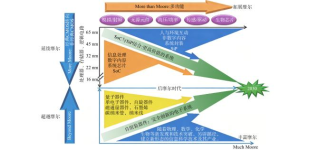
Perhaps more interesting is the road forward:

1772857013008.png

"System-in-package (SiP) is the future direction of extending Moore's Law."
 

Attachments

  • 1772857906911.png
    1772857906911.png
    212.9 KB · Views: 19
Last edited:
In contrast, the EUV status report seems to highlight a national-level challenge:

"Reports indicate that China's EUV laser light source, mobile platform, and optical system have all achieved breakthroughs in different units. How to integrate these components with national resources is a problem that must be solved during the 15th Five-Year Plan period. How to create a Chinese ASML, allowing those being integrated to transcend the constraints of personal gain and to centrally allocate funds and human resources, is an urgent issue that relevant departments should immediately formulate and implement." It looks like suppliers for this Chinese ASML could experience financial loss.

Yes, that is exactly what I meant above. No internal competition in China, but collaboration, coordination and integration at the national level. They have the big advantage that they can follow/copy/improve on the path made by ASML, Zeiss, Cymer/Trumpf and many others.
How quickly they can get all this together sourcing all EUV-technology from within their own country we'll find out the coming 5 years I would think.

Here another nice story on the long history of EUV development and how it ended up under the umbrella of ASML in a small country like NL:

https://www.construction-physics.com/p/how-asml-got-euv
An important takeaway from the story of EUV is that developing a technology that works, and successfully competing with that technology in the marketplace, are two different things. Thanks to contributions from researchers around the world, including a who’s who of major US research organizations — DARPA, Bell Labs, the US National Labs, IBM Research — EUV went from unpromising speculation to the next generation of lithography technology. But by the time it was ready, US firms had been almost entirely forced out of the lithography tools market, leaving EUV in the hands of a single European firm to take it across the finish line and commercialize.
 
In this Youtube interview with Dan Gelbart "Solving Impossible Problems for Fun and Profit: Dan Gelbart"
at 27:11 to 32:30 he talks about the moat that ASML has built around their technology, and the challenges
that other companies (and countries) will face competing with ASML.

My impression is that China doesn't need to compete (commercially) with ASML. There will probably be no EUV-tool buyers outside China (TSMC, INTEL, Samsung, SK Hynix, Micron) once available.

China just needs a first (complete) EUV-tool and from that position they just keep building many tools and improve while learning. The question is, how quickly can they source and make everything using China suppliers.

It is "almost" similar to INTEL Foundry, they do not have to compete commercially with TSMC. INTEL foundry will survive simply as a national security asset.

Some other podcasts with the author Marc Hijink on his book Focus, about the EUV-story and ASML:
https://www.amazon.com/Focus-Inside-struggle-complex-machine/dp/B0D7DRJL2W
 
Originally, I had posted their development goals directly from the auto-translation, but the translation contained misleading errors.

Focusing on the process development, their suggested goals for the 15th Five-Year Plan (which ends 2030) are:

1. A controllable and self-reliant 28nm ecosystem
2. Stable 14nm production
3. Preliminary completion of the construction and trial operation of the fully domestically supplied 7nm production line.
 
China just needs a first (complete) EUV-tool and from that position they just keep building many tools and improve while learning. The question is, how quickly can they source and make everything using China suppliers.
The article briefly mentioned that Shanghai Microelectronics Equipment (Group) Co., Ltd.'s 28nm lithography machine (ArF, Immersion) "has entered the process testing stage." So how well they will do there is still a question.
 
In this Youtube interview with Dan Gelbart "Solving Impossible Problems for Fun and Profit: Dan Gelbart"
at 27:11 to 32:30 he talks about the moat that ASML has built around their technology, and the challenges
that other companies (and countries) will face competing with ASML.
Thanks for sharing it's a real nice interview to listen to

27:11 to 32:30
ASML built an unbeatable supply chain by sourcing every critical component from the world’s best specialists—Zeiss for mirrors, Philips for metrology, Cymer for EUV light sources—locking them into exclusive partnerships that China cannot replicate because it would require recreating both the technologies and the decades‑honed craftsmanship behind them.

32:30 to 39:37
And because these machines rely on components with atom‑level tolerances, any imperfection causes irreversible loss of precision in the image, meaning no amount of software, feedback, or computing power can compensate for a fundamentally flawed optical or mechanical base.

>> One of the like most famous precise instruments now is the ASML stepper.
>> Oh yeah.
>> Right. which is now being sold, you know, for $300 million and so on. And it's kind of considered like that nobody can make one besides ASML and so on >> and and and the Chinese are desperate to make one and fail in.
>> Have you have you been tempted to make a stepper?
>> The thing is in order to make one you have to believe you have a better idea >> than others. and I don't have the knowledge to even know if if I will have a better idea. You know, you have to spend time and understand it because it's immensely complicated technology. I mentioned before that I worked on this nonlinear resist nonlinear thermal resist which I thought could be the basis of a higher resolution stepper and we did develop together with a university here in town a very good thermal resist and and we modeled it and tested it but
>> so it's a resist which you when you heat it with two
>> change solubility yes it's a photo resist but thermally activated which is totally nonlinear so that part is very good but with today's geometries you run into the basic optics problem.
So basically first there is two ideas one idea to approach it from making the ideal resist that has no cross stop no proximity effect and you can achieve that with special ideas and resist but you still don't get around the problem how do you bring the wavelengths down so much so that you can write nanometer lines and as you know in the ASML current machine a huge part of the money was to develop the UV source which is
>> and optics.
>> Well, the optics are mirrors but but the problem was to make them so perfect.
>> Exactly.
>> There is a very good video by Veritasio and that's which shows the difficulty gives you an idea of the difficulty. I visited ASML many years ago. But most people don't understand why did ASML succeed where everybody failed including China which put in billions into this effort and ASML succeeded where everybody failed because they went against common wisdom in manufacturing because common wisdom is always never rely on a single source because that single source lets you down you're stuck. So everybody was taught if you manufacture you have to have multiple sources for each part. But you know the usual story. ASML said no no this is not the way to succeed. The way to succeed is find the best supplier in the world for each component each critical component >> and make an exclusivity deal with them that they can only make it for you and you can never buy this part for somebody else. So ASML looked around and said who is the company which makes the best lenses and optics in the world and that was clearly Zeiss Carl in Germany the long tradition and they went to Zeiss and says you will make us the lenses and we'll never buy lenses for somebody else but you cannot sell the lenses to anybody and they signed a deal a multi-year deal and the lenses changed.
Original lenses were for 193 nanometer.
Now they are mirrors for EUV but they stayed with the same supplier.
Then they thought who is the best methology place in the world and there was a group at Philillips in Einhovven and Philips is known for light bulbs and refrigerators and appliances. But Philillips had a phenomenally good metrology group and they went to Philillips and says we want to make a deal with your metrology group. We don't care what you do with the rest of your products but they will only work for us and we will not buy from anybody else and they did more than that. They said we will guarantee the profitability of each one of the suppliers.
>> It's like accumulative effect seems like. So for China it seems like in order to make it they need on every single step. So that's a that's a that's a barrier that ASML locked up the best vendor in the world for each component.
There was a company which made the eximer lasers. So ASML bought them.
So some companies they bought and some made this deal. So at the end they ended up that for every critical part of the machine they locked up the best vendor in the world who couldn't sell to anybody else. Okay? And that's why nobody can compete with ASML because to succeed you'll have to find a replacement for Zeiss, a replacement for Philips, a replacement for Sim, replacement for 10 other critical vendors.

>> It's like whole world efforts.
>> Exactly. And that's why the Chinese that's one of the few things they miserably failed and they gave up and now they started again. And you know that they had a disography project for 10 years which failed and now they started again to make an ASML like machine and it seems they got very little progress. They managed to make the source part and it's not as good as ASML after spending a huge amount.
>> Mhm.
>> Why it takes time to get to this level of precision? Can it be accelerated?
>> There is experience of people. There is trade secrets. It's not something you can look up in a book. Yeah, >> especially when you do you have to polish a mirror flat to one atom.
>> Mhm.
>> Okay. There's always some old guys there who know what to do and these are irreplaceable. All right. So that's an amazing story and what is so amazing about ASML is their philosophy that they have single source for everything, the best in the world and that's a barrier.
>> That's super interesting. I I don't think I've heard that analysis.
>> Oh yeah. Yeah. No, that's how they operate. Yeah. As I said, I visited them and I know them well.
>> The best bolts, the best knots, the best mirrors, you know, it's nuts.
>> No, bolts are not somebody else can also make a good enough nut. But if you look at some key elements like the mirrors, the the motions, the lasers, there's about 10 critical elements. If you lock those up be very very difficult especially Z with the lenses and the mirrors because Z you know it's a very long tradition of how to make these optical parts.
>> Yeah I feel like I can understand like well switching the fields like when you go to high precision >> it's like complete different universe like you need to take everything into account. It's true and there's a lot of materials knowledge >> that details you don't take usually >> and there is a lot of experience of older people who've been doing it for many years. That's why I mentioned to you before in this factory where they make the jig bers in that book everybody looks older than I am because these are people who have been doing it 50 years same job >> and and and you just don't understand how they can do it so fast because you know they scrape this thing to sub micron in minutes and you try it takes you days and it's still no good because you know if you've been doing the same thing 50 years you can do it with your eyes closed close to perfection.
>> So do you think that maybe now there's like a big bet on AI kind of pushing the limits on maybe high precision like something which people didn't realize but >> no but >> by trial and error see like >> I think people most people don't make the connection between methology the high precision and computing power because the limit to computing power is methrology. Sure.
>> Because if you you know if you can make denser chips you can compute a lot faster and the and the and the chips the chips take less power because the gates are smaller. You know if the gate is much smaller it takes less power per gate. So you can put more gates on the chip because they they dissipate less power. So, so what limits computing power is the methology of the stages and the methology of the optics and both optics and the positioning it's it's a mechanical limit. How accurate can you make a mechanical part in the case of the mirrors is how you have a shape parabolic shape. Yeah.
>> How accurate can you make this parabola?
It's a mechanical problem and the motion of the stages is you have to move these stages to nanometers. So basically if you had a 10 times better methology you can make computers 10 times more powerful >> but could it work in reverse way like let's say if it's let's say for optics we are not limited by just spherical surfaces. If we go to >> caspherics or more complex patterns which is kind of beyond the no you can have new ideas there but you still need the brute force accuracy.
>> Sure.
>> Because if you make an apheric lens it's even harder.
>> Yes.
>> Because a spherical shape is selfgenerating. Self-generating means if you rub two pieces of glass together there they'll become spherical.
>> Yes. But if you want it aspheric, it's much harder, but it's not self-generating. There is no averaging effect. So spherical is actually self-generating and it relies on averaging like lapping. Any lapping relies on averaging, okay? And selfcorrection. But aspheric is not self-generating. If you rub two piece of glass together, they'll never become a spheric. The shape you want. They'll only become spherical. Okay? So because of that the it doesn't help you can compute better you can model the lens much better with computers but you still have to make it to atomic tolerances >> well I mean like for the tools let's say you will have a control of how you >> uh so okay so this is a common fallacy adjustments >> okay this is a common fallacy for most people who didn't work in this field most people who didn't work in this field says why do we need this raise the precision. Why don't we close the loop >> and measure the error and and do closed loop control and fix it? The >> idea, right?
>> Yeah. The way you take out distortion from an audio amplifier, you close the loop and take out the distortion. So, it turns out you can't in meology because it turns out that the same reasons which limit the accuracy in first place will prevent you from closing the loop. For example, you can calibrate the system to try to take out the errors with a lookup table, but the system will drift. The calibration will drift >> because it will wear if something is not perfect. It will wear at the high spots and it lose its accuracy. So it turns out that using this adaptive or software or feedback or even all kinds of clever feedback, not just normal feedback, but predictive feedback of high order.
>> You can improve the performance 5x 10x but you cannot take something totally bad and add infinite power and make it good.
>> 10x would be great. I mean that's like already >> 10x is is about the limit. So, so all these systems use corrective tables. So, so when I say Philips makes these perfect stages, they still correct them with lookup tables.
>> Okay. But the starting stage has to be astonishingly good that you can improve it a bit with some lookup tables at the end.
>> Okay. And yeah, it does use feedback.
All these ASML machines, they use a lot of sensors and feedback. But the basic system say if you have a parabola which is not perfect parabola there is no software correction for that because it's loss of information. The way to understand it best is think of a low pass filter. If you have an electronics lass filter and you send information through it you lose some of the information. There's nothing you can do after that low pass filter to restore what you lost. And that basically what Shannon came up with saying you have a bandwidth there's only so much information you can pass through this channel nothing will help you you can code and code but we reach that Shannon limit >> no more information can be trans the channel now the same is true for optics the information meaning the sharpness of the image okay if you have some bad optics and you get some bad image so there's some tricks you can recover some of the operations but basically information is lost and that information lost cannot be recovered by any any tricks.
>> Mhm.
>> So, so if the parabolic mirror in ASML machine is not the perfect parabola, there will be some blur and that's it.
Instead of a sharp edge, you get a soft edge to the line. There's nothing you can do which will help you. So, there is a fundamental limit. However, if the line is very sharp and accurate, software can position it if there is some small error and uh you have also a problem with aligning the different layers in a chip and this can be done by feedback. You sense the position and
align it.

 
Thanks for sharing it's a real nice interview to listen to

27:11 to 32:30
ASML built an unbeatable supply chain by sourcing every critical component from the world’s best specialists—Zeiss for mirrors, Philips for metrology, Cymer for EUV light sources—locking them into exclusive partnerships that China cannot replicate because it would require recreating both the technologies and the decades‑honed craftsmanship behind them.

32:30 to 39:37
And because these machines rely on components with atom‑level tolerances, any imperfection causes irreversible loss of precision in the image, meaning no amount of software, feedback, or computing power can compensate for a fundamentally flawed optical or mechanical base.
Also, the components of ASML's EUV systems are individually expensive and many would only be used just for those kinds of systems. Even something that may sound trivial like precision maglev vacuum stages. Hydrogen-proofing makes it sound less trivial.
 
So, so if the parabolic mirror in ASML machine is not the perfect parabola, there will be some blur and that's it.
Instead of a sharp edge, you get a soft edge to the line. There's nothing you can do which will help you. So, there is a fundamental limit.
Well, this may not age so well, as there is plenty of blur that does not come from ASML's machine, namely, the resist (from the electrons, and in a lot of cases, acids).
 
Back
Top