Array
(
    [content] => 
    [params] => Array
        (
            [0] => /forum/threads/ai-data-centers-are-forcing-dirty-%E2%80%98peaker%E2%80%99-power-plants-back-into-service.24256/
        )

    [addOns] => Array
        (
            [DL6/MLTP] => 13
            [Hampel/TimeZoneDebug] => 1000070
            [SV/ChangePostDate] => 2010200
            [SemiWiki/Newsletter] => 1000010
            [SemiWiki/WPMenu] => 1000010
            [SemiWiki/XPressExtend] => 1000010
            [ThemeHouse/XLink] => 1000970
            [ThemeHouse/XPress] => 1010570
            [XF] => 2030770
            [XFI] => 1060170
        )

    [wordpress] => /var/www/html
)

AI data centers are forcing dirty ‘peaker’ power plants back into service

Daniel Nenni

Admin
Staff member
Dirty Power AI Data Centers.jpg


- AI data center electricity demand revives peaker power plants
- Peakers emit more pollution when they run than typical power plants
- The power plants are often located in low-income, minority communities

CHICAGO, Dec. 23 - In Chicago’s working-class Pilsen neighborhood, a 60s-era oil-fired power plant rises up from an industrial lot behind Dvorak Park, which in warmer weather is packed with children climbing on its colorful playground and zooming down slides.

The rarely-used eight-unit Fisk power plant owned by Houston-based NRG Energy was scheduled to retire next year. But then came electricity demands from artificial intelligence.

Prices shot up in the country’s biggest power market – PJM Interconnection – as electricity requests from data centers exceeded existing supplies, sounding the alarm over power shortfalls, and making Fisk and other plants like it suddenly profitable.

"We believe there's an economic case to keep them around, so we withdrew the retirement notice,” said Matt Pistner, senior vice president of generation at NRG, of Fisk’s eight power-generating units.

The Fisk power plant is among a growing number of so-called “peaker” electric generating units being pressed into duty across the U.S. as the nation’s electrical grids struggle to keep up with growing demand from data centers powering Big Tech’s investments in artificial intelligence.

Peakers, which are meant to run only in short bursts during periods of spiking electricity demand, help stave off blackouts by supplying power on a moment’s notice. But there’s a trade-off: these often decades-old, fossil-fueled facilities emit more pollution when they are running and cost more to produce electricity than continuous power plants.

A Reuters analysis of filings with the country’s biggest power grid shows that about 60% of oil, gas and coal power plants slated for retirement in PJM postponed or cancelled those plans this year. Most of the plants averting shutdowns are peaker units.

The Fisk peakers were built on the site of a now-defunct coal-fired electricity generating station that operated for over a century. After years of fierce opposition by local residents, the coal plant shut more than a decade ago, but eight peaking units that run on petroleum oil continue to operate on the site.

“When we found out that the coal plant was closing but there was still going to be power produced at the site, it was very disappointing,” said Jerry Mead-Lucero, a longtime advocate for the closure of the Fisk coal station who spent most of his adult life in Pilsen.

Following the coal plant closure, pollution plummeted, but it didn’t vanish. Sulfur dioxide ranged from about 2 to as much as 25 tons per year from the site, according to the Environmental Protection Agency, as the eight-unit peaker plant occasionally lumbered to life to feed the grid.

"That's not an insignificant amount considering the low chimneys and homes nearby," said Brian Urbaszewski, Director of Environmental Health Programs for Respiratory Health Association, an Illinois nonprofit that focuses on helping people with respiratory disease.

DIRTY POWER
Because they were built for speed instead of efficiency, peakers often do not have pollution controls like mercury scrubbers, which remove the toxic chemical from the power plants’ emissions, and filters for particulate matter, according to academic and federal government research.

Some also have lower smokestacks, or chimneys, environmental advocates say, meaning pollution can be more concentrated locally.

Keeping peakers running longer may accelerate under U.S. President Donald Trump’s administration, which said it was exploring ways to tap into existing power sources, including peaker plants and other emergency systems, to quickly meet the massive new electricity demand.

“There are a ton of peaker plants that could operate more,” U.S. Energy Secretary Chris Wright told Reuters in an interview in September, adding that clean air regulations have kept more from running more frequently. “The biggest targets are spare capacity on the grid today.”

While peaker plants contribute about 3% of the country’s power, they have the total capacity to produce 19%, according to a report by the U.S. Government Accountability Office.

Tapping into that spare capacity, however, could mean more harmful emissions being spewed into neighborhoods that are often already overburdened with environmental hazards.

The country's roughly 1,000 peaker plants are disproportionately located in low-income communities of color, according to academic and federal government research, meaning that extending the plants’ lives could leave vulnerable Americans to bear the brunt of more pollution.

A 2022 study of formerly “redlined” U.S. communities, which were cut off from financial services like mortgages for being predominantly Black or immigrant, found that residents were 53% more likely to have had a peaker plant built nearby since the year 2000 than in non-redlined areas.

“If you were a redlined neighborhood, you were more likely to have a fossil fuel power plant built nearby, and we saw that relationship was even stronger for peaker plants,” said UCLA professor of environmental health sciences Lara Cushing, who led the study.

POWER DEMANDS STRAINING THE GRID
Most of the country's peaker plants were built during two periods of growth in energy consumption: in the mid-20th century as electrical appliances became common household items, and at the turn of the millennium as the economy grew and computers gained popularity. Afterwards, as energy-sapping devices and infrastructure became more efficient, U.S. power demand waned and many fossil-fired power plants shut.

Meanwhile, solar and wind farms, which only produce power when the sun is shining and the wind is blowing, began to supply more of the country’s energy.

"We're kind of making the old system work harder and that's part of why we're seeing this increased use of plants operating as peakers," said Frank Rusco, a director with the Government Accountability Office, which was directed by U.S. Congress, at the urging of environmental justice groups, to study the use of peaker plants and how they intersect with American communities.

The study found that natural gas peaker plants emit 1.6 times more sulfur dioxide for each unit of electricity produced on a median basis compared to non-peaker plants.

Fisk is part of the nation’s largest electrical grid, PJM Interconnection, which stretches across 13 states and covers the world’s biggest concentration of data centers. Demand from AI data centers is threatening to engulf the grid’s power reserves, and it is already driving up prices.

Prices paid to power suppliers in PJM to ensure plants run at times of spiking demand soared by more than 800% this summer, compared to a year earlier. That made owning peaker power plants much more lucrative.

“It is clear today, nationally, that electricity demand is outstripping supply – the market reflects this, and generators are responding,” PJM spokesman Jeff Shields said. “We cannot afford to lose existing generation while we continue to bring on new generation to keep pace with the electricity needs of data centers and other large loads powering the country’s economy.”

About 23 oil, gas and coal power plants in PJM territory were scheduled to retire starting in 2025 or shortly after, according to a Reuters analysis of letters sent to PJM Interconnection by power companies.

Since January, U.S. power companies, the grid operator, and the federal government have delayed or cancelled the retirements of 13 of those power plants, the letters showed. Of those plants that averted closure, 11 were peakers.

Among those delayed were the roughly 55-year-old units at the “Eddystone” plant outside of Philadelphia, owned by Constellation Energy, which were ordered to keep running by the Department of Energy. The Wagner peaker near Baltimore, meanwhile, was kept alive at the request of PJM while the grid operator coordinates on the transmission needed for the removal of the generator.

Many of the retained power plants were built as peakers, while others were initially intended to be around-the-clock power, but later downgraded to run only during emergencies.

‘LAST LINE OF DEFENSE’
Fisk owner NRG Energy says peakers are essential safeguards for the grid that are being called on more often not just for data centers but for the electrification of manufacturing and transportation, and to avert blackouts caused by increasingly severe winter storms and summer heatwaves.

Having the Fisk peakers in the city means that Chicago doesn’t need to import electricity in the case of an emergency when outside power sources go down.

“They really are the last line of defense, and the shock absorber, for the system,” said Matt Pistner of NRG Energy. “When they’re needed, there is no other place to go.”

While NRG has owned power generating sources from nuclear energy to wind and solar, oil-fired peakers add another layer of certainty by ensuring the power fuel source can be stored on site, Pistner said.

“During its run times, the power plant consistently operates within federal and state environmental regulations — and we are proud of its record," an NRG spokesman told Reuters separately.

Energy experts say there are alternatives to peakers. Investing in more robust transmission lines could transport electricity from parts of the country with oversupplies of power to those with shortfalls.

"If we do that, the system would run more efficiently and you would probably have a reduction in the amount of reliance on peakers," said the GAO's Rusco.

Batteries, which are undergoing technological improvements to store power for longer, could also replace many peaker units, according to clean energy advocates.

In the meantime, as AI power demand rises, communities like Pilsen, which have successfully fought to close some pollution sources in recent history, may find peaker plants more difficult to fight.

“It all adds up to significant cost increases for electricity consumers and significant increases in local pollution and will prevent new clean energy generation from connecting to the grid," said John Quigley, of the University of Pennsylvania’s Kleinman Center for Energy Policy.

PJM said it would continue to connect carbon-free renewable power, nuclear and gas-fired energy to the grid regardless of whether peakers stay on longer.

"We need every single megawatt of energy we can get right now," Shields said. Deactivating existing power plants, he added, "ignores reality."

Northern Illinois is a budding data center market, with at least one data center already operating in Pilsen and multiple other energy-intensive projects planned for nearby areas, including a 20-building campus announced this year by T5 Data Centers.

Mead-Lucero worries that the Fisk peaker units will continue the legacy of environmental hazards plaguing his hometown, which also sees emissions from industrial truck traffic, a metal scrapper and a major highway cutting through the neighborhood. “You add all of these compounding factors, and you end up with a real problem again.”

 
It’s a real shame we have to put the nearly-retired peakers, especially the most heavily polluting 10% that run on oil, back in service. But in my mind, energy policy decisions are the main cause here, not data centers that some people want to make out as villains. To put numbers in energy perspective, all US data centers will use an aggregate 200TWh of energy in 2025 while all refineries will use something like 1,100TWh (including oil and electric energy).
 
It’s a real shame we have to put the nearly-retired peakers, especially the most heavily polluting 10% that run on oil, back in service. But in my mind, energy policy decisions are the main cause here, not data centers that some people want to make out as villains. To put numbers in energy perspective, all US data centers will use an aggregate 200TWh of energy in 2025 while all refineries will use something like 1,100TWh (including oil and electric energy).
I'm missing your point.
 
I'm missing your point.
Fair enough - data centers aren’t the problem. These peakers, especially the dirty oil ones, were on their way out, likely to be replaced by renewables and batteries, until the change in government policy that put the brakes on renewables and mandated keeping the peakers in service to ensure “reliable” supply for data centers. This article presents data centers as the “villain” but they are far from the biggest users of energy in the country, and the retention of these dirty sources is being driven policy interacting with increased demand for electricity, not just demand alone.

ps: what’s also odd is that the EIA slots data centers into Commercial electricity usage, rather than Industrial, even though they look more like a factory nowadays in terms of scale and economic model (token factories).
 
Fair enough - data centers aren’t the problem. These peakers, especially the dirty oil ones, were on their way out, likely to be replaced by renewables and batteries, until the change in government policy that put the brakes on renewables and mandated keeping the peakers in service to ensure “reliable” supply for data centers. This article presents data centers as the “villain” but they are far from the biggest users of energy in the country, and the retention of these dirty sources is being driven policy interacting with increased demand for electricity, not just demand alone.

ps: what’s also odd is that the EIA slots data centers into Commercial electricity usage, rather than Industrial, even though they look more like a factory nowadays in terms of scale and economic model (token factories).

what do you think about nuclear power? seems to be the only high density power source. we are generations ahead now in technology to make it safe and handle the waste.
 
what do you think about nuclear power? seems to be the only high density power source. we are generations ahead now in technology to make it safe and handle the waste.

I'm all in favor of the new generation of SMRs (small modular reactors) if we can commercialize them quickly. There are something like 74 SMR designs in the pipeline, but only 3 operational, of which none are in the US.


As for the large scale one-off nuclear plant, they don't seem cost effective between construction and decommissioning costs. The 2 newest large-scale utility reactors in the US, Vogtle 3 and 4, have cost 2 1/2 times as much money as California has spent on High Speed Rail to date ($37B), and took 15 years to build.


The current pricetage for decommissioning runs around $5B.

 
I'm all in favor of the new generation of SMRs (small modular reactors) if we can commercialize them quickly. There are something like 74 SMR designs in the pipeline, but only 3 operational, of which none are in the US.


As for the large scale one-off nuclear plant, they don't seem cost effective between construction and decommissioning costs. The 2 newest large-scale utility reactors in the US, Vogtle 3 and 4, have cost 2 1/2 times as much money as California has spent on High Speed Rail to date ($37B), and took 15 years to build.


The current pricetage for decommissioning runs around $5B.

wow. wonder what's behind those cost and time. with the demand of power right now, surely there can be startups building this in much more competitive way
 
I'm all in favor of the new generation of SMRs (small modular reactors) if we can commercialize them quickly. There are something like 74 SMR designs in the pipeline, but only 3 operational, of which none are in the US.

I like this concept too, mostly because the reactors are standardized designs built in a factory, and the generation plants that house them will be orders of magnitude simpler than the full-custom large-scale plants.
As for the large scale one-off nuclear plant, they don't seem cost effective between construction and decommissioning costs. The 2 newest large-scale utility reactors in the US, Vogtle 3 and 4, have cost 2 1/2 times as much money as California has spent on High Speed Rail to date ($37B), and took 15 years to build.
There were numerous issues encountered during the construction process, not the least of which was a dearth of workers in the US with experience in nuclear plant construction. The Westinghouse AP1000 reactor in the Georgia plants is used around the world, including being operational in China, but construction delays in the US due to lack of experience at multiple levels extended production timelines for years.
GCV is a political action group highly biased to renewables and batteries. While I agree with their financial criticism of the Georgia plants, their lack of practical alternatives make them look silly.
The current pricetag for decommissioning runs around $5B.

I can't believe it's only $5B. Unless they're just going to let "the boobs" sit there on the beach forever.

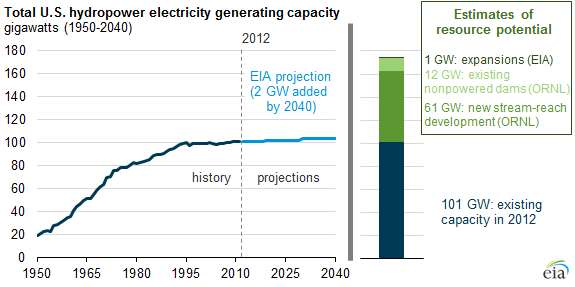
The only really practical, safe, and buildable large-scale power plants in the US have been hydropower. The Grand Coulee Dam in Washington produces 6.8GW of power. Of course, that pales in comparison to the 22.5GW China produces at the Three Gorges Dam. I suspect that if you add up all of the environmental costs of the various generation alternatives for electric power, considering mining, fuel production, emissions, and safety, hydropower is really the best for the environment overall. But I can't imagine what it would take to expand hydropower in the US. Environmentalists never seem to consider the big picture justification cases, only their personal agendas.
 
wow. wonder what's behind those cost and time. with the demand of power right now, surely there can be startups building this in much more competitive way
The first 3 US SMRs will likely come online in early 2030's, even with accelerated NRC licensing / approvals.
• TVA’s Clinch River GEH BWRX‑300: TVA has submitted an NRC construction permit, and DOE has awarded up to about 400 million dollars to accelerate deployment, with commercial operation of the first unit targeted for the early 2030s. But GE/Hitachi, not a startup.
• Holtec’s Palisades SMR‑300: Holtec plans to build two SMRs alongside restarting the existing Palisades plant, backed by up to about 400 million dollars in DOE cost‑sharing for early deployment. Holtec isn't a startup either.
• Natrium's 345 MWe sodium‑cooled fast reactor - TerraPower initially aimed for a 2028 start but delayed about two years due to HALEU fuel supply constraints; the current target is first fuel loading and operation around 2030–2031.

Leaves quite an energy gap that we need to fill.
 
GCV is a political action group highly biased to renewables and batteries. While I agree with their financial criticism of the Georgia plants, their lack of practical alternatives make them look silly.
The cost is the cost no matter who reports it, though the next bunch of AP1000s might be cheaper to build, now that the design NRE has been funded, the kinks have been worked out, and some workers have new experience. But who's willing to take the economic risk ?
But I can't imagine what it would take to expand hydropower in the US.

Pretty sure the limits on this one are economic as well. There just aren't that many economically feasible hydropower sites left in the US, unless you considering pumped-hydro, in the mix.


Environmentalists never seem to consider the big picture justification cases, only their personal agendas.

My take is that there are an awful lot of "environmentalists" in the US who do things entirely for personal interests, in lieu of protecting the environment:

A long list of NIMBY "environmental" lawsuits attempting to stop California High Speed Rail.
• County of Kern v. CAHSR Authority; City of Bakersfield v. CAHSR Authority
• County of Kings v. California High‑Speed Rail Authority
• Coffee‑Brimhall LLC; First Free Baptist Church; Dignity Health v. CAHSR Authority
• Town of Atherton v. California High‑Speed Rail Authority (Peninsula program EIR)
• Millbrae CEQA suit (Millbrae Station / maintenance facilities)
• City of Brisbane & Baylands Development Inc. v. CAHSR Authority

The ultimate faux-environmentalist NIMBY CEQA lawsuit that stoppered up UC Berkeley's new dorm plans for People's park, by claiming more students represent "noise pollution".
• Make UC a Good Neighbor v. The Regents of the University of California.

I'm guessing any attempts to build more reservoirs in areas with private land ownership would incur the wrath of these types of "personal property environmentalists"
 
The cost is the cost no matter who reports it, though the next bunch of AP1000s might be cheaper to build, now that the design NRE has been funded, the kinks have been worked out, and some workers have new experience. But who's willing to take the economic risk ?


Pretty sure the limits on this one are economic as well. There just aren't that many economically feasible hydropower sites left in the US, unless you considering pumped-hydro, in the mix.


My take is that there are an awful lot of "environmentalists" in the US who do things entirely for personal interests, in lieu of protecting the environment:

A long list of NIMBY "environmental" lawsuits attempting to stop California High Speed Rail.
• County of Kern v. CAHSR Authority; City of Bakersfield v. CAHSR Authority
• County of Kings v. California High‑Speed Rail Authority
• Coffee‑Brimhall LLC; First Free Baptist Church; Dignity Health v. CAHSR Authority
• Town of Atherton v. California High‑Speed Rail Authority (Peninsula program EIR)
• Millbrae CEQA suit (Millbrae Station / maintenance facilities)
• City of Brisbane & Baylands Development Inc. v. CAHSR Authority

The ultimate faux-environmentalist NIMBY CEQA lawsuit that stoppered up UC Berkeley's new dorm plans for People's park, by claiming more students represent "noise pollution".
• Make UC a Good Neighbor v. The Regents of the University of California.

I'm guessing any attempts to build more reservoirs in areas with private land ownership would incur the wrath of these types of "personal property environmentalists"
agree. California seems to lead the nation in such "environmental" regulations. Recall spaceX has to change to TX for their launch sites.

perhaps more Federal lands can be used for these purposes.
 
Recall spaceX has to change to TX for their launch sites.
They can't for what they need from California.

For maximum effect, you want to launch in two directions, east for near-equatorial orbit because you get to add the Earth's rotational velocity, and north or south for polar orbits which see the whole Earth as it turns beneath them.

Texas is not bad for the first, but in the US we use Vandenberg Space Force Base for polar orbit satellites because there's no landmass south of it until Antarctica. We also use it for a lot of tests going west where we don't care much about orbiting or about range, like for ICBMs and their interceptors.

So there are vigorous "build absolutely nothing anywhere near anything" or anyone (BANANA) efforts to stop or limit all launches from there, and SpaceX in particular because they're the only company seriously expanding the number of their launches, and now of course because of politics.
 
California seems to lead the nation in such "environmental" regulations. Recall spaceX has to change to TX for their launch sites.
My view from California is that only part the problem is the regulation, the other part is the NIMBY individual mentality that uses what should be safeguards for everybody, to safeguard their interests over others. When residents of a university town claim students are “noise pollution” or people who have lived next to train tracks for years sue to prevent new services, the abuse is obvious.

And quite honestly, we’re seeing a mix of legitimate and NIMBY environmental lawsuits against Tesla, SpaceX and Boring Company in Texas nowadays. Some of them involve debris raining down on people, and some involve neighbors who think the Tesla/Boring facility is an eyesore.
 
My take is that there are an awful lot of "environmentalists" in the US who do things entirely for personal interests, in lieu of protecting the environment:

A long list of NIMBY "environmental" lawsuits attempting to stop California High Speed Rail.
• County of Kern v. CAHSR Authority; City of Bakersfield v. CAHSR Authority
• County of Kings v. California High‑Speed Rail Authority
• Coffee‑Brimhall LLC; First Free Baptist Church; Dignity Health v. CAHSR Authority
• Town of Atherton v. California High‑Speed Rail Authority (Peninsula program EIR)
• Millbrae CEQA suit (Millbrae Station / maintenance facilities)
• City of Brisbane & Baylands Development Inc. v. CAHSR Authority

The ultimate faux-environmentalist NIMBY CEQA lawsuit that stoppered up UC Berkeley's new dorm plans for People's park, by claiming more students represent "noise pollution".
• Make UC a Good Neighbor v. The Regents of the University of California.

I'm guessing any attempts to build more reservoirs in areas with private land ownership would incur the wrath of these types of "personal property environmentalists"
I completely agree. None other than the socialist Robert Reich (former US Sec of Labor) and constant critic of capitalism (at least when he doesn't personally benefit) is one of the most famous NIMBY people going on record for opposing more dense or more affordable housing in Berkeley, because it would negatively impact the character of the community.

I like protecting the environment too, but I also believe humans come first. A few of my most out-spoken "green" friends seem to consider humanity a pox on the planet.

I have been told by former Dept of Energy people that existing hydropower projects could be dramatically upgraded if we chose to, but building the transmission lines to send the power to where it's needed is the biggest challenge. The Grand Coulee lines are 500KV, but China uses 1.1MV lines, which are much more efficient, obviously. A year ago the Bonneville Power Administration started an upgrade of the Grand Coulee transmission lines, but I understand it's mainly for reliability, rather than increasing capacity. The point is, I'm not sure we need very many more hydropower sites as we need to upgrade the ones we have.

We seem to have a problem in the US getting really serious about anything. IMO, it will make us a second-class country in the future if that attitude continues.
 
Last edited:
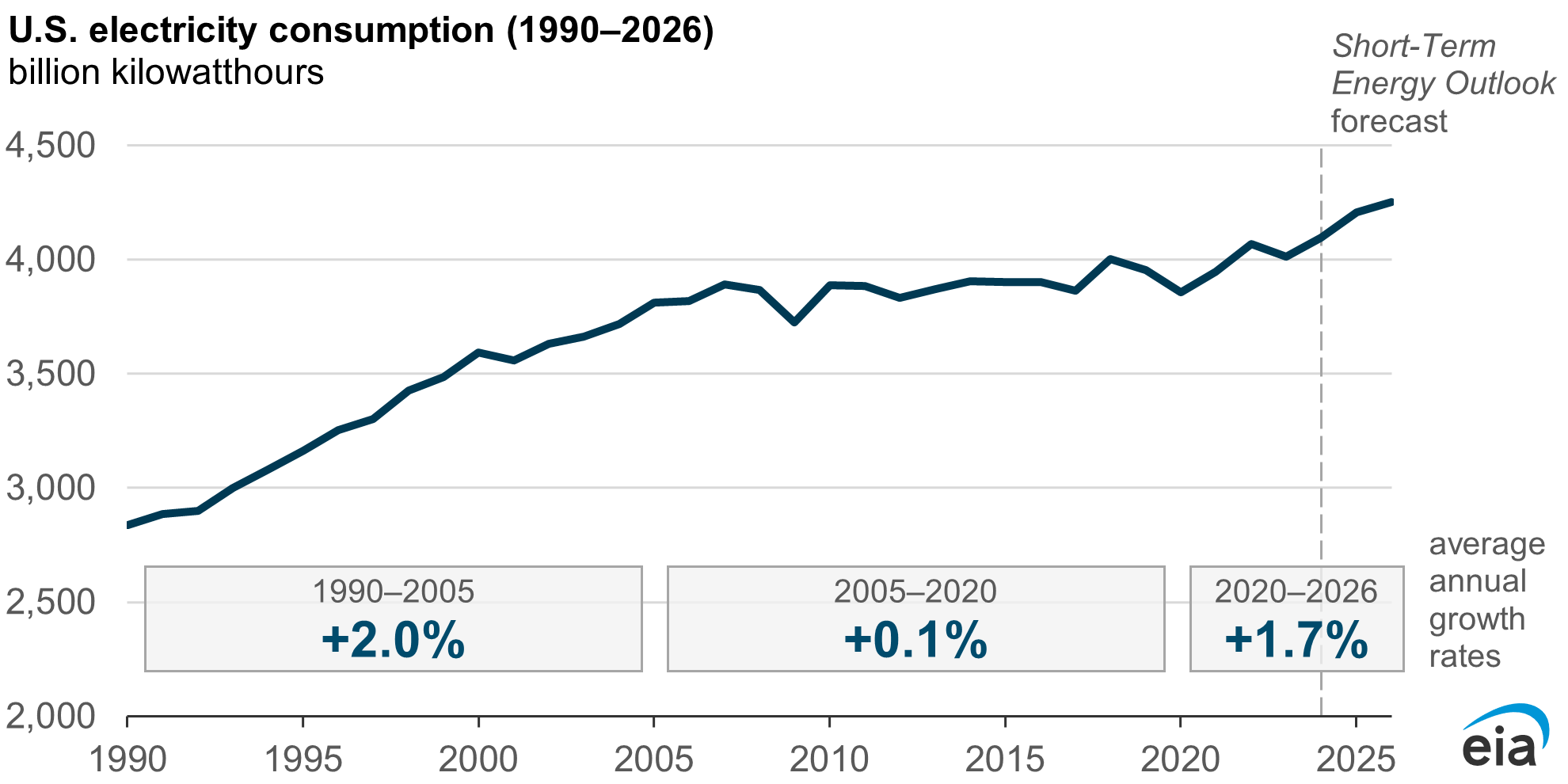
Great website: It is now growing at 1.7%. It is projected to grow at 2.5% annually through 2035 IF we build all the datacenters.

Seems Doable.... IF we want it.

Do we want more electricity in the US or not? Do we want to ban Datacenters or not. Do we want nuclear or not? Do we want to shut down working coal plants or not?
If we want to decide state by state, we can do that as well. "All things are possible, not all things are beneficial" .... just make a decision and lets see what happens.
 
What percentage of electrical use is data centers in the US?
Based on the numbers I have seen, data centers will come in at around 200TWh of electricity usage in 2025 with all usage hitting just over 4,000 TWh. So 5%of all usage today.

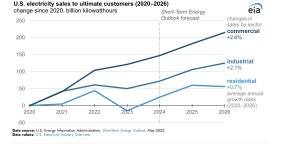
The second chart in the report that @blueone posted shows the issue - 2.6% annual growth in Commerical which is where data centers reside.
 

Attachments

  • IMG_0324.jpeg
    IMG_0324.jpeg
    236.8 KB · Views: 4
Do we want more electricity in the US or not? Do we want to ban Datacenters or not. Do we want nuclear or not? Do we want to shut down working coal plants or not?
If we want to decide state by state, we can do that as well. "All things are possible, not all things are beneficial" .... just make a decision and lets see what happens.
To quote myself, and my answer to your questions:

We seem to have a problem in the US getting really serious about anything. IMO, it will make us a second-class country in the future if that attitude continues.

I wish I was trying to be humorous.
 
I completely agree. None other than the socialist Robert Reich (former US Sec of Labor) and constant critic of capitalism (at when he doesn't personally benefit) is one of the most famous NIMBY people going on record for opposing more dense or more affordable housing in Berkeley, because it would negatively impact the character of the community.

I like protecting the environment too, but I also believe humans come first. A few of my most out-spoken "green" friends seem to consider humanity a pox on the planet.

I have been told by former Dept of Energy people that existing hydropower projects could be dramatically upgraded if we chose to, but building the transmission lines to send the power to where it's needed is the biggest challenge. The Grand Coulee lines are 500KV, but China uses 1.1MV lines, which are much more efficient, obviously. A year ago the Bonneville Power Administration started an upgrade of the Grand Coulee transmission lines, but I understand it's mainly for reliability, rather than increasing capacity. The point is, I'm not sure we need very many more hydropower sites as we need to upgrade the ones we have.

We seem to have a problem in the US getting really serious about anything. IMO, it will make us a second-class country in the future if that attitude continues.
Look, you guys in the US (I assume you are) may have invented this term NIMBY, but frankly you're rank amateurs at this stuff compared to the UK. We're spending £100m on a 1km bat tunnel on our new high speed rail line (300 bats protected - so £333K per bat). Rail line construction started in 2019 and was originally forecast for completion in 2025. The opening date was then put back to 2033. Before they decided to stop forecasting the opening date ...

If there's one thing I admire about the Chinese and the east Asians generally, it's that they just get this stuff done. Consultation and protest, like all work, always expands to fill the time and budget available.
 
Back
Top