






- Samsung Foundry Discusses Order for AMD 2nm Chips;
- Expected to Handle Production of AMD's Next-Generation AI Chip CPUs;
- Anticipation of Securing 2nm Client Following Tesla
[Edaily Reporter Gong Ji-yu] Samsung Electronics has officially begun discussions with AMD regarding semiconductor contract manufacturing (foundry). As orders for artificial intelligence (AI) semiconductors from global big tech companies explode, intensifying supply bottlenecks for semiconductors including central processing units (CPUs), Samsung Electronics' foundry is emerging as an alternative to the existing TSMC.
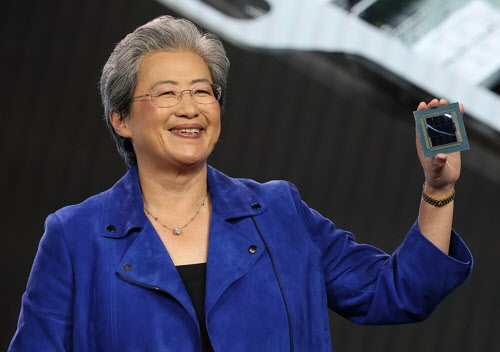
On January 5 (local time), one day before the opening of 'CES 2026,' the world's largest consumer electronics and information technology (IT) exhibition, AMD CEO Lisa Su unveils the next-generation EPYC Server CPU 'Venice' during a keynote speech at the Venetian Hotel in Las Vegas, Nevada. (Photo = Yonhap News)
According to industry sources on the 7th, Samsung Electronics’ Foundry Division is recently advancing discussions with AMD regarding orders for 2-nanometer (nm) chips. It is reported that discussions regarding 2nm orders took place after AMD CEO Lisa Su visited Korea last March to tour Samsung Electronics’ Pyeongtaek foundry plant. Results are expected to materialize soon. As
the trend in the AI era shifts from chatbots that simply answer questions to "Agentic AI" that performs tasks autonomously, demand for CPUs is increasing alongside that for Graphics Processing Units (GPUs). The importance of CPUs has grown as they play a role in managing the entire process of increasingly complex workflows. Consequently, the profitability of AMD, which holds the lead in the CPU sector, is growing rapidly. AMD recorded revenue of $10.25 billion in the first quarter, a 38% increase compared to the same period last year.
Supply bottlenecks are intensifying as CPU demand is rapidly increasing while supply remains limited. AMD entrusts most of its CPU production to TSMC, the world's leading foundry, but TSMC is struggling to meet demand due to a surge in orders from big tech clients such as Nvidia, Tesla, and Apple. It is understood that a significant volume of TSMC's advanced processes of 2nm and below is already pre-booked until after 2028.
AMD’s decision to partner with Samsung Electronics is interpreted as an attempt to diversify its supply chain in this context. The plan is to meet demand by entrusting production to Samsung Electronics, which is currently improving the yield of its 2nm process. As Samsung Electronics secures a portion of AMD’s next-generation CPU production volume, it is expected that foundry opportunities for the company will expand. It
also carries symbolic significance in securing another big tech client following Tesla. Samsung Electronics has officially announced that it has won the order for Tesla’s next-generation AI chip, 'AI6,' and has also agreed to handle the production of the 'AI5' chip. The company plans to kickstart a turnaround to profitability by producing chips using advanced processes of 2nm or smaller for these big tech companies at its Taylor plant in the U.S. starting next year.
AI 병목 CPU로 이동…AMD, 삼성에 2나노 맡긴다
삼성전자가 AMD와 반도체 위탁 생산(파운드리) 논의에 본격 돌입했다. 글로벌 빅테크 기업들의 인공지능(AI) 반도체 주문이 폭발적으로 늘어나면서 중앙처리장치(CPU)를 비롯한 반도체 공급 병목 현상이 심화하는 가운데, 기존 TSMC의 대안으로 삼성전자 파운드리가 떠...
