Source: Future Horizons
Executive Summary
December’s total semiconductor annualised growth rate, at 41.3 percent, was up both on November’s 36.7 percent and October’s 33.0 percent numbers. It was also noticeably higher than the 39.3 percent Covid-boom peak and on a steep upward trajectory.
At first sight, these are numbers to break out the champagne, but the headline glitz and glamour masks a broader industry malaise.
ASP-driven growth is as fickle as a fair-weather friend and our champagne is staying firmly locked in the cooler until we see signs of a unit driven, non-memory, broader-based recovery.
Market Outlook
How long this current ASP-driven market growth spurt can last is notoriously hard to predict. It lasted a year in 2021-22, but if the 2025-26 spurt lasts longer, it will surely slow in 2027.
The big uncertainties remain “How much longer will the AI-driven boom last” and “Is the overall world economy strong enough to sustainably float the broader industry recovery?” Added to these risks now, given the insane memory famine, is “How soon will additional memory capacity come on stream?”
The trigger for the next crash will either be an increase in supply, with its longer gestation time, or a collapse in demand, which would be much more abrupt. In either case, once the impact takes over, ASPs will collapse and the growth pendulum will instantly and irrevocably reverse.
With still no sign yet of any slowdown in current growth, a strong first quarter would blow our plus 12 percent forecast, with an upside of 18 percent, clear out of the water, with an upside now north of 40 percent.
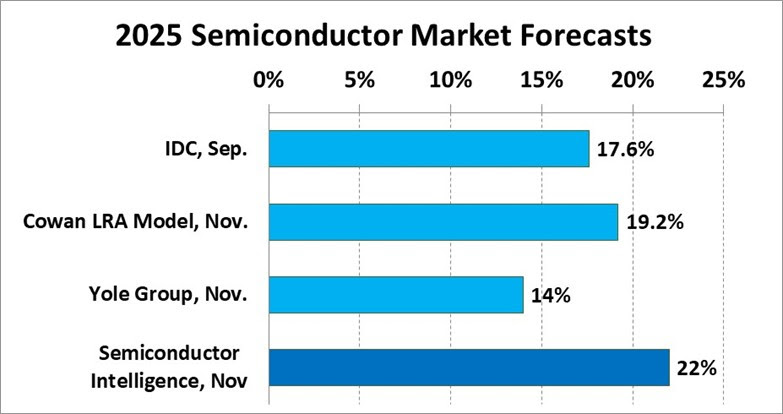
Even if the 2026 market slowed gracefully here on out, year on year growth would still be in the mid- to high- twenties, hence the flurry of recent pronouncements for a trillion-dollar 2026 chip market, up 26.3 percent on 2025, reaching US$ 1.4-1.6 trillion by 2030 and US$ 2.4 trillion by 2035, a Compound Annual Growth Rate of 11.7 percent and a remarkably strong, double-digit, downturn free, uninterrupted home run for the next ten year period.
Whilst we have previously had three consecutive years of strong double-digit growth, namely in 1976-1980, 1986-1988, and 1993-1995, only 1976-1980 lasted more, at five years; the other two crashed in year four.
A global economic slowdown brought the first two chip booms to a close, given any slowdown in demand automatically tippes the supply-demand balance into over-supply, with overinvestment and consequent oversupply in a DRAM market struggling to keep pace with the then booming, Windows OS-driven, PC demand caused the 1996 market to collapse.
Implicit in these current market extrapolations is an inexhaustible end-market demand for AI-hyperscaler infrastructure investment, an insatiable demand for higher-performance processors, and memory supply completely unable to catch up with demand, along with ever-increasing chip prices and an unfaltering global economy.
Even with the most optimistic rose-tinted glasses, that is a pretty tall order, given any one of these failing would bring the bull run to an abrupt end.
It is also something that has never ever happened in the 80-year chip industry history, or the vacuum-tube business before it.
Our overall message for 2026 is clear; enjoy the party if you can but proceed with extreme caution and do not be distracted by 2025’s headline dollar growth. Most of that growth reflects ASP expansion rather than fundamental demand.
A downturn and correction in chip market growth is inevitable and unavoidable, only the trigger and timing is uncertain.
If the trigger is a correction in AI demand, the downturn will happen in Q4-2026.
If that demand stays strong throughout 2026, then the crash will come in Q1-2027 once the additional DRAM capacity comes on stream.
Malcolm Penn
13 February 2060
Future Horizons