





Array
(
    [content] => 
    [params] => Array
        (
            [0] => /forum/threads/intel-is-proud-to-join-the-terafab-project-with-spacex-xai-and-tesla-to-help-refactor-silicon-fab-technology.24892/page-2
        )

    [addOns] => Array
        (
            [DL6/MLTP] => 13
            [Hampel/TimeZoneDebug] => 1000070
            [SV/ChangePostDate] => 2010200
            [SemiWiki/Newsletter] => 1000010
            [SemiWiki/WPMenu] => 1000010
            [SemiWiki/XPressExtend] => 1000010
            [ThemeHouse/XLink] => 1000970
            [ThemeHouse/XPress] => 1010570
            [XF] => 2031070
            [XFI] => 1060170
        )

    [wordpress] => /var/www/html
)

"Intel is proud to join the Terafab project with @SpaceX, @xAI, and @Tesla to help refactor silicon fab technology"

A TSMC Gigafab produces more than 100,000 12‑inch wafers per month. Elon Musk’s “Terafab”, if the name is meant to signal anything, should produce far more.

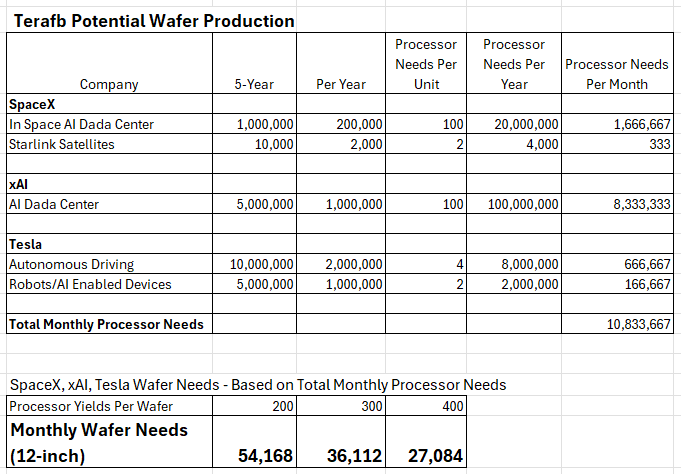
I did a calculation to estimate the wafer demand across all of Elon’s known projects. I may have understated some needs, but I intentionally, and probably significantly, overestimated others. The goal is to gauge potential demand against Terafab’s capacity, resource constraints, feasibility, and the broader impact on the market and on competitors. You can also plug in your own assumptions to explore the scenario further.

To live up to the “Tera” branding, a Terafab would need to produce far more than TSMC’s 100,000‑wafer Gigafab monthly output. Based on the estimates below, the combined wafer demand across SpaceX, xAI, and Tesla is only between 27,000 and 54,000 wafers per month. That means Elon Musk and Terafab would need to secure enormous external orders to reach anything close to “Tera” scale or even true “Giga” scale. Can Musk actually do that?

If Intel is helping Musk achieve Terafab’s massive output, does that mean Intel is effectively building a monster competitor that could quickly hurt Intel itself?


Terafb Potential Wafer Production
1775868321095.png
 
Last edited:
A TSMC Gigafab produces more than 100,000 12‑inch wafers per month. Elon Musk’s “Terafab”, if the name is meant to signal anything, should produce far more.

I did a calculation to estimate the wafer demand across all of Elon’s known projects. I may have understated some needs, but I intentionally, and probably significantly, overestimated others. The goal is to gauge potential demand against Terafab’s capacity, resource constraints, feasibility, and the broader impact on the market and on competitors. You can also plug in your own assumptions to explore the scenario further.

To live up to the “Tera” branding, a Terafab would need to produce far more than TSMC’s 100,000‑wafer Gigafab monthly output. Based on the estimates below, the combined wafer demand across SpaceX, xAI, and Tesla is only between 27,000 and 54,000 wafers per month. That means Elon Musk and Terafab would need to secure enormous external orders to reach anything close to “Tera” scale or even true “Giga” scale. Can Musk actually do that?

If Intel is helping Musk achieve Terafab’s massive output, does that mean Intel is effectively building a monster competitor that could quickly hurt Intel itself?


Terafb Potential Wafer Production

View attachment 4421
Terafab is supposed to be 25B..... with memory and Logic and packaging. That is a pretty small factory (Micro Fab? Kilo Fab?) REALITY? Its a made up affirmation. It should say "Elon plans to do something someday and Intel plans to talk with Elon about it"
Something major may be in the works... but not agreed yet

Its like TSMC saying they will have 12 factories in AZ. The havent opened the 2nd one. they claim 500B in spending. The have spent like 50B in 5 years. These hyperbolic statements need to stop, it is causing irrational exuberance IMO.
 
Terafab is supposed to be 25B..... with memory and Logic and packaging. That is a pretty small factory (Micro Fab? Kilo Fab?) REALITY? Its a made up affirmation. It should say "Elon plans to do something someday and Intel plans to talk with Elon about it"
Something major may be in the works... but not agreed yet

Its like TSMC saying they will have 12 factories in AZ. The havent opened the 2nd one. they claim 500B in spending. The have spent like 50B in 5 years. These hyperbolic statements need to stop, it is causing irrational exuberance IMO.
Or it's a deliberated strategy of Elon, who once claimed spending much less on advertisement than his competitors.
Consider how much people are discussing it, here for example, and how much it equals to the advertisement value.
 
I tihnk I will wait to see what this really is before concluding. We have a mythical memory and logic fab with packaging. Then we have a twitter of a partnership between the mythical fab and the manufacturing company that loses 8B per year.

My current model is that this will have no positive effect on Intel financials for 2+ years. Lets see if anything is announced at earnings. It can't be a meaningful agreement yet or it would require SEC filing.
Tan is copying Musk's homework, remember Musk's "funding secured!"
 
I don't believe 25B is for TeraFab: https://semiwiki.com/forum/threads/terafab-21-march-2026.24804/post-98569

I would imagine that Musk sees the demand of chips from his two companies scaling far beyond their current levels. If not, what would be the impetus for building his own fab?
I (and many media people) total missed that. thank you.

So terafab is all things, everywhere, all at once..... but it doesnt exist yet.

Lets wait until someone presents a actual agreement and committment.

This is actually good for Intel as they could possible unload all their unused shells on Elon for money.
 
Terafab is supposed to be 25B..... with memory and Logic and packaging. That is a pretty small factory (Micro Fab? Kilo Fab?) REALITY? Its a made up affirmation. It should say "Elon plans to do something someday and Intel plans to talk with Elon about it"
Something major may be in the works... but not agreed yet

Its like TSMC saying they will have 12 factories in AZ. The havent opened the 2nd one. they claim 500B in spending. The have spent like 50B in 5 years. These hyperbolic statements need to stop, it is causing irrational exuberance IMO.

My estimate is that the monthly wafer demand across SpaceX, xAI, and Tesla will be between 27,000 and 54,000 12‑inch wafers, even under very optimistic assumptions about their internal needs. But this is still far smaller than TSMC’s Gigafab capacity of 100,000 wafers per month. That gap suggests Elon Musk may already intend to bring in external customers to scale Terafab to something larger than TSMC’s.

1775870370628.png


Although anything is possible, the goal behind Terafab is extraordinarily aggressive. Let’s call it IDM 3.0.

Elon Musk is effectively trying to build an IDM that integrates semiconductor design, logic and memory manufacturing, assembly and packaging, testing, and end‑product manufacturing - including robots, autonomous cars and trucks, consumer and industrial smart‑AI devices, and AI data centers both in space and on Earth.

Traditional IDMs such as Intel and Samsung have, at various points, participated in end‑product manufacturing, but never at the scale Musk is envisioning.

Musk may believe that his IDM (Terafab) will have strong internal and captive customers that provide continuous, reliable orders. What he may not fully appreciate is that Intel once operated under the same assumption and it did not work out well for the past 10 years.
 
Last edited:
My estimate is that the monthly wafer demand across SpaceX, xAI, and Tesla will be between 27,000 and 54,000 12‑inch wafers, even under very optimistic assumptions about their internal needs. But this is still far smaller than TSMC’s Gigafab capacity of 100,000 wafers per month. That gap suggests Elon Musk may already intend to bring in external customers to scale Terafab to something larger than TSMC’s.

View attachment 4425

Although anything is possible, the goal behind Terafab is extraordinarily aggressive. Let’s call it IDM 3.0.

Elon Musk is effectively trying to build an IDM that integrates semiconductor design, logic and memory manufacturing, assembly and packaging, testing, and end‑product manufacturing - including robots, autonomous cars and trucks, consumer and industrial smart‑AI devices, and AI data centers both in space and on Earth.

Traditional IDMs such as Intel and Samsung have, at various points, participated in end‑product manufacturing, but never at the scale Musk is envisioning.

Musk may believe that his IDM (Terafab) will have strong internal and captive customers that provide continuous, reliable orders. What he may not fully appreciate is that Intel once operated under the same assumption and it did not work out well for the past 10 years.

Jensen Huang, Lisa Su, and others are very good at playing by the rules that are given them. And yes they bend rules a bit so maybe we should call them guidelines like in the Pirate of the Caribean.

Elon operates on a different level. He creates his own rules. If you take a close look at his record of success versus failure he is more like a VC. Lots of losses but a few very big wins that more than make up for it.

I like the IDM 3.0 tag but it comes with a lot more risk than IDM 2.0 or TSMC's Foundry 2.0.

The Apple / TSMC relationship is a low risk version of IDM 3.0. If Apple tanked TSMC would still be in business. If Elon's chip projects tank then Intel fabs will be out of business. But with risk comes reward and if I was in Lip-Bu's position I would grab on to Terafab and ride it like a boss, absolutely.
 
Jensen Huang, Lisa Su, and others are very good at playing by the rules that are given them. And yes they bend rules a bit so maybe we should call them guidelines like in the Pirate of the Caribean.

Elon operates on a different level. He creates his own rules. If you take a close look at his record of success versus failure he is more like a VC. Lots of losses but a few very big wins that more than make up for it.

I like the IDM 3.0 tag but it comes with a lot more risk than IDM 2.0 or TSMC's Foundry 2.0.

The Apple / TSMC relationship is a low risk version of IDM 3.0. If Apple tanked TSMC would still be in business. If Elon's chip projects tank then Intel fabs will be out of business. But with risk comes reward and if I was in Lip-Bu's position I would grab on to Terafab and ride it like a boss, absolutely.
Again with the assumptions on Intel role. Is there ANY Indicator that says wafers will be started at Intel factories? Is there a reason to believe it wouldnt be a Licensing deal for 18A/14A (which would not be a massive revenue help)

I will leave the Terafab PR to Musk, But Musk companies are not the largest Fab customers in the world today by any stretch. It is not clear why they would need massive capacity in the future

Please ask musk "what data indicates that you have significant demand for wafers? When will this capacity be needed"
 
Again with the assumptions on Intel role. Is there ANY Indicator that says wafers will be started at Intel factories? Is there a reason to believe it wouldnt be a Licensing deal for 18A/14A (which would not be a massive revenue help)

I will leave the Terafab PR to Musk, But Musk companies are not the largest Fab customers in the world today by any stretch. It is not clear why they would need massive capacity in the future

Please ask musk "what data indicates that you have significant demand for wafers? When will this capacity be needed"

There are several conferences this month, including the TSMC Symposium, so I expect to learn more about Terafab in the coming weeks. It is very difficult to keep anything Intel secret these days so stay tuned for more leaks. But given the information available today (which is not much at all) we can only make assumptions based on what we know about Elon and Lip-Bu. Or we can just wait for an official announcement but what is the fun in that?

My Perspective: Elon Musk and Lip-Bu Tan have much more in common than you might imagine. Both Lip-Bu and Elon are focused on fixing their companies execution challenges. Lip-Bu is pivoting a semiconductor manufacturing legend while Elon Musk is greenfield semiconductor/system level manufacturing. Both support US manufacturing. Both have strong ties to the US Government. Both also have ties to China. Both are risking their legacies.

It all comes down to chemistry. Does Lip-Bu and Elon have chemistry? Can they trust each other? I say yes they can so to me this is a great opportunity for Intel.
 
There are several conferences this month, including the TSMC Symposium, so I expect to learn more about Terafab in the coming weeks. It is very difficult to keep anything Intel secret these days so stay tuned for more leaks. But given the information available today (which is not much at all) we can only make assumptions based on what we know about Elon and Lip-Bu. Or we can just wait for an official announcement but what is the fun in that?

My Perspective: Elon Musk and Lip-Bu Tan have much more in common than you might imagine. Both Lip-Bu and Elon are focused on fixing their companies execution challenges. Lip-Bu is pivoting a semiconductor manufacturing legend while Elon Musk is greenfield semiconductor/system level manufacturing. Both support US manufacturing. Both have strong ties to the US Government. Both also have ties to China. Both are risking their legacies.

It all comes down to chemistry. Does Lip-Bu and Elon have chemistry? Can they trust each other? I say yes they can so to me this is a great opportunity for Intel.


It's back to a fundamental question: is there any reason that the IDM business model will rise again, despite more than three decades of decline?
 
It's back to a fundamental question: is there any reason that the IDM business model will rise again, despite more than three decades of decline?

Yes, for companies that want to create their own silicon. Call it IDM 3.0 for companies that are in a very competitive market. We saw this in mobile, right? How do you compete with companies who use the same SoC and the same software stack?

Apple changed the game by creating their own SOC and software stack. If you create your own SoC you can develop software in parallel to the chip using emulation and prototyping giving you a time to market lead over others who use off the shelf silicon. You can also customize the silicon to better serve the software and visa versa.

Who is the #1 smartphone company? Apple (custom silicon). #2 is Samsung which is split between a custom SoC (Exynos and QCOM Snapdragon). #3 is Xiaomi and they use QCOM, MediaTek, and custom SOCs. Vivo is #4 and they are similar to Xiaomi. Low cost phones use QCOM or MediaTek.

Hyperscalers will follow the same path. They are building custom silicon to better compete. The difference is that cost does not matter since they are not selling chips, they are using them internally. In fact, given the cost of Nvidia chips and the short supply it may be cheaper to make your own.

Apple and TSMC partnered on Foundry 2.0 and now TSMC is unbeatable. Elon Musk and Lip-Bu Tan can do the same for hyperscalers. Apple stayed in the lead by getting most favored nation wafer agreements. Elon can do the same, just my opinion of course. Can Intel Fabs survive with two customers? Intel Design and SpaceX etc...? It certainly seems so.

Next step? Elon makes an investment in Intel and signs a massive wafer agreement with pre pay most favored nation status. Or he just buys Intel Fabs?
 
Back
Top