Array
(
    [content] => 
    [params] => Array
        (
            [0] => /forum/threads/intel-ceo-tan-reconsidering-fate-of-chipmakers-new-manufacturing-tech-cfo-says.24680/
        )

    [addOns] => Array
        (
            [DL6/MLTP] => 13
            [Hampel/TimeZoneDebug] => 1000070
            [SV/ChangePostDate] => 2010200
            [SemiWiki/Newsletter] => 1000010
            [SemiWiki/WPMenu] => 1000010
            [SemiWiki/XPressExtend] => 1000010
            [ThemeHouse/XLink] => 1000970
            [ThemeHouse/XPress] => 1010570
            [XF] => 2030970
            [XFI] => 1060170
        )

    [wordpress] => /var/www/html
)

Intel CEO Tan reconsidering fate of chipmaker's new manufacturing tech, CFO says

Daniel Nenni

Admin
Staff member
1772695345613.png


March 4 (Reuters) - Intel CEO Lip-Bu Tan is now starting to recognize its 18A manufacturing technology as a potential offering for ‌external clients after relegating it largely to internal use last ‌year, Chief Financial Officer David Zinsner said on Wednesday during a tech conference in San Francisco.

This could mark a reversal from a major facet of Tan's turnaround strategy set out last year, when he said he believes Intel's so-called 18A manufacturing process — in which his predecessor Pat Gelsinger had deeply invested — ‌could generate a reasonable ⁠return only if it is used for Intel's own products.

Shares of the company were up about 6% amid a ⁠broader uptick across chip stocks.

"While Lip-Bu was ... thinking that we probably should focus on 14A as a foundry node and make 18A really just an internal node, now that we've got seen some real progress there, I think ‌he's now starting to recognize that this is actually a good node to offer to external customers as well," Zinsner said at the Morgan Stanley Technology, Media and Telecom conference on Wednesday.

Reuters has reported that only a small percentage of the chips printed via 18A have been ‌good enough to make available to customers. Intel has said its yields, or the number of good chips per silicon wafer, are improving monthly. Weak yields also routinely ‌pressure margins.

Since his appointment as CEO, Tan has made big changes to Intel. Last year, Intel cut roughly 20% of its workforce as Tan reshaped the company's strategy to tackle artificial intelligence.

Tan has also vowed ‌to continue to operate Intel's factories and pursue new customers for its next-generation manufacturing tech called 14A.

 
So apparently Intel's CEO Lip-Bu Tan is doing a bit of a U-turn on their 18A manufacturing tech. Last year he was saying this process should stay internal, only used for Intel's own chips, because that's where the return would come from. Now? Looks like he's opening the door to selling it to outside customers after all.

The CFO mentioned at some conference that they've seen real progress with 18A, enough that Tan is reconsidering. Which is interesting because just a while ago Reuters was reporting yield issues - only a small percentage of chips were good enough to actually use. Intel says those numbers are improving every month though.

Shares jumped about 6% on the news, though chip stocks were having a good day overall anyway.

Tan's been pretty aggressive since taking over - cut like 20% of the workforce last year, really pushing the AI angle. Now it seems like he might be willing to let 18A play a bigger role in the foundry business instead of just keeping it in-house.

Still early days but worth watching. If yields really are getting better, having 18A as an option for external clients could change things.
 
Exactly. GO INTEL!
Intel offered it heavily to any and all takers in 2021-2024. Why were there not takers? what has changed? Why is Intel still planning to have 25-30% of its silicon external in 2029

18A planned peak is in 2030. by the time any external customers ramp, 18A will be pretty mature
 
Intel offered it heavily to any and all takers in 2021-2024. Why were there not takers? what has changed? Why is Intel still planning to have 25-30% of its silicon external in 2029

18A planned peak is in 2030. by the time any external customers ramp, 18A will be pretty mature
Maybe because after recent process screw-ups at Intel people wanted to see a real process in real production and yielding before signing up to it?
 
Maybe because after recent process screw-ups at Intel people wanted to see a real process in real production and yielding before signing up to it?
This is true. but since 2025, do you think that IFS has improved its reputation with constraints, yield, costs, and Intel continuing to outsource to TSMC going forward?

Which brings up a question: Why do you think intel choose to use N2 Nova lake for 90% of Nova lake wafers (CPU die)?
 
This is true. but since 2025, do you think that IFS has improved its reputation with constraints, yield, costs, and Intel continuing to outsource to TSMC going forward?

Which brings up a question: Why do you think intel choose to use N2 Nova lake for 90% of Nova lake wafers (CPU die)?
Since 2025 Intel has now got Panther Lake into mass production in 18A, which gives customers confidence that they can actually deliver what they promised -- unlike some previous processes like 10nm where thy tried to do a lot of new stuff and fell over.

Exact yields and costs are a minor concern (and can be argued about/improved later) compared to having a process that can't actually be mass-produced and can destroy your business -- so this will make customers much more willing to go with Intel, at least in 18A -- which seems to be the gist of the announcement.

This may also have increased customer confidence in 14A, though the proof of the pudding is still in the eating.

Why did Intel (product division) choose N2 for Nova Lake? Maybe they had exactly the same concerns as everyone else about whether Intel Foundry could deliver, but knew that TSMC would... ;-)
 
Last edited:
Why did Intel (product division) choose N2 for Nova Lake? Maybe they had exactly the same concerns as everyone else about whether Intel Foundry could deliver, but knew that TSMC would... ;-)
Exactly!

Side note: perhaps we should wait until Fab 52 is loaded to half of planned production capacity before we say 18A is ramped and healthy
 
Exactly!

Side note: perhaps we should wait until Fab 52 is loaded to half of planned production capacity before we say 18A is ramped and healthy
 
Why did Intel (product division) choose N2 for Nova Lake? Maybe they had exactly the same concerns as everyone else about whether Intel Foundry could deliver, but knew that TSMC would... ;-)
It's pretty simple N2 is outright better on PPA according to Intel products and they need that to compete so they went with N2 for high end so the main compute tile went to TSMC
 
It's pretty simple N2 is outright better on PPA according to Intel products and they need that to compete so they went with N2 for high end so the main compute tile went to TSMC
But Intel claim 14A has better PPA than N2... ;-)

(yes I know, it's too late for Nova Lake...)
 
But Intel claim 14A has better PPA than N2... ;-)

(yes I know, it's too late for Nova Lake...)
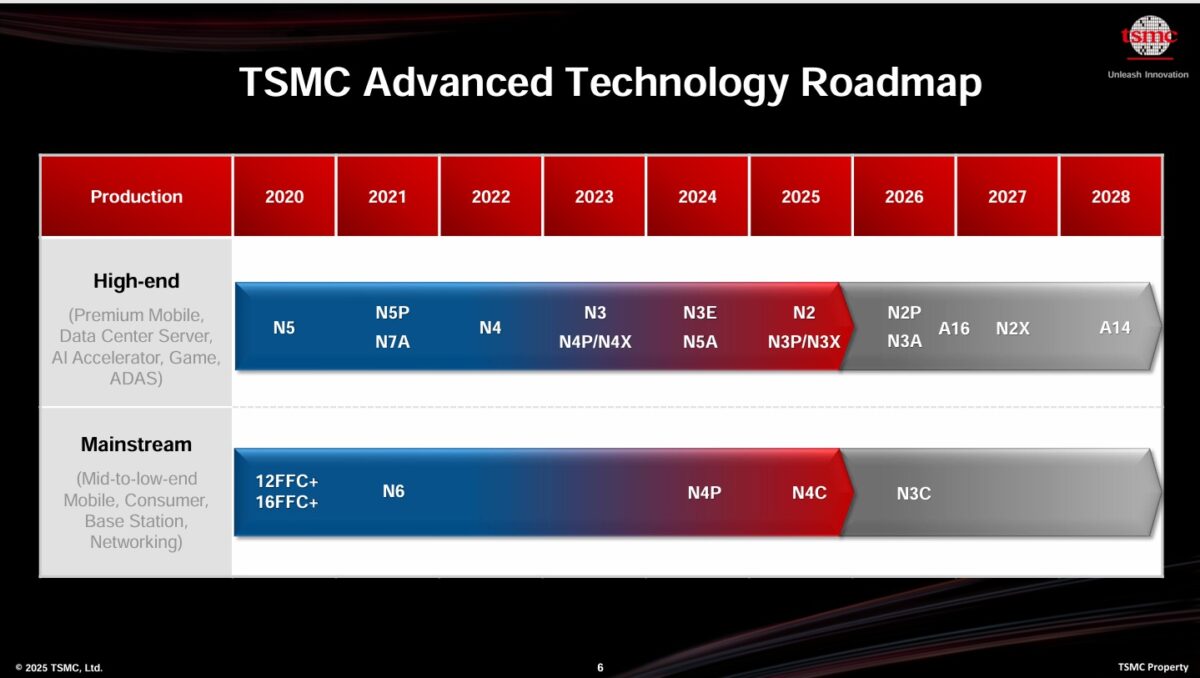
14A is like 27 risk production anyway. I have only heard that Intel rates 18A somewhat near N3P in terms of PPA and 18AP is like close to N2 only in perf/watt but Nova Lake Is N2P
 
14A is like 27 risk production anyway. I have only heard that Intel rates 18A somewhat near N3P in terms of PPA and 18AP is like close to N2 only in perf/watt but Nova Lake Is N2P
Is N2P one of the derivatives of N2 that actually has loosened design rules and is less dense than N2 for manufacturability reasons?

Proof will be in the pudding once we actually see an 18AP product but I think someone here said “the proof is in the pudding that’s being eaten” and that’s N2 😆
 
Back
Top