Array
(
    [content] => 
    [params] => Array
        (
            [0] => /forum/threads/spacex-generated-about-8b-in-profit-last-year-ahead-of-ipo-sources.24448/
        )

    [addOns] => Array
        (
            [DL6/MLTP] => 13
            [Hampel/TimeZoneDebug] => 1000070
            [SV/ChangePostDate] => 2010200
            [SemiWiki/Newsletter] => 1000010
            [SemiWiki/WPMenu] => 1000010
            [SemiWiki/XPressExtend] => 1000010
            [ThemeHouse/XLink] => 1000970
            [ThemeHouse/XPress] => 1010570
            [XF] => 2030871
            [XFI] => 1060170
        )

    [wordpress] => /var/www/html
)

SpaceX generated about $8b in profit last year ahead of IPO: Sources

Daniel Nenni

Admin
Staff member
SpaceX's most recent financials, which have not been previously reported, led some banks to estimate that the company could raise more than $50 billion at a valuation exceeding $1.5 trillion, said the people, who asked not to be named to discuss private conversations.

SpaceX's next-generation Starship spacecraft atop its Super Heavy booster is launched on its ninth test at the company's launch pad in Starbase, Texas, US, May 27, 2025. Photo: REUTERS/Joe Skipper

SpaceX's next-generation Starship spacecraft atop its Super Heavy booster is launched on its ninth test at the company's launch pad in Starbase, Texas, US, May 27, 2025. Photo: REUTERS/Joe Skipper

SpaceX generated about $8 billion in profit on $15 billion to $16 billion of revenue last year, two people familiar with the company's results said, providing fresh insight into the financial health of Elon Musk's space company that is expected to go public later this year.

SpaceX's most recent financials, which have not been previously reported, led some banks to estimate that the company could raise more than $50 billion at a valuation exceeding $1.5 trillion, said the people, who asked not to be named to discuss private conversations.

Reuters reported on 29 January that SpaceX is also in talks with Musk's artificial intelligence company, xAI, about a merger ahead of the IPO.

SpaceX did not immediately return a request for comment.

The profit figure was earnings before interest, taxes, depreciation and amortization, a key measure of operating performance. Musk's satellite-based internet system Starlink is the main revenue driver, accounting for about 50% to 80% of the total, the people said.

The rapid launch of 9,500 Starlink satellites since 2019 has made SpaceX the world's largest satellite operator with over 9 million users of the broadband internet service. The internet service, along with government contracts associated with Starlink and military-grade satellite network Starshield, has generated key revenue to help fund development of the company's next-generation Starship rocket that Musk wants to use to loft more powerful Starlinks into orbit.

The company bought $19 billion worth of wireless spectrum rights from EchoStar last year as it expands Starlink into the direct-to-device market, in which mobile phones can connect directly with Starlink satellites without the need for a Starlink user terminal.

The satellite and rocket company is planning the biggest IPO in the world, close to Musk's 55th birthday on 28 June, the people said.

Musk expects Starship, which has test-launched 11 times since 2023, to start launching payloads into space this year. The billionaire expects to use Starship to eventually launch space-based AI data centers, a risky and nascent pursuit tied to the company's proposed merger with xAI.

 
SpaceX generated about $8 billion in profit on $15 billion to $16 billion of revenue last year, two people familiar with the company's results said, providing fresh insight into the financial health of Elon Musk's space company that is expected to go public later this year.

This $8 billion profit figure represents EBITDA (Earnings Before Interest, Taxes, Depreciation, and Amortization). Net profit margin is also important, or even more important in my view, for this type of business.
 
SpaceX is definitely Musk's greatest achievement. And an amazing achievement. IMO, arguably the greatest entrepreneurial accomplishment ever, worldwide. Even Starlink on its own would be an amazing achievement.

Agreed, well worth an IPO. Elon Musk will be a trillionaire? He owns 40%+ of the shares and controls 80% of the voting rights. Amazing!

Hopefully he starts putting this extra money to good use. It just seems like the world's billionaires could solve world hunger. That would be a great place to start. 50M+ people in the US don't have enough food. That is just disgusting! My kids and I used to volunteer at food banks. It is shocking at how low food banks are today. Meals on Wheels for seniors is also a notable cause.

Come on billionaires, fill those food banks!
 
Reuters reported on 29 January that SpaceX is also in talks with Musk's artificial intelligence company, xAI, about a merger ahead of the IPO.

Is this a rerun of the same scheme as when Tesla bought the financially distressed SolarCity (where Elon was a major shareholder and Chairman), or when xAI acquired Elon Musk’s money losing, heavily indebted X (Twitter)?”

There are at least two possibilities:

1. Elon Musk is a genius - he can step in and rescue a company from total collapse.

  1. 2. Elon Musk is a “genius” - he uses a new business venture to raise more of other people’s money in order to salvage his own failing businesses.
 
Is this a rerun of the same scheme as when Tesla bought the financially distressed SolarCity (where Elon was a major shareholder and Chairman), or when xAI acquired Elon Musk’s money losing, heavily indebted X (Twitter)?”

There are at least two possibilities:

1. Elon Musk is a genius - he can step in and rescue a company from total collapse.

  1. 2. Elon Musk is a “genius” - he uses a new business venture to raise more of other people’s money in order to salvage his own failing businesses.
None of the above. Musk founded SpaceX in 2002.

The only comparable effort I'm aware of is Jeff Bezos with Blue Origin. Bezos seems to be following Musk's basic plan, which includes satellite-based data communications (TeraWave).
 
Hopefully he starts putting this extra money to good use. It just seems like the world's billionaires could solve world hunger. That would be a great place to start. 50M+ people in the US don't have enough food. That is just disgusting! My kids and I used to volunteer at food banks. It is shocking at how low food banks are today. Meals on Wheels for seniors is also a notable cause.

Come on billionaires, fill those food banks!
Sorry to be a dark cloud, but I doubt it. According to the World Food Program USA there are over 700 million people worldwide suffering from malnutrition. Assuming only $500US per year per person would be necessary, that's $350B per year, to solve world hunger. And I have doubts $500 per year per person solves the problem. The administration costs alone would be huge.
 
I'm wondering why SpaceX needs to buy xAI, a company that has spent a lot, needs to raise much more capital and debt, and will probably have no profit for the next several years.

And I was wondering why xAI bought Elon Musk's X (Twitter), another money‑losing, heavily indebted personal business venture of his.

I was also wondering why the other xAI investors allowed xAI to buy Elon’s X while xAI itself is losing money and needs a large amount of capital.

Now I can see a possible reason: a SpaceX IPO and the potential acquisition of xAI would provide Elon Musk and the other xAI investors an exit path to recover their huge investment in xAI, make a large profit, and offload all the debts onto SpaceX.

Amazon alone will spend $125 billion to $140 billion (or more) in CapEx for 2026, with the majority going toward building AI infrastructure. xAI’s investors and Elon Musk know they can’t compete against Amazon, Microsoft, and Google in the CapEx spending that is crucial in the AI race.
 
SpaceX is definitely Musk's greatest achievement. And an amazing achievement. IMO, arguably the greatest entrepreneurial accomplishment ever, worldwide. Even Starlink on its own would be an amazing achievement.
ULA does not like your response ;-)
 
Amazon alone will spend $125 billion to $140 billion (or more) in CapEx for 2026, with the majority going toward building AI infrastructure. xAI’s investors and Elon Musk know they can’t compete against Amazon, Microsoft, and Google in the CapEx spending that is crucial in the AI race.

I don't think xAI needs to spend nearly as much CapEx as Microsoft or Amazon to achieve similar results as far as advancing AI. A lot of xAI's 'use' is "internally facing" -- training the Tesla FSD stack, and eventually prepping to handle logistics for the Cybercab / Robotaxi fleet. I also don't think xAI also really caters to corporate customers (at least not in the way Microsoft and OpenAI do, or even AWS) - B2C alone has less requirements than B2C+B2B. Also consider Deepseek became relevant on a much lower budget -- and Elon has a history of making more out of a lot less.

It's also slightly telling that OpenAI is starting to trail Grok in a number of areas -- Grok had the companion personalities capabilities out first, and also access to current events, news, and feeds well before ChatGPT. Now ChatGPT is trying to add some of these features to shore up revenue before cash burn reality slaps them in the face. Grok may just need to be funded a few quarters longer than ChatGPT to get closer to success..

..

As for the burdens and capital demands per investors -- I think you're on the right track with recovering their investment.

Elon has also stated that if he can't "control" xAI's direction he'll take AI elsewhere with him, away from Tesla -- which kinda forced Tesla investors hands if they wanted to keep Elon around. That's kept the use cases and money flowing between Tesla and xAI, and I suspect some similar dynamics are at play with Twitter/X and xAI (i.e. Twitter drives increased use of Grok, etc).
 
I was referring to start-ups, not big companies trying to act like a start-up.
I'm just kidding around, I 100% agree with your comments - it is a huge achievement.

I'm really happy SpaceX and Musk disrupted the defacto space launch monopoly that was ULA... the company receiving a $1B launch retainer even if they did literally nothing.
 
Sorry to be a dark cloud, but I doubt it. According to the World Food Program USA there are over 700 million people worldwide suffering from malnutrition. Assuming only $500US per year per person would be necessary, that's $350B per year, to solve world hunger. And I have doubts $500 per year per person solves the problem. The administration costs alone would be huge.
hopefully we do not get California type admin overhead, otherwise, you would need 10x funding to achieve original goal
 

February 2, 2026​

xAI joins SpaceX to Accelerate Humanity’s Future

SpaceX has acquired xAI to form the most ambitious, vertically-integrated innovation engine on (and off) Earth, with AI, rockets, space-based internet, direct-to-mobile device communications and the world’s foremost real-time information and free speech platform. This marks not just the next chapter, but the next book in SpaceX and xAI's mission: scaling to make a sentient sun to understand the Universe and extend the light of consciousness to the stars!

Current advances in AI are dependent on large terrestrial data centers, which require immense amounts of power and cooling. Global electricity demand for AI simply cannot be met with terrestrial solutions, even in the near term, without imposing hardship on communities and the environment.

In the long term, space-based AI is obviously the only way to scale. To harness even a millionth of our Sun’s energy would require over a million times more energy than our civilization currently uses!

The only logical solution therefore is to transport these resource-intensive efforts to a location with vast power and space. I mean, space is called “space” for a reason. 😂

By directly harnessing near-constant solar power with little operating or maintenance costs, these satellites will transform our ability to scale compute. It’s always sunny in space! Launching a constellation of a million satellites that operate as orbital data centers is a first step towards becoming a Kardashev II-level civilization, one that can harness the Sun’s full power, while supporting AI-driven applications for billions of people today and ensuring humanity’s multi-planetary future.

Orbital Data Centers​

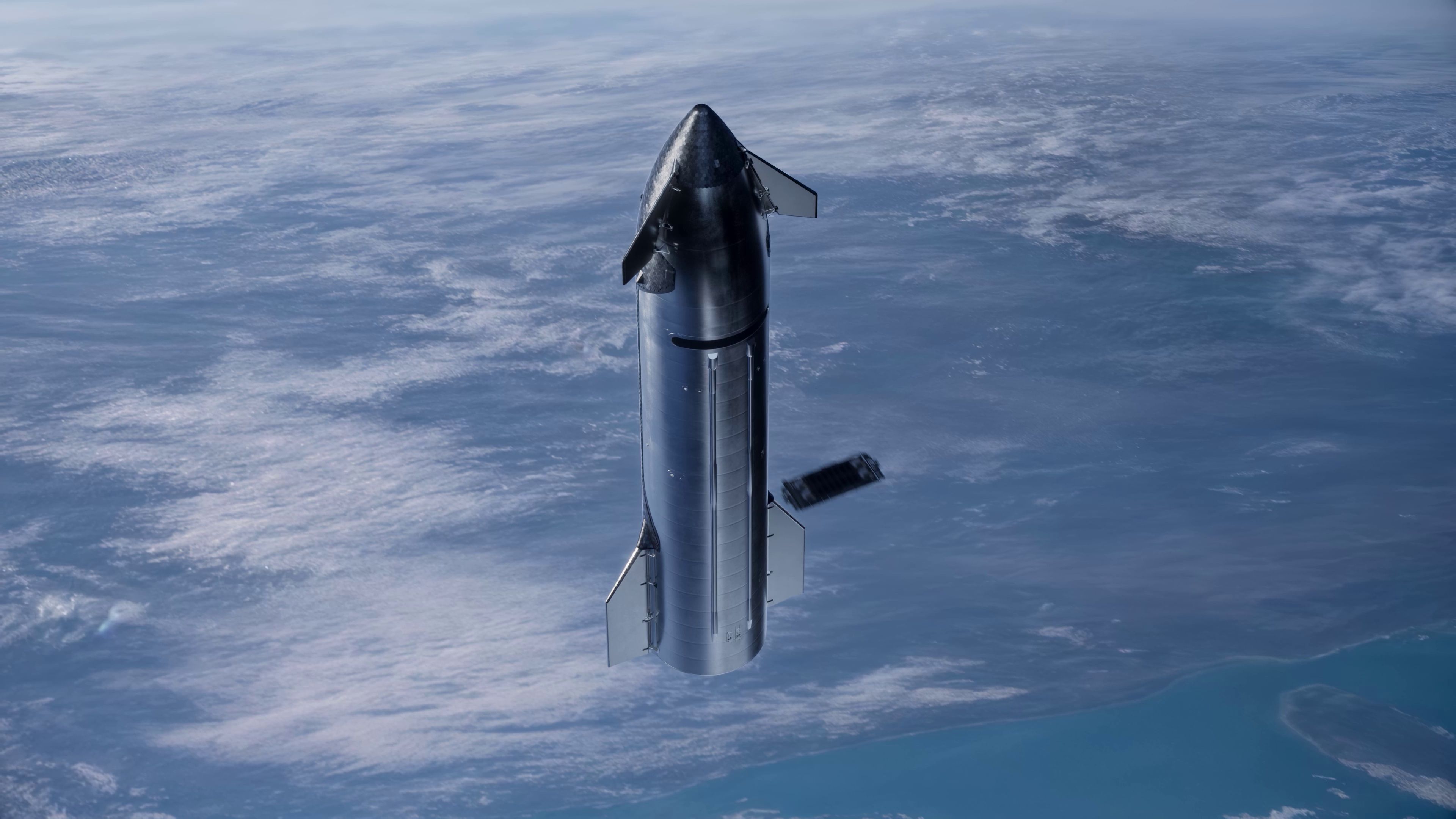
Starship_Deploy_91b8acf776.jpg


In the history of spaceflight, there has never been a vehicle capable of launching the megatons of mass that space-based data centers or permanent bases on the Moon and cities on Mars require. Even in 2025, the most prolific year in history in terms of the number of orbital launches, only about 3000 tons of payload was launched into orbit, primarily consisting of Starlink satellites carried by our Falcon rocket.

The requirement to launch thousands of satellites to orbit became a forcing function for the Falcon program, driving recursive improvements to reach the unprecedented flight rates necessary to make space-based internet a reality. This year, Starship will begin delivering the much more powerful V3 Starlink satellites to orbit, with each launch adding more than 20 times the capacity to the constellation as the current Falcon launches of the V2 Starlink satellites. Starship will also launch the next generation of direct-to-mobile satellites, which will deliver full cellular coverage everywhere on Earth.

While the need to launch these satellites will act as a similar forcing function to drive Starship improvements and launch rates, the sheer number of satellites that will be needed for space-based data centers will push Starship to even greater heights. With launches every hour carrying 200 tons per flight, Starship will deliver millions of tons to orbit and beyond per year, enabling an exciting future where humanity is out exploring amongst the stars.

The basic math is that launching a million tons per year of satellites generating 100 kW of compute power per ton would add 100 gigawatts of AI compute capacity annually, with no ongoing operational or maintenance needs. Ultimately, there is a path to launching 1 TW/year from Earth.

My estimate is that within 2 to 3 years, the lowest cost way to generate AI compute will be in space. This cost-efficiency alone will enable innovative companies to forge ahead in training their AI models and processing data at unprecedented speeds and scales, accelerating breakthroughs in our understanding of physics and invention of technologies to benefit humanity.

This new constellation will build upon the well-established space sustainability design and operational strategies, including end-of-life disposal, that have proven successful for SpaceX’s existing broadband satellite systems.

While launching AI satellites from Earth is the immediate focus, Starship’s capabilities will also enable operations on other worlds. Thanks to advancements like in-space propellant transfer, Starship will be capable of landing massive amounts of cargo on the Moon. Once there, it will be possible to establish a permanent presence for scientific and manufacturing pursuits. Factories on the Moon can take advantage of lunar resources to manufacture satellites and deploy them further into space. By using an electromagnetic mass driver and lunar manufacturing, it is possible to put 500 to 1000 TW/year of AI satellites into deep space, meaningfully ascend the Kardashev scale and harness a non-trivial percentage of the Sun’s power.

The capabilities we unlock by making space-based data centers a reality will fund and enable self-growing bases on the Moon, an entire civilization on Mars and ultimately expansion to the Universe.

Thank you for everything you have done and will do for the light cone of consciousness.

Ad Astra!
Elon
 
Back
Top