



Overview
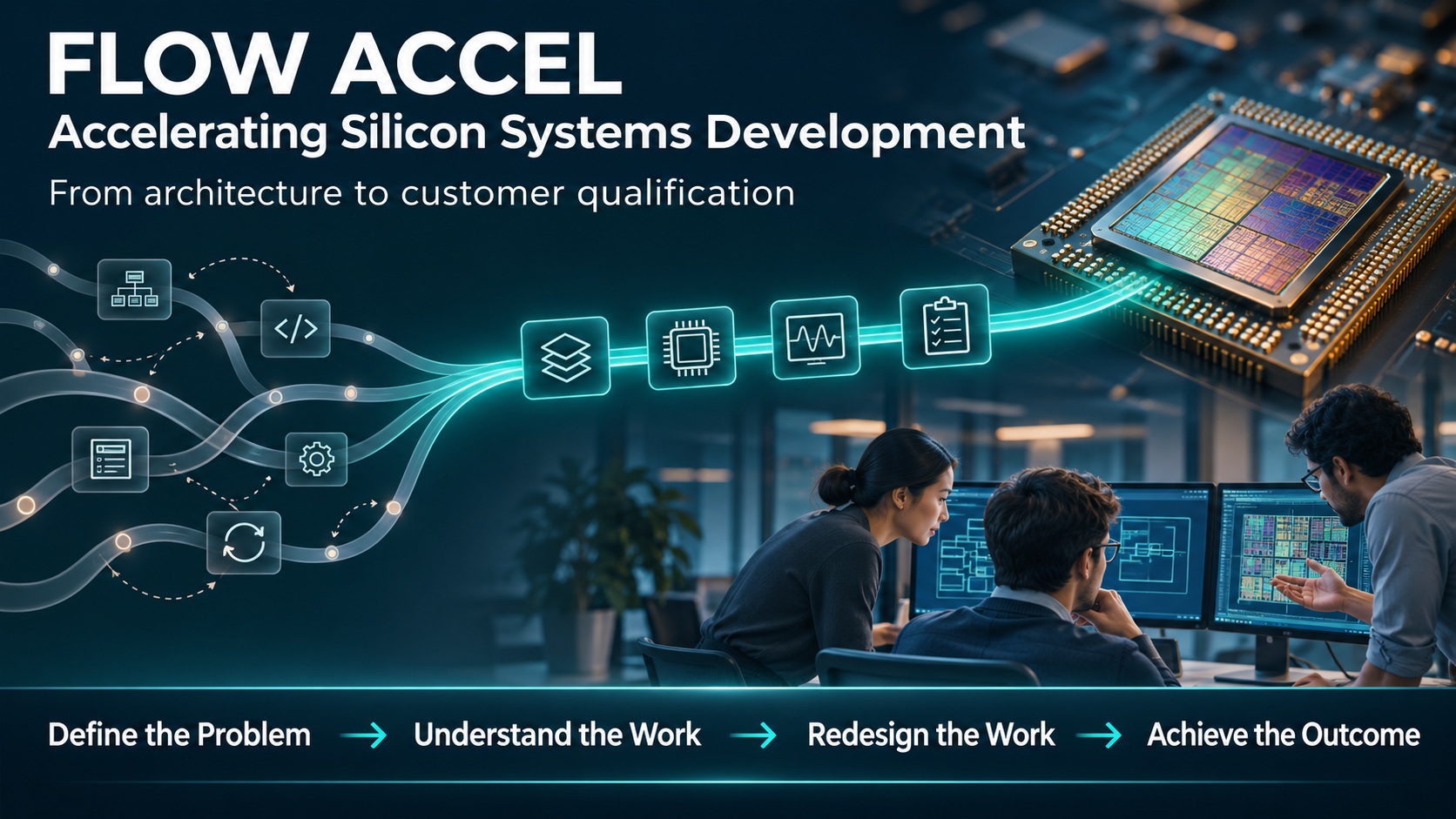
Flow Accel is a semiconductor development consultancy that helps silicon systems engineering leaders deliver and scale their programs. The company works with VPs and Directors responsible for CPU, GPU, ASIC, SoC, and NVM devices and platforms, from architecture and design through validation, integration, and customer qualification. Flow Accel focuses on the work between the milestones, the handoffs, waits, decisions, and rework where programs lose time they can’t get back, and redesigns that work alongside the engineers who do it.
History & Foundation
Flow Accel was founded in June 2025 by Joel Jorgensen and is based in Folsom, California. Jorgensen spent 25 years at Intel, starting as an analog circuit designer and architect in flash memory, with roles in fab product engineering and new product introduction. He holds two patents in flash memory design, co-authored two IEEE ISSCC papers, and served on the JEDEC and ONFI standards bodies. From 2014 to 2022 he led development flow improvement for Intel’s NAND group, working directly with Steven Spear, author of The High Velocity Edge, for six of those years. That work trained 1,700 people and helped launch nearly 1,800 improvement efforts.
Key Offerings & Technology
Flow Accel’s core capabilities include:
Silicon Systems Leadership Framework: A four-pillar framework for leading development through complexity and change, applied at the roadmap level and across the product life cycle from exploration through delivery.
Workflow Accelerator System: The four-step method behind every engagement: Define the Problem, Understand the Work, Redesign the Work, and Achieve the Outcome.
Three-Day Breakthrough Sprint: A focused engagement on one problem a leader can name, such as a slipping schedule or a quality issue, ending with a map of the work and a path to the outcome.
Development Flow Diagnostic: A live, hands-on assessment run against the client’s actual program.
Development Flow: Stabilize and Accelerate: The full engagement that redesigns the workflow and fixes what the Diagnostic found.
Development Flow: Sustain the Gains: Ongoing guidance so improvements hold after the engagement ends.
Training and Coaching: Sessions for development teams and leaders on product development methods, building high-velocity learning organizations, Lean, Agile, complexity, and leadership.
Competitive Strengths
Silicon engineering background: 25 years in silicon development, from circuit design to fab to NPI, so the work starts in the team’s own language.
Works with the engineers: Improvements are designed with the people doing the work, not imposed from above through reorganizations or PMO layers.
Designs the work like a product: Applies the same discipline teams use on the chip, design, verify, and iterate, to the workflow that delivers it.
Proven foundations: Built on Spear’s high velocity principles, Deming, the Toyota development system, and Reinertsen’s product development flow, and applied for years inside Intel.
Applications & Use Cases
Schedule recovery and pull-in, including post-silicon validation (one program cut validation cycle time 50%). Handoffs between architecture, design, verification, firmware, and validation. Integrating AI tools into development without shifting the bottleneck. Derivative and SKU proliferation on shared teams. Decision and design review bottlenecks. New product introduction and technology ramps. Scaling development practices as organizations grow.
Business Model
Flow Accel provides consulting, training, and coaching to semiconductor development organizations. Engagements typically begin with a short front-end Sprint or Diagnostic, move into a core engagement that redesigns the workflow and delivers the outcome, and continue with advisory support to sustain the gains. Engagements are delivered on-site or virtually.
Vision & Mission
Flow Accel’s mission is to help silicon systems engineering leaders find where their programs lose time they can’t get back, and design the fix with their engineers. The company aims to build development organizations that grow capacity faster than complexity, so leaders keep their roadmap commitments and the people doing the work have the time and space to do it well.
Share this post via:


Comments
There are no comments yet.
You must register or log in to view/post comments.