You are currently viewing SemiWiki as a guest which gives you limited access to the site. To view blog comments and experience other SemiWiki features you must be a registered member. Registration is fast, simple, and absolutely free so please,
join our community today!
By Shaurya Seth
Terafab is one of the most ambitious projects of the decade: $16.8 billion for phase one and up to $119 billion across four phases. A research fab in Austin iterates on process recipes, transistor designs, and packaging variants at a few thousand wafers per month. A volume fab in Grimes County targets 100,000 wafer… Read More
To me this is going to be one of the bigger Chicken Little moments in the history of semiconductors. Mostly because we are now a click driven society and the media is plagued by so called influencers that live and die by clicks. In my 40+ years as a semiconductor professional I have witnessed many of these Chicken Little moments with … Read More
The Pan Am–Boeing playbook and what Musk’s Terafab order could mean for Intel Foundry
“We either build the Terafab or we don’t have the chips.” That’s Elon Musk, speaking to Reuters, stating a supply constraint as plainly as anyone has stated one. TSMC is sold out. Samsung is committed. The existing supply chain can’t expand fast… Read More
Intel, Musk, and the Tweet That Launched a 1000 Ships on a Becalmed Sea
Why do professional executives running major corporations frame a major moment in their company’s history with a tweet? Jerry Sanders spent his career yelling “real men have fabs!” Now Intel has fabs–and apparently tweets about … Read More
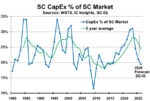
Semiconductor Intelligence estimates total semiconductor industry capital spending (CapEx) was $166 billion in 2025, up 7% from 2024. We estimate 2026 CapEx will be $200 billion, up 20% from 2025. TSMC was the largest spender in 2024 with $40.9 billion in CapEx, 25% of the total. TSMC projects 2026 CapEx will be between $52 billion… Read More
At the TERAFAB launch event in Austin on March 21, Elon Musk made a prediction that would have sounded like science fiction a decade ago—and may still: roughly 80 percent of AI compute will eventually move off-planet.
The argument is straightforward once you accept his premises. Earth-based data centers face three hard constraints—land,… Read More