You are currently viewing SemiWiki as a guest which gives you limited access to the site. To view blog comments and experience other SemiWiki features you must be a registered member. Registration is fast, simple, and absolutely free so please,
join our community today!
A Brief History of SPICEby Daniel Payne on 08-10-2012 at 4:06 pmCategories: EDA
SPICE is an acronym for Simulation Program with Integrated Circuit Emphasis and represents a class of EDA software used by circuit designers at the transistor-level to predict the timing, frequency, voltage, current or power of an IC or interconnect before fabrication.
In 1971 there was a tool called CANCER (Computer Analysis… Read More
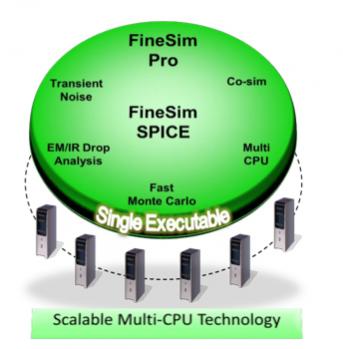
FineSim is Magma’s circuit simulator that has been doing extraordinarily well. In my opinion it is one of the big reasons that Synopsys is acquiring (presumably, still subject to approval of course) Magma. FineSim is especially strong in the memory market with over 70% of the top 5 DRAM manufacturers and the top 10 flash manufacturers… Read More
Wow! We always hear semiconductor companies complain about the lack of innovation amongst the EDA leaders. Placing high on the Deloitte 500 list shows that innovation is alive and well in EDA and it IS possible to have a meaningful impact regardless of your overall size. It is worth noting that there are very few EDA companies that… Read More
I spent Thursday Sept. 22 at the first nanometer Circuit Verification Forum, held at TechMart in Santa Clara. Hosted by Berkeley Design Automation (BDA), the forum was attended by 100+ people, with circuit designers dominating. I spoke with many attendees. They were seeking solutions to the hugely challenging problems they … Read More
Verifying circuits on advanced process nodes has always been difficult, and it’s no easier with today’s nanometer CMOS processes. There’s a great paradox in nanometer circuit design and verification. Designers achieve their greatest differentiation when they implement analog, mixed-signal, RF and custom … Read More
Introduction
When I designed DRAM chips at Intel I wanted to simulate at the worst case process corners to help make my design as robust as possible in order to improve yields. My manager knew what the worst case corners were based on years of prior experience, so that’s what I used for my circuit simulations.… Read More
Workshops are a great where to learn hands-on about IC design technology. Mentor has a free workshop to introduce you to creating, simulating and verifying mixed-signal (Analog and Digital) designs.
PLL waveforms showing both digital and analog signals.
Dates in Fremont, California
July 26, 2011
September 15, 2011
November… Read More
Intro
On Monday evening I talked with Linda Fosler, Director of marketing for the DSM Division at Mentor about what’s new at DAC this year in circuit simulation and IC layout tools.
Notes
IC Station – old name for IC layout tools
Eldo – Eldo Classic- Cell characterization
– ST is the early customer and teaching customer,… Read More
Introduction
3D field solvers produce the most accurate netlists of RC values of your IC layout that can then be used in SPICE circuit simulators however most of these solvers produce a flat netlist which tends to simulate rather slowly. Thankfully several years ago the first hierarchical SPICE tools were offered by Nassda (HSIM… Read More
I love SPICE and Fast SPICE circuit simulators, so here’s my feature list for the ultimate SPICE circuit simulator:
[LIST=1]
Input netlists – HSPICE, Spectre, ELDO
Multi-core support – parse and simulate fast and accurate
LRC Reduction – built-in LRC reduction with a few knobs to control accuracy
Tuning…
Read More