





Array
(
    [content] => 
    [params] => Array
        (
            [0] => /forum/threads/memory-will-not-be-an-issue-in-5-years.25402/
        )

    [addOns] => Array
        (
            [DL6/MLTP] => 13
            [Hampel/TimeZoneDebug] => 1000070
            [SV/ChangePostDate] => 2010200
            [SemiWiki/EmailDomainReplace] => 1000010
            [SemiWiki/Newsletter] => 1000010
            [SemiWiki/WPMenu] => 1000010
            [SemiWiki/XPressExtend] => 1000010
            [ThemeHouse/XLink] => 1000970
            [ThemeHouse/XPress] => 1010570
            [XF] => 2031070
            [XFI] => 1060170
        )

    [wordpress] => /var/www/html
)

Memory will not be an issue in 5 years.

DanX

Active member
Most people have no idea of China’s production capacity.
The output gap isn’t from 30% to 50% of the world need.
It is from 100% all the way up to 500%.

Memory will not be an issue in 5 years.


China plans to have its installed power capacity exceed 5.4 billion kilowatts by 2030.
(current at 4 b)

The world’s total installed power capacity currently stands at 11.8 billion kilowatts, with industrial consumption accounting for 25% to 30% of total power usage.

Betting on SpaceX is wise.
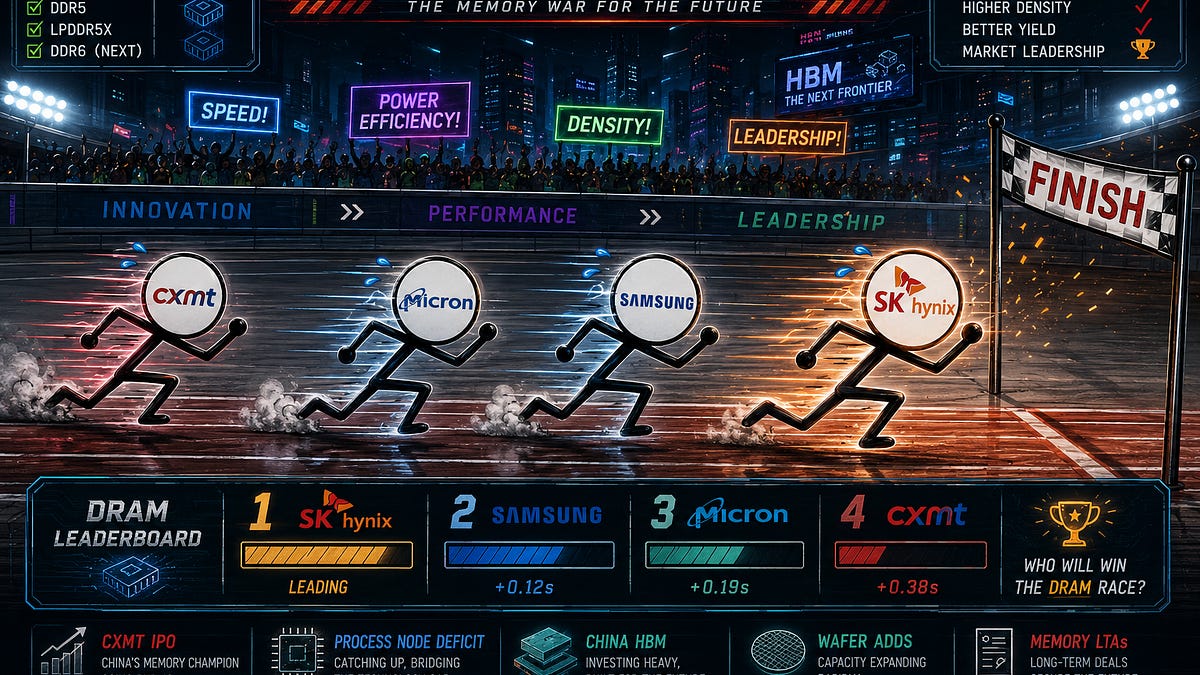
 
According to this latest Semianalysis article,CXMT’s share of global bit shipment is expected to rise from 9% to 12% in 2027. Wafer capacity reach 500kwspm by the end of 2028, accounting for ~17% of global DRAM supply. Still far from "flooding" the market


4e7341ef-e3c9-4fa0-a8c7-66ce087b659d_2326x692.png
 
Most people have no idea of China’s production capacity.
The output gap isn’t from 30% to 50% of the world need.
It is from 100% all the way up to 500%.

Memory will not be an issue in 5 years.


China plans to have its installed power capacity exceed 5.4 billion kilowatts by 2030.
(current at 4 b)

The world’s total installed power capacity currently stands at 11.8 billion kilowatts, with industrial consumption accounting for 25% to 30% of total power usage.

Betting on SpaceX is wise.

Memory is a good fit for China, logic not so much. If China can produce the DRAM that they use internally (20%+) that would free up DRAM for others. Win-Win.
 
According to this latest Semianalysis article,CXMT’s share of global bit shipment is expected to rise from 9% to 12% in 2027. Wafer capacity reach 500kwspm by the end of 2028, accounting for ~17% of global DRAM supply. Still far from "flooding" the market


View attachment 4788

CXMT are still behind Micron, Samsung and SK Hynix on density, yield etc. and though they have made huge progress in recent years, I consider it an open question if they will be able to narrow the gap further with the current WFE export restrictions in place.

So, CMXT may get to app. 17 percent of WSPM in 2028, but that will likely translate to a bit supply market share of around 10-14 percent depending on their technological progress.
 
The cartel will get fat cashing in on yet another supply chain crisis, which is just more incentive for China to figure it out similar to what happened with the trade war. My money is on them achieving parity on semiconductors writ large in 5 years. Too bad for us there's bipartisan consensus that China is the devil, nevermind that they've been underwriting the Great Leap Forward for almost 50 years now.
 
The cartel will get fat cashing in on yet another supply chain crisis, which is just more incentive for China to figure it out similar to what happened with the trade war. My money is on them achieving parity on semiconductors writ large in 5 years. Too bad for us there's bipartisan consensus that China is the devil, nevermind that they've been underwriting the Great Leap Forward for almost 50 years now.

Correct ... Fake supply issues forcing price rises.

Still when its being peddled by Musk and Tim Cook , then who isnt going to believe.

Whether Chinese competition benefit the consumer in the long run I doubt it.

People need to be prepared to pay a lot for everything , those running the show will not allow any disruption to this gravy train they are on.
 

The current global DRAM wafer capacity appears to be ~ 27 million wafers. so I've reworked the chart to show what the growth above actually means:

[TABLE width="100%"]
[TR]
[td width="25.0000%"]OEM[/td][td width="24.9531%"]2026[/td][td width="24.9531%"]2027[/td][td width="25.0000%"]2028[/td]
[/TR]
[TR]
[td width="25.0000%"]Samung[/td][td width="24.9531%"]+0.7%[/td][td width="24.9531%"]+2.2%[/td][td width="25.0000%"]+4.9%[/td]
[/TR]
[TR]
[td width="25.0000%"]SK Hynix[/td][td width="24.9531%"]+2.4%[/td][td width="24.9531%"]+2.4%[/td][td width="25.0000%"]+4.0%[/td]
[/TR]
[TR]
[td width="25.0000%"]Micron[/td][td width="24.9531%"]+1.2%[/td][td width="24.9531%"]+4.0%[/td][td width="25.0000%"]+5.0%[/td]
[/TR]
[TR]
[td width="25.0000%"]CXMT[/td][td width="24.9531%"]+3.7%[/td][td width="24.9531%"]+3.1%[/td][td width="25.0000%"]+3.7%[/td]
[/TR]
[TR]
[td width="25.0000%"]Total Capacity Growth (vs 2025)[/td]
[td width="24.9531%"]+8.0%[/td][td width="24.9531%"]+11.7%[/td]
[td width="25.0000%"]+17.6%[/td]
[/TR]
[/TABLE]
Notes:
- Numbers slightly rounded up overall, growth based on 2025 (i.e.% is overestimated in 2027 and 2028)
- This implies DRAM wafer capacities of: 2025 - 27M, 2026 - 29.2M, 2027 - 32.6M, 2028 - 38.4M, or compound growth of 42%.

(Source for total wafers - 2.25M wafer starts per month in 2025 - https://www.tomshardware.com/pc-com...to-the-tune-of-up-to-900-000-wafers-per-month )

EDIT: Looks like the table function broke on this forum - I'm not sure why.
 
The current global DRAM wafer capacity appears to be ~ 27 million wafers. so I've reworked the chart to show what the growth above actually means:

[TABLE width="100%"]
[TR]
[td width="25.0000%"]OEM[/td][td width="24.9531%"]2026[/td][td width="24.9531%"]2027[/td][td width="25.0000%"]2028[/td]
[/TR]
[TR]
[td width="25.0000%"]Samung[/td][td width="24.9531%"]+0.7%[/td][td width="24.9531%"]+2.2%[/td][td width="25.0000%"]+4.9%[/td]
[/TR]
[TR]
[td width="25.0000%"]SK Hynix[/td][td width="24.9531%"]+2.4%[/td][td width="24.9531%"]+2.4%[/td][td width="25.0000%"]+4.0%[/td]
[/TR]
[TR]
[td width="25.0000%"]Micron[/td][td width="24.9531%"]+1.2%[/td][td width="24.9531%"]+4.0%[/td][td width="25.0000%"]+5.0%[/td]
[/TR]
[TR]
[td width="25.0000%"]CXMT[/td][td width="24.9531%"]+3.7%[/td][td width="24.9531%"]+3.1%[/td][td width="25.0000%"]+3.7%[/td]
[/TR]
[TR]
[td width="25.0000%"]Total Capacity Growth (vs 2025)[/td]
[td width="24.9531%"]+8.0%[/td][td width="24.9531%"]+11.7%[/td]
[td width="25.0000%"]+17.6%[/td]
[/TR]
[/TABLE]
Notes:
- Numbers slightly rounded up overall, growth based on 2025 (i.e.% is overestimated in 2027 and 2028)
- This implies DRAM wafer capacities of: 2025 - 27M, 2026 - 29.2M, 2027 - 32.6M, 2028 - 38.4M, or compound growth of 42%.

(Source for total wafers - 2.25M wafer starts per month in 2025 - https://www.tomshardware.com/pc-com...to-the-tune-of-up-to-900-000-wafers-per-month )

EDIT: Looks like the table function broke on this forum - I'm not sure why.

I think that is exactly why a lot of people do not see the market loosening in the foreseeable future. Below 10 pct. WSPM growth in 2026 and just above 10 pct. in 2027. We do not have major density improvements to rely on, so the supply increase will fall far short of even a historically low bit demand growth of 20 pct. per year. You need to bet on massive demand destruction due to high pricing for demand and supply to even out this year or the next.
 
I’ve recently been watching videos and reading reports about China’s applications of AI and robotics. There’s one about an AI-powered robot catching squids that’s really fascinating.
It can essentially be replicated infinitely.
Let's think about TVs, washing machines and air conditioners. If there were no tariff restrictions, would there still be shortages? Would prices keep rising?
 
CXMT are still behind Micron, Samsung and SK Hynix on density, yield etc. and though they have made huge progress in recent years, I consider it an open question if they will be able to narrow the gap further with the current WFE export restrictions in place.

So, CMXT may get to app. 17 percent of WSPM in 2028, but that will likely translate to a bit supply market share of around 10-14 percent depending on their technological progress.
Typically, cartels fear that sustained high prices may help build a formidable competitor. In CXMT’s case, that risk is viewed as lower, mainly due to WFE constraints and their familiarity with CXMT’s management team, many of whom came from Micron but are not regarded as particularly strong operators.
 
I’ve recently been watching videos and reading reports about China’s applications of AI and robotics. There’s one about an AI-powered robot catching squids that’s really fascinating.
It can essentially be replicated infinitely.
Let's think about TVs, washing machines and air conditioners. If there were no tariff restrictions, would there still be shortages? Would prices keep rising?

Shouldnt we be optimising outputs rather than making for the sake of making.

Just what we need , more cheap disposable one time effective use crap.

Keeps folk in jobs I suppose
 
Back
Top