





Very interesting development around SoC PLANNER, bringing together CEA’s A-DECA, Defacto’s SoC Compiler, and Innova’s PDM to accelerate upstream SoC design exploration.
This is an important direction for the industry.
Moving from high-level KPIs to RTL-ready configurations faster can significantly improve design productivity, especially when teams are trying to balance power, performance, area, cost, schedule, and even eco-design footprint.
But it also raises the next lifecycle question:
Once an optimized SoC configuration is generated, how do we prove that it remains converged after physical implementation, packaging, validation, qualification, and field operation?
That is where I see a natural connection to SEGA-AI™ / Governance for Lifecycle.
Automated SoC planning accelerates design intent.
Governed realization verifies whether that intent survives:
In other words, upstream automation can generate a strong Pareto-optimal configuration.
But downstream governance must still ask:
Is the evidence mature enough?
Is the result admissible?
Is the causality understood?
Is the lifecycle decision bounded and auditable?
This is not a conflict between design automation and governance.
It is the next integration point.
SoC PLANNER helps accelerate the path from KPI to RTL.
SEGA-AI™ helps govern the path from RTL intent to realized system convergence.
The future semiconductor flow will not be only faster design generation.
It will be faster design generation connected to evidence maturity, physical realization, bounded gate authority, and lifecycle learning.
That is how automation becomes trustworthy at scale.
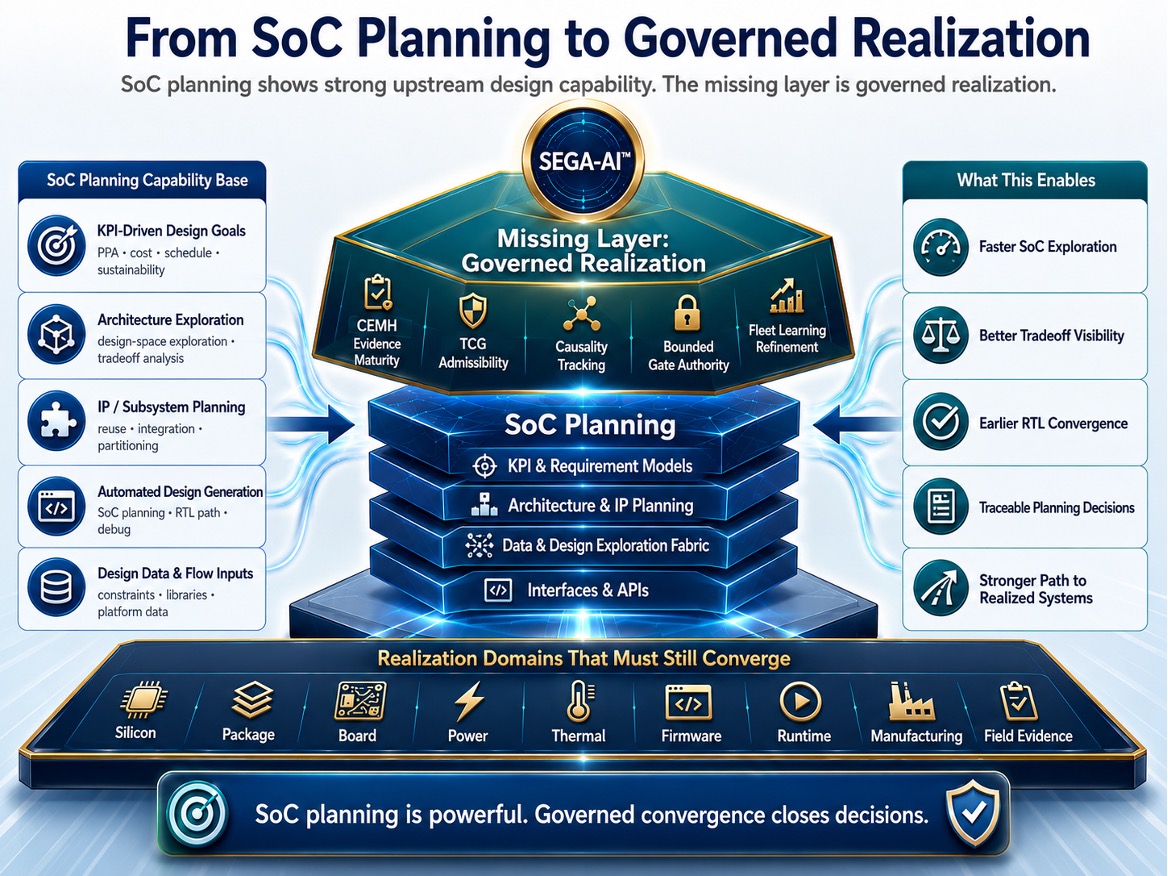
This is an important direction for the industry.
Moving from high-level KPIs to RTL-ready configurations faster can significantly improve design productivity, especially when teams are trying to balance power, performance, area, cost, schedule, and even eco-design footprint.
But it also raises the next lifecycle question:
Once an optimized SoC configuration is generated, how do we prove that it remains converged after physical implementation, packaging, validation, qualification, and field operation?
That is where I see a natural connection to SEGA-AI™ / Governance for Lifecycle.
Automated SoC planning accelerates design intent.
Governed realization verifies whether that intent survives:
- physical implementation constraints
- package and substrate realities
- SI / PI / PDN behavior
- thermal and mechanical coupling
- validation correlation
- manufacturing variation
- qualification evidence
- runtime telemetry
- Fleet Learning feedback
In other words, upstream automation can generate a strong Pareto-optimal configuration.
But downstream governance must still ask:
Is the evidence mature enough?
Is the result admissible?
Is the causality understood?
Is the lifecycle decision bounded and auditable?
This is not a conflict between design automation and governance.
It is the next integration point.
SoC PLANNER helps accelerate the path from KPI to RTL.
SEGA-AI™ helps govern the path from RTL intent to realized system convergence.
The future semiconductor flow will not be only faster design generation.
It will be faster design generation connected to evidence maturity, physical realization, bounded gate authority, and lifecycle learning.
That is how automation becomes trustworthy at scale.