






Business traction on 22nm continues to gain momentum, accounting for 14% of Q1 revenue
Expect Q2 wafer shipments to grow by high single digit
First Quarter 2026 Overview1:
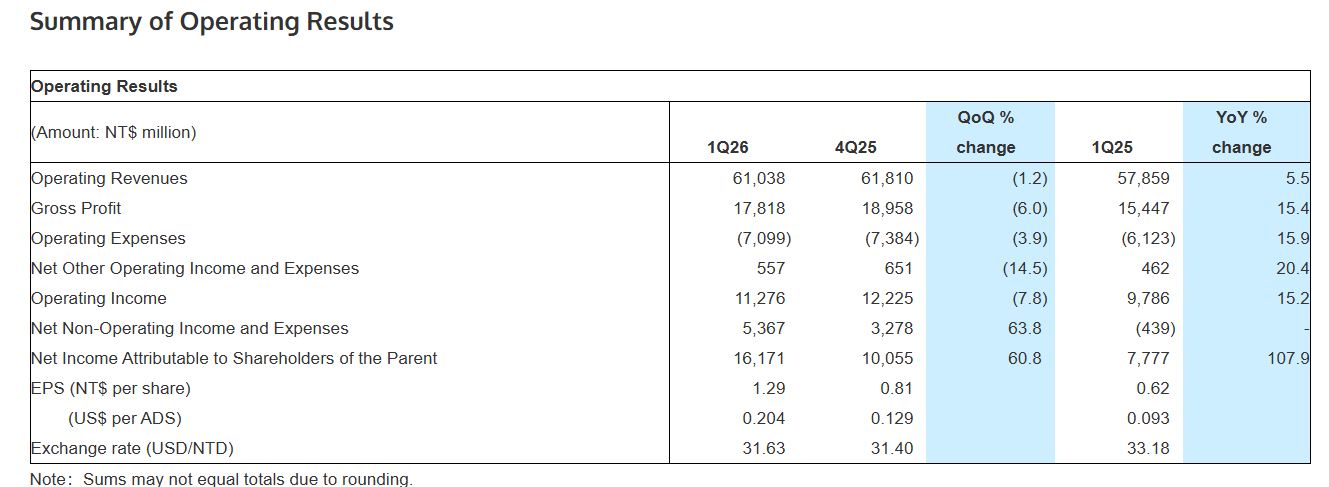
First quarter consolidated revenue was NT$61.04 billion, decreasing 1.2% from NT$61.81 billion in 4Q25. Compared to a year ago, 1Q26 revenue increased 5.5%. Consolidated gross margin for 1Q26 was 29.2%. Net income attributable to the shareholders of the parent was NT$16.17 billion, with earnings per ordinary share of NT$1.29.
Jason Wang, CEO of UMC, said, “In the first quarter, our wafer shipments increased 2.7% quarter-on-quarter on strong growth in the consumer segment, lifting overall utilization rate to 79%. Despite a decline in blended average selling price during the quarter, which partly reflected higher 8-inch wafer shipments, gross margin held firm at 29.2%. Demand for our 22nm logic and specialty processes continues to gain momentum, with 22nm revenue reaching another record high and accounting for 14% of first-quarter revenue. By the end of this year, over 50 customers will have completed tape-outs on our 22nm platforms for a diverse range of applications, including display driver ICs, networking chips, and microcontrollers. We continue to invest in next-generation technologies – beyond 22nm, our 12nm collaboration with Intel will provide customers with technology continuity as well as a U.S.-based manufacturing option. UMC also recently announced important developments in emerging businesses, including a strategic partnership to deploy thin-film lithium niobate (TFLN) photonics for AI infrastructure.”
CEO Wang added, “Going into the second quarter, we expect strong wafer shipment growth across both 8-inch and 12-inch portfolios, supported by a strong rebound in the communication segment as well as healthy demand across computer, consumer, and industrial markets. While the current memory supply shortage and the ongoing conflict in the Middle East are creating certain headwinds and market volatility, UMC continues to foresee resilient market demand. UMC will continue to monitor industry and macroeconomic developments closely while prudently managing our business to cope with market dynamics amid evolving semiconductor landscape changes.”
CEO Wang said, “UMC’s long-term commitment to corporate sustainability was once again recognized in S&P Global’s annual Sustainability Yearbook. With only 848 out of 9,200 large corporations selected for the 2026 Yearbook, UMC was awarded the ‘Top 1%’ highest ranking within the Semiconductor and Semiconductor Equipment sector. Last month, we also announced a MoU with Infineon to drive reduction of greenhouse gas emissions across our shared supply chain. With value chain (Scope 3) emissions the largest share of a company’s total emissions, and also the most complex to address, collaboration with our partners is essential as we strive towards our goal of achieving net zero emissions by 2050. We are pleased to join forces with Infineon to accelerate decarbonization action among our common suppliers.”
Expect Q2 wafer shipments to grow by high single digit
First Quarter 2026 Overview1:
- Revenue: NT$61.04 billion (US$1.93 billion)
- Gross margin: 29.2%; Operating margin: 18.5%
- Revenue from 22/28nm: 34%
- Capacity utilization rate: 79%
- Net income attributable to shareholders of the parent: NT$16.17 billion (US$511 million)
- Earnings per share: NT$1.29; earnings per ADS: US$0.204
First quarter consolidated revenue was NT$61.04 billion, decreasing 1.2% from NT$61.81 billion in 4Q25. Compared to a year ago, 1Q26 revenue increased 5.5%. Consolidated gross margin for 1Q26 was 29.2%. Net income attributable to the shareholders of the parent was NT$16.17 billion, with earnings per ordinary share of NT$1.29.
Jason Wang, CEO of UMC, said, “In the first quarter, our wafer shipments increased 2.7% quarter-on-quarter on strong growth in the consumer segment, lifting overall utilization rate to 79%. Despite a decline in blended average selling price during the quarter, which partly reflected higher 8-inch wafer shipments, gross margin held firm at 29.2%. Demand for our 22nm logic and specialty processes continues to gain momentum, with 22nm revenue reaching another record high and accounting for 14% of first-quarter revenue. By the end of this year, over 50 customers will have completed tape-outs on our 22nm platforms for a diverse range of applications, including display driver ICs, networking chips, and microcontrollers. We continue to invest in next-generation technologies – beyond 22nm, our 12nm collaboration with Intel will provide customers with technology continuity as well as a U.S.-based manufacturing option. UMC also recently announced important developments in emerging businesses, including a strategic partnership to deploy thin-film lithium niobate (TFLN) photonics for AI infrastructure.”
CEO Wang added, “Going into the second quarter, we expect strong wafer shipment growth across both 8-inch and 12-inch portfolios, supported by a strong rebound in the communication segment as well as healthy demand across computer, consumer, and industrial markets. While the current memory supply shortage and the ongoing conflict in the Middle East are creating certain headwinds and market volatility, UMC continues to foresee resilient market demand. UMC will continue to monitor industry and macroeconomic developments closely while prudently managing our business to cope with market dynamics amid evolving semiconductor landscape changes.”
CEO Wang said, “UMC’s long-term commitment to corporate sustainability was once again recognized in S&P Global’s annual Sustainability Yearbook. With only 848 out of 9,200 large corporations selected for the 2026 Yearbook, UMC was awarded the ‘Top 1%’ highest ranking within the Semiconductor and Semiconductor Equipment sector. Last month, we also announced a MoU with Infineon to drive reduction of greenhouse gas emissions across our shared supply chain. With value chain (Scope 3) emissions the largest share of a company’s total emissions, and also the most complex to address, collaboration with our partners is essential as we strive towards our goal of achieving net zero emissions by 2050. We are pleased to join forces with Infineon to accelerate decarbonization action among our common suppliers.”