





Array
(
    [content] => 
    [params] => Array
        (
            [0] => /forum/threads/electro-optical-realization-corridor.25327/
        )

    [addOns] => Array
        (
            [DL6/MLTP] => 13
            [Hampel/TimeZoneDebug] => 1000070
            [SV/ChangePostDate] => 2010200
            [SemiWiki/EmailDomainReplace] => 1000010
            [SemiWiki/Newsletter] => 1000010
            [SemiWiki/WPMenu] => 1000010
            [SemiWiki/XPressExtend] => 1000010
            [ThemeHouse/XLink] => 1000970
            [ThemeHouse/XPress] => 1010570
            [XF] => 2031070
            [XFI] => 1060170
        )

    [wordpress] => /var/www/html
)

Electro-Optical Realization Corridor

moh.kolb

Member
CPO and optical I/O are often described as “light replacing copper.”

I think that framing is incomplete.

Before data becomes optical, the electrical launch still has to close. After conversion, the optical path still has to be attached, powered, aligned, cooled, coupled to fiber, tested, and qualified.

That is why I frame this as an Electro-Optical Realization Block, or EORB, inside a broader Electro-Optical Realization Corridor.

The modulator or optical engine may be the device breakthrough. But the product is the full realization path:

electrical launch
optical conversion
driver integration
package/substrate interface
alignment stability
thermal drift control
fiber attach
SI/PI behavior
test coverage
yield learning
lifecycle reliability

This is especially important for CPO, silicon photonics, and future AI/HPC optical interconnects.

The winning architecture will not be the one with the best optical device alone. It will be the one that proves the full electro-optical corridor can be manufactured, tested, cooled, aligned, and trusted at scale.

Light may solve distance.

Governed electro-optical realization determines whether it scales.
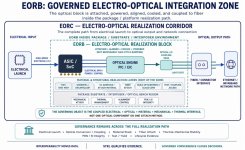
 

Attachments

  • Picture1_EORB_SEMI_JUNE17.jpg
    Picture1_EORB_SEMI_JUNE17.jpg
    235.9 KB · Views: 174
One additional point:

The optical path is not only attached, powered, aligned, cooled, and coupled to function inside the package.

It is attached, powered, aligned, cooled, coupled, tested, yielded, and governed to become part of a trusted realization path.

Light may solve distance.

Governed electro-optical realization determines whether it scales.
 
Additional points:

Replacing long copper electrical paths with optical links can reduce reach-related loss, improve bandwidth density, lower some power burden from high-speed electrical signaling, and reduce signal-degradation issues over distance.

But I think the key point is that optics does not remove the full power and thermal problem — it relocates and changes it.

The optical engine still needs drivers, TIAs, lasers, coupling, thermal control, alignment, test, yield, and serviceability. So CPO helps solve the copper reach and bandwidth wall, but it also creates a new electro-optical realization challenge inside the package and system.

That is why I see CPO not only as “replacing copper,” but as building a manufacturable optical connectivity path that can scale reliably in AI infrastructure.
 
This is a great point about moving from just a working lab prototype to a trusted, real-world product. Even if a microscopic optical laser aligns perfectly on day one inside a cleanroom, running intense AI workloads makes these chips incredibly hot, which can physically warp the packaging materials over time.
How are companies planning to govern and monitor these chips over their lifespan? Are they building tiny sensors directly inside the chip architecture to actively adjust the lasers as the hardware ages?
 
Great question.

Day-one optical alignment is not enough for CPO.

In real AI systems, thermal gradients, workload cycling, material expansion, laser drift, coupling variation, aging, and package stress can all shift the electro-optical path over time.

So yes, companies will need embedded sensing and feedback: temperature sensors, monitor photodiodes, laser power tracking, wavelength and bias control, link-margin telemetry, firmware calibration, and package reliability models.

But the key is not just adding sensors.

The system must turn those signals into causal, trusted, decision-ready evidence.

Optical power drift is only a symptom. The cause could be laser aging, thermal shift, coupling loss, package deformation, driver behavior, or workload-induced heating.

That is why CPO is not only an optical-engine problem.

It is a lifecycle-governed electro-optical realization problem.
 
Great question.

Day-one optical alignment is not enough for CPO.

In real AI systems, thermal gradients, workload cycling, material expansion, laser drift, coupling variation, aging, and package stress can all shift the electro-optical path over time.

So yes, companies will need embedded sensing and feedback: temperature sensors, monitor photodiodes, laser power tracking, wavelength and bias control, link-margin telemetry, firmware calibration, and package reliability models.

But the key is not just adding sensors.

The system must turn those signals into causal, trusted, decision-ready evidence.

Optical power drift is only a symptom. The cause could be laser aging, thermal shift, coupling loss, package deformation, driver behavior, or workload-induced heating.

That is why CPO is not only an optical-engine problem.

It is a lifecycle-governed electro-optical realization problem.
Exactly. A basic sensor only flags a symptom, but it can’t cross-correlate the root cause. If a system has to instantly diagnose whether a drop in light is from laser aging, a localized thermal hotspot, or sub-micron packaging warpage, it completely outpaces traditional software.

This seems like the ultimate playground for Agentic AI and multi-physics telemetry to orchestrate real-time diagnosis.


From a practical standpoint, who is actually building this infrastructure right now? Is the burden falling entirely on advanced packaging foundries to develop proprietary diagnostics, or are the EDA giants stepping in to provide unified lifecycle AI orchestrators?
 
Great question.

I do not think this will be owned by one layer alone.

Foundries and OSATs will own much of the process, assembly, metrology, and reliability foundation.
Optical engine and silicon photonics companies will build monitor photodiodes, temperature sensing, laser-control loops, calibration structures, and link-margin telemetry into the hardware.
EDA and simulation companies are moving toward unified multiphysics environments that connect electrical, thermal, mechanical, EM, photonic, and reliability behavior. System companies and hyperscalers will connect those signals to rack and fleet operation.

But the missing layer is still evidence governance.
 
Great question.

I do not think this will be owned by one layer alone.

Foundries and OSATs will own much of the process, assembly, metrology, and reliability foundation.
Optical engine and silicon photonics companies will build monitor photodiodes, temperature sensing, laser-control loops, calibration structures, and link-margin telemetry into the hardware.
EDA and simulation companies are moving toward unified multiphysics environments that connect electrical, thermal, mechanical, EM, photonic, and reliability behavior. System companies and hyperscalers will connect those signals to rack and fleet operation.

But the missing layer is still evidence governance.
This highlights a massive venture gap. Because multi-die systems turn silicon into a system-level lifecycle problem, no single player currently owns the complete diagnostic data loop.
From a commercial and startup standpoint, where do you see the biggest monetization or business opportunity emerging from this evidence governance crisis? Will it be an independent SaaS layer acting as a trusted 'black box' for hyperscalers, or will the EDA giants absorb this space entirely by extending their multi-physics environments into real-time fleet operations?
 
Great question.

I do not think the full diagnostic data loop will be owned by one player.

EDA companies are well positioned to extend multiphysics models into package, board, thermal, optical, and reliability domains. But real CPO/EORB behavior also depends on manufacturing variation, assembly history, calibration state, firmware behavior, workload patterns, field telemetry, and fleet drift.

That data is distributed.

Foundries and OSATs own process evidence.
EDA owns design intent and models.
Module and system companies own calibration and firmware behavior.
Hyperscalers own fleet telemetry.

So I would not frame the opportunity as only independent SaaS versus EDA absorption.

The real gap is connecting these domains into trusted, lifecycle-aware decision.

For CPO/EORB, the winner will not simply collect more telemetry.

The winner will help convert distributed optical, thermal, electrical, mechanical, firmware, and fleet signals into evidence aware.
 
one more interesting point:
CPO does not eliminate copper. It moves the copper-light boundary closer to the compute engine.
OR
Optics solves part of the reach problem, but it creates a boundary-realization problem.
Today, most AI systems are still copper-dominant inside the package, board, box, and rack.

Electrical signals move through silicon, package routing, substrates, PCBs, connectors, and cables. The optical transition usually happens later, at the module, front panel, box edge, or rack boundary. In other words, optics has historically lived outside the main compute package.

That is now changing.

As bandwidth, power, reach, and thermal limits become harder, the industry is trying to move the copper-to-light boundary closer to the ASIC. This is the direction of co-packaged optics and related electro-optical integration.

The goal is not simply to “replace copper with light.”

The goal is to shorten the lossy electrical path before it becomes too expensive in power, heat, equalization, crosstalk, and signal integrity complexity.

But bringing optics closer creates a new problem: the boundary problem.

The system must now integrate drivers, modulators, lasers, photodetectors, TIAs, SerDes, waveguides, couplers, fiber attach, power delivery, thermal control, calibration, test, and reliability inside or near the advanced package.

That boundary is not free.

It adds cost, alignment sensitivity, thermal drift, coupling loss, manufacturing complexity, field reliability risk, and test burden.


The winning architecture will be the one that places the copper-light boundary where the system-level gain is greater than the boundary penalty.
 
That boundary penalty framing is spot on. Standard, rigid foundry packages won't solve this out of the box. It turns CPO into a pure system-level optimization problem.
Where does the biggest venture opportunity live here? Will independent architects win by building customized, evidence-aware frameworks to bridge the gap? Or will hyperscalers just bypass traditional integration, build the custom systems themselves, and dictate the boundary?
Also, if an independent team wanted to tackle this, what specific mix of skills is actually required to build a cross-domain solution like this?
 
Great questions, Mihir.

I agree that optimization is required, but I would not frame CPO as a pure system-level optimization problem.

Optimization is necessary, but not sufficient.

The harder issue is system-level realization.

The copper-light boundary can be optimized on paper across bandwidth, power, reach, latency, thermal load, and cost. But the boundary only becomes useful if it can be physically realized: packaged, coupled, aligned, powered, cooled, tested, calibrated, yielded, serviced, and trusted at scale.

That is where I think the opportunity exists.

Not just in another photonic device.

Not just in another packaging flow.

But in the trusted realization bridge between photonics, electronics, packaging, manufacturing, and deployment.

Hyperscalers will absolutely push custom systems and dictate many requirements. But they still need an ecosystem that can translate those requirements into manufacturable electro-optical systems.

The independent opportunity is to become the trusted bridge across domains, especially where no single foundry, OSAT, EDA vendor, photonics company, or hyperscaler owns the full boundary.

The skill mix is unusual.

It requires photonics, PIC design, EIC/ASIC interface knowledge, high-speed electrical design, advanced packaging, fiber attach, laser integration, thermal/mechanical engineering, SI/PI, test, calibration, reliability, OSAT/manufacturing, and system architecture.
 
The deeper question is about boundary- placement decision!
I think the deeper question is not whether optics replaces electronics.

The real question is where the electrical-optical boundary should live.

Each approach is making a different boundary-placement decision.

Optical I/O chiplets keep much of the existing package architecture while reducing the high-speed electrical reach burden.

Hybrid photonic fabrics introduce optics where the system benefit is clear.

Photonic interposers push the boundary more aggressively toward compute and memory fabrics, but also increase optical alignment, laser integration, packaging, thermal, calibration, and test complexity.

So the competition is not only about bandwidth.

It is about boundary realization.

Moving optics closer to the compute engine can reduce electrical loss, power, and reach limitations. But the optical boundary is not free. It introduces coupling loss, thermal drift, package stress, calibration burden, serviceability questions, and manufacturing risk.

The winning architecture will place the copper-light boundary where the system-level gain is greater than the boundary penalty.

For AI infrastructure, electronics will remain strong for local computation and short-reach connectivity.

Photonics will expand where bandwidth, reach, and energy-per-bit justify the realization burden.

Electronics for computation.
Photonics for communication.
Advanced packaging for realization.
 
Back
Top