






The global foundry 2.0 market’s revenue grew 23% YoY to $86 billion in Q1 2026, as AI GPUs and AI ASICs continued to drive demand across both leading-edge process nodes and advanced packaging.
The AI investment cycle is reshaping the semiconductor value chain, accelerating the industry's transition toward the Foundry 2.0 era, which is characterized by the integration of wafer manufacturing, advanced packaging, and testing. As AI systems become more complex and packaging-intensive, competitive advantages are no longer determined solely by process technology, but by the ability to deliver advanced packaging and foundry capacity at scale.
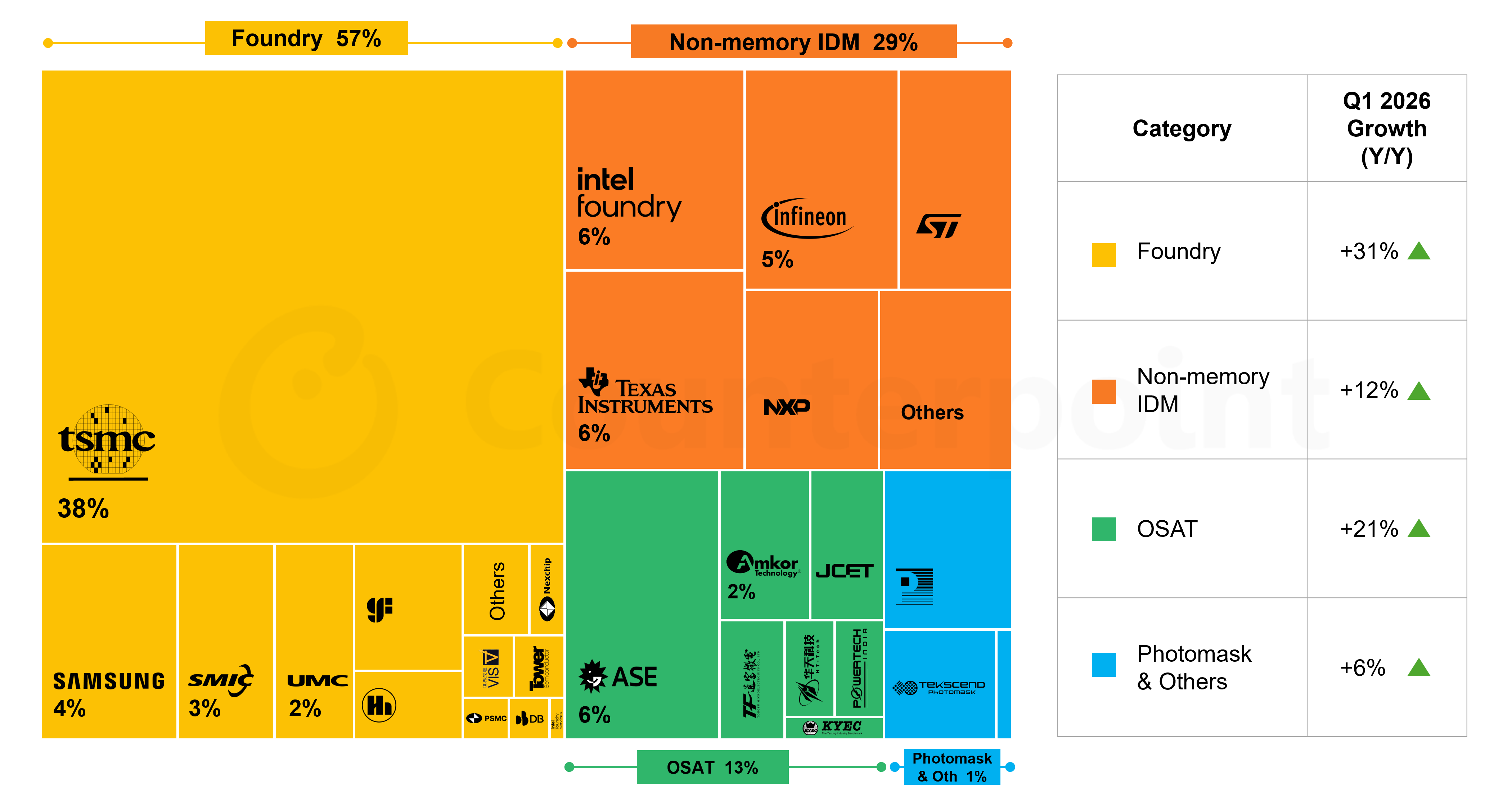 Source: Counterpoint Research Foundry Tracker, June 2026
Pure Play Foundries Revenue Growth Driven by TSMC and SMIC
TSMC remained the primary beneficiary of the AI-driven semiconductor upcycle, with revenue growth accelerating to 41% YoY in Q1 2026. Strong demand for AI GPUs, AI ASICs, and advanced packaging continued to support utilization across its leading-edge process nodes. We expect this momentum to remain intact throughout the year and TSMC to deliver about 36% YoY revenue growth for full-year 2026.
Commenting on TSMC's performance and outlook, Senior Analyst William Li noted, "What stands out in this cycle is not only the strength of AI demand, but also how it is reshaping TSMC's operating strategy. We are seeing unprecedented capacity reallocations across multiple fabs, with mature-node capacity increasingly being converted to support advanced technologies. At the same time, TSMC has adopted pricing actions that differ from its traditional annual pricing framework, highlighting a level of demand intensity in previous semiconductor cycles. Combined with continued CoWoS capacity constraints, we believe the current AI boom reflects more than just a cyclical upturn. It points to a broader structural transformation across the semiconductor industry.”
Non-TSMC pure-play foundries also reported a modest 9% YoY revenue increase in Q1 2026. Chinese foundries continued to benefit from domestic semiconductor localization demand and structural wafer price increases across both 8-inch and 12-inch nodes. As a result, SMIC’s revenue rose 12% YoY, while Nexchip achieved a 19% YoY increase. We expect these favorable industry dynamics to continue through 2026, supporting sequential revenue growth across Chinese foundries.
UMC and Vanguard also posted robust Q1 2026 results, with revenue rising 10% YoY and 14% YoY, respectively, as the two companies benefitted from a recovery in consumer electronics demand and continued strength in the PMIC market. Additionally, Counterpoint Research has assessed that both foundries are well positioned to capture TSMC’s overflow orders as the company is optimizing its capacity at mature nodes.
Meanwhile, MediaTek securing a larger share of Google TPUs, along with other potential ASIC opportunities, could likely become an important driver of wafer demand. As orders scale up, capacity constraints across both advanced node and advanced packaging will likely escalate, creating incremental opportunities for other foundry suppliers.
In our view, this dynamic could provide significant tailwinds for both Intel Foundry and Samsung Foundry as customers are looking for additional sources. For Intel, stronger demand could help accelerate adoption of its advanced packaging technologies while improving the visibility of its foundry business. Potential design wins, such as Apple M7 on Intel 18A-P, would further solidify market confidence in Intel Foundry.
Non-Memory IDMs Continued to Improve, Thanks to AI and Data Center Demand
Non-memory IDMs continued to recover in Q1 2026, benefiting from improving industrial demand as well as growing exposure to AI and data center power management. Most companies within the group reported double-digit percentage YoY revenue growth, led by STMicroelectronics, which delivered a strong 21% YoY rise.
We expect the sector's recovery to gain further momentum in H2 2026, driven by a combination of industrial market normalization and sustained investment in AI infrastructure, which should provide additional support for power, analog, and automotive demand.
AI-driven Demand Transforms OSAT into a Key Bottleneck Across Semiconductor Supply Chain
The OSAT sector maintained solid momentum in Q1 2026, supported by sustained AI-driven demand rather than a cyclical rebound. ASE reported 18% YoY revenue growth and raised its LEAP advanced packaging revenue target to over $3.5 billion for 2026, from the $3.2 billion guidance in the last quarter.
Amkor’s revenue jumped 25% YoY to hit a record high, thanks to high utilization rates across advanced packaging lines. Management expects AI-related revenue to triple in 2026, supported by its Arizona ramp in H2 2026. Both companies highlight increasing capacity commitments from customers amid tight CoWoS supply.
In fact, we see this strength extends across the ecosystem. Tongfu reported 29% YoY revenue growth driven by AMD’s AI packaging ramp, while KYEC grew 45% YoY, supported by longer AI test lead time, and Powertech is capturing spillover demand while moving on FOPLP technology with key customers.
Commenting on the AI-driven advanced packaging trends, Associate Director Brady Wang noted, “Advanced packaging has become a key bottleneck in AI deployment. OSAT vendors now benefit from better visibility and tighter demand, supported by robust Q1 2026 results and aggressive capacity expansion across the ecosystem.”
- TSMC remained the major beneficiary of the AI cycle, delivering 41% YoY revenue growth in Q1 2026. We expect AI-driven demand momentum to remain strong, supporting 36% YoY revenue growth for the full year 2026.
- Chinese foundries continued to outperform on localization demand and structural wafer price increases, with SMIC and Nexchip reporting 12% YoY and 19% YoY revenue growth, respectively.
- UMC’s revenue rose 10% YoY while Vanguard’s climbed 14% YoY benefiting from improving consumer electronics demand and PMIC strength.
- Growing TPU and ASIC demand could further tighten leading-edge capacity, creating opportunities for Intel Foundry and Samsung Foundry, with Apple M-series chip on Intel Foundry as a potential catalyst.
- ASE and Amkor reported 18% YoY and 25% YoY revenue growth, respectively, highlighting how AI demand is increasingly expanding beyond foundry and into packaging and testing capacity.
Seoul, Beijing, Berlin, Buenos Aires, Fort Collins, Hong Kong, London, New Delhi, Taipei, Tokyo – June 25, 2026
The global foundry 2.0 market revenue climbed 23% YoY in Q1 2026 to reach $86 billion, according to Counterpoint Research’s latest Foundry Market Supply Tracker. The expansion was largely driven by strong demand for AI GPUs and AI ASICs, which boosted both advanced node wafer demand and advanced packaging utilization. TSMC remained the primary beneficiary of this trend, while leading OSAT vendors also captured incremental opportunities as packaging capacity became an increasingly critical constraint across the AI supply chain.The AI investment cycle is reshaping the semiconductor value chain, accelerating the industry's transition toward the Foundry 2.0 era, which is characterized by the integration of wafer manufacturing, advanced packaging, and testing. As AI systems become more complex and packaging-intensive, competitive advantages are no longer determined solely by process technology, but by the ability to deliver advanced packaging and foundry capacity at scale.
Foundry 2.0 Market Revenue Share, Q1 2026
Pure Play Foundries Revenue Growth Driven by TSMC and SMIC
TSMC remained the primary beneficiary of the AI-driven semiconductor upcycle, with revenue growth accelerating to 41% YoY in Q1 2026. Strong demand for AI GPUs, AI ASICs, and advanced packaging continued to support utilization across its leading-edge process nodes. We expect this momentum to remain intact throughout the year and TSMC to deliver about 36% YoY revenue growth for full-year 2026.
Commenting on TSMC's performance and outlook, Senior Analyst William Li noted, "What stands out in this cycle is not only the strength of AI demand, but also how it is reshaping TSMC's operating strategy. We are seeing unprecedented capacity reallocations across multiple fabs, with mature-node capacity increasingly being converted to support advanced technologies. At the same time, TSMC has adopted pricing actions that differ from its traditional annual pricing framework, highlighting a level of demand intensity in previous semiconductor cycles. Combined with continued CoWoS capacity constraints, we believe the current AI boom reflects more than just a cyclical upturn. It points to a broader structural transformation across the semiconductor industry.”
Non-TSMC pure-play foundries also reported a modest 9% YoY revenue increase in Q1 2026. Chinese foundries continued to benefit from domestic semiconductor localization demand and structural wafer price increases across both 8-inch and 12-inch nodes. As a result, SMIC’s revenue rose 12% YoY, while Nexchip achieved a 19% YoY increase. We expect these favorable industry dynamics to continue through 2026, supporting sequential revenue growth across Chinese foundries.
UMC and Vanguard also posted robust Q1 2026 results, with revenue rising 10% YoY and 14% YoY, respectively, as the two companies benefitted from a recovery in consumer electronics demand and continued strength in the PMIC market. Additionally, Counterpoint Research has assessed that both foundries are well positioned to capture TSMC’s overflow orders as the company is optimizing its capacity at mature nodes.
Meanwhile, MediaTek securing a larger share of Google TPUs, along with other potential ASIC opportunities, could likely become an important driver of wafer demand. As orders scale up, capacity constraints across both advanced node and advanced packaging will likely escalate, creating incremental opportunities for other foundry suppliers.
In our view, this dynamic could provide significant tailwinds for both Intel Foundry and Samsung Foundry as customers are looking for additional sources. For Intel, stronger demand could help accelerate adoption of its advanced packaging technologies while improving the visibility of its foundry business. Potential design wins, such as Apple M7 on Intel 18A-P, would further solidify market confidence in Intel Foundry.
Non-Memory IDMs Continued to Improve, Thanks to AI and Data Center Demand
Non-memory IDMs continued to recover in Q1 2026, benefiting from improving industrial demand as well as growing exposure to AI and data center power management. Most companies within the group reported double-digit percentage YoY revenue growth, led by STMicroelectronics, which delivered a strong 21% YoY rise.
We expect the sector's recovery to gain further momentum in H2 2026, driven by a combination of industrial market normalization and sustained investment in AI infrastructure, which should provide additional support for power, analog, and automotive demand.
AI-driven Demand Transforms OSAT into a Key Bottleneck Across Semiconductor Supply Chain
The OSAT sector maintained solid momentum in Q1 2026, supported by sustained AI-driven demand rather than a cyclical rebound. ASE reported 18% YoY revenue growth and raised its LEAP advanced packaging revenue target to over $3.5 billion for 2026, from the $3.2 billion guidance in the last quarter.
Amkor’s revenue jumped 25% YoY to hit a record high, thanks to high utilization rates across advanced packaging lines. Management expects AI-related revenue to triple in 2026, supported by its Arizona ramp in H2 2026. Both companies highlight increasing capacity commitments from customers amid tight CoWoS supply.
In fact, we see this strength extends across the ecosystem. Tongfu reported 29% YoY revenue growth driven by AMD’s AI packaging ramp, while KYEC grew 45% YoY, supported by longer AI test lead time, and Powertech is capturing spillover demand while moving on FOPLP technology with key customers.
Commenting on the AI-driven advanced packaging trends, Associate Director Brady Wang noted, “Advanced packaging has become a key bottleneck in AI deployment. OSAT vendors now benefit from better visibility and tighter demand, supported by robust Q1 2026 results and aggressive capacity expansion across the ecosystem.”