






In the last few days, rumours have been circulating that Qualcomm is in talks to buy Tenstorrent for around $8-$10 billion. If true, it would be Qualcomm’s third major chip acquisition in the space of just a few months.
Source: Tenstorrent
By acquiring Tenstorrent, Qualcomm gains a ready-made, enterprise-grade AI accelerator architecture that can be scaled within its data centre server racks and used as part of its newly announced Dragonfly data center brand. This will allow Qualcomm to immediately compete more effectively in the high-margin server rack space, rather than wasting 5 years building a comparable processor from scratch.
However, there are risks. Qualcomm’s engineers will need to manage two different types of AI accelerators (Hexagon NPU/Tenstorrent Tensix cores) and multiple CPU architectures (ARM-based Oryon, Ventana and Tenstorrent RISC-V IP) simultaneously. Combining these into a single, cohesive product line under the new Dragonfly brand could lead to chaotic roadmaps and delayed chip rollouts.
If the deal closes, it would be one of the largest semiconductor acquisitions of 2026 to date and a clear sign that Qualcomm is serious about data centers. However, it remains to be seen whether it can integrate multiple chip architectures into a product line that competes at the top end with NVIDIA, AMD as well as the hyperscalers’ own custom silicon solutions.
 counterpointresearch.com
Building a Data Center Stack, Piece by Piece
It has only been a few months since Qualcomm bought Ventana Microsystems, a developer of RISC-V-based CPU IP. A few months before that, Qualcomm acquired data center interconnect start-up Alphawave Semiconductors for $2.4 billion. Acquiring Tenstorrent adds two things to Qualcomm’s data center arsenal that it does not already have: Tenstrorrent’s BUDA software stack that allows AI models to run on non-NVIDIA chips and Tensix cores developed by Tenstortrent specifically for AI training:· The BUDA Software Stack
BUDA allows standard AI models written in PyTorch or TensorFlow to compile and run on non-NVIDIA chips without any code rewrite. This is important because one of NVIDIA’s biggest “moat” is its proprietary CUDA software stack, which is universally used by developers. BUDA gives cloud customers a path to switch away from NVIDIA hardware and software but without breaking their existing software ecosystems.· Tensix Cores for AI Training
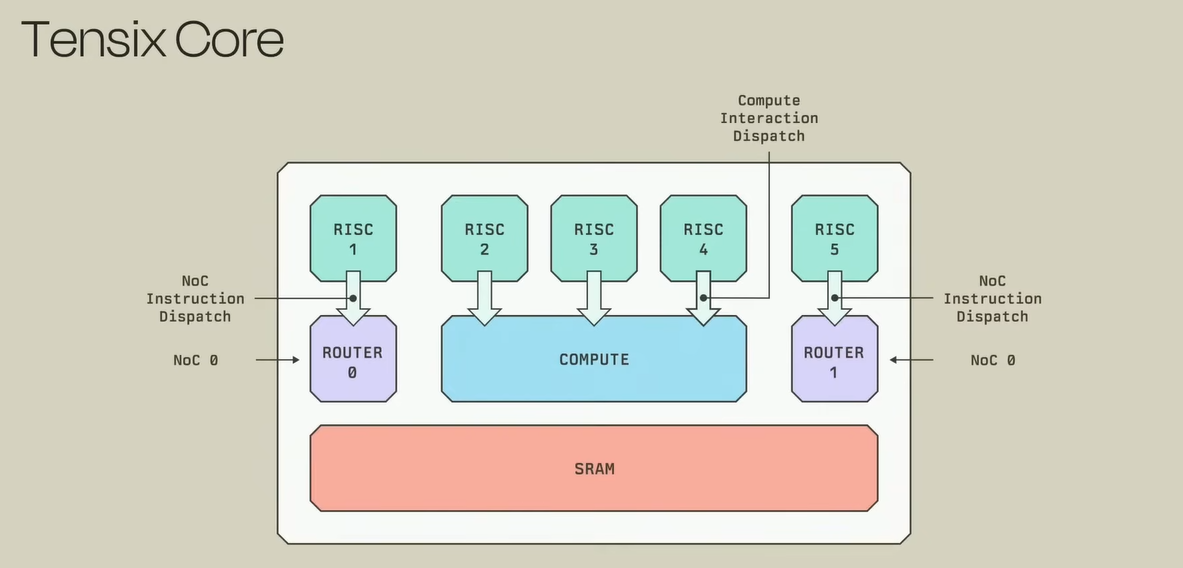
Qualcomm’s Hexagon AI chips used in the AI100 and AI250 rackscale systems are essentially scaled-up mobile chips. They are designed for inference, not for training Large Language Models (LLMs) or for handling the type of continuous, high-throughput workloads used in multi-rack data centres. From the outset, Tenstorrent’s proprietary Tensix cores are designed for high-performance AI training. Unlike standard mobile chips, they can handle both high-end AI training and dense, continuous workloads.
Source: Tenstorrent
By acquiring Tenstorrent, Qualcomm gains a ready-made, enterprise-grade AI accelerator architecture that can be scaled within its data centre server racks and used as part of its newly announced Dragonfly data center brand. This will allow Qualcomm to immediately compete more effectively in the high-margin server rack space, rather than wasting 5 years building a comparable processor from scratch.
DEAL AT A GLANCE
- Reported valuation: $8–10 billion
- Follows Ventana Microsystems (RISC-V CPUs) and Alphawave ($2.4B, interconnects)
- BUDA stack gives cloud customers a path from NVIDIA hardware without rewriting code
- Tensix cores fill the AI training gap in Qualcomm’s Hexagon-based portfolio
- Fits under Qualcomm’s newly announced Dragonfly data center brand
Analyst Viewpoint
Qualcomm’s multi-billion-dollar acquisition of Tenstorrent is a calculated play to tap into the fast-growing AI data centre market and further diversify its business model away from its mainstay smartphone market. Acquiring Tenstorrent would enable it to overcome two of its biggest challenges: Nvidia’s near-monopoly of the AI training market and its reliance on ARM by leveraging the RISC-V IP acquired from Tenstorrent and Ventana.However, there are risks. Qualcomm’s engineers will need to manage two different types of AI accelerators (Hexagon NPU/Tenstorrent Tensix cores) and multiple CPU architectures (ARM-based Oryon, Ventana and Tenstorrent RISC-V IP) simultaneously. Combining these into a single, cohesive product line under the new Dragonfly brand could lead to chaotic roadmaps and delayed chip rollouts.
If the deal closes, it would be one of the largest semiconductor acquisitions of 2026 to date and a clear sign that Qualcomm is serious about data centers. However, it remains to be seen whether it can integrate multiple chip architectures into a product line that competes at the top end with NVIDIA, AMD as well as the hyperscalers’ own custom silicon solutions.
Qualcomm Acquiring RISC-V Chip Start-Up Tenstorrent?
In the last few days, rumours have been circulating that Qualcomm is in talks to buy Tenstorrent for around $8-$10 billion. If true, it would be Qualcomm’s third major chip acquisition in the space…
counterpointresearch.com