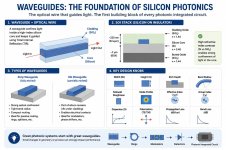
Waveguides are the foundation of silicon photonics.
Before there is a modulator, detector, ring resonator, splitter, WDM system, optical engine, or CPO architecture, there must be a controlled path for light.
That path is the waveguide.
A waveguide is the optical equivalent of a wire.
Instead of carrying electrons, it guides photons through a high-index silicon core. In a typical silicon-on-insulator platform, the silicon core sits above buried oxide and is surrounded by oxide cladding. The large refractive-index contrast between silicon and silicon dioxide allows strong optical confinement.
That confinement is what makes silicon photonics powerful.
It allows light to be routed, bent, split, coupled, delayed, modulated, filtered, and detected on a chip.
But waveguide design is not just drawing an optical line.
Small changes in geometry can change the behavior of the entire photonic system.
Key design knobs include:
waveguide width
silicon thickness
etch depth
bend radius
sidewall roughness
mode profile
effective index
group index
dispersion
polarization behavior
propagation loss
bend loss
fabrication tolerance
Strip waveguides are fully etched, compact, and useful for tight routing and strong confinement.
Rib waveguides are partially etched and often useful when electrical access is needed, such as in modulators and phase shifters.
This is why waveguides are more than passive optical routing.
They are the first realization layer of the photonic system.
For AI optical interconnects, CPO, and photonic integrated circuits, the waveguide must connect cleanly to modulators, detectors, couplers, fiber attach, thermal control, calibration, packaging, and test.
Guiding light is the foundation.
Realizing the full optical system is the challenge.
Before there is a modulator, detector, ring resonator, splitter, WDM system, optical engine, or CPO architecture, there must be a controlled path for light.
That path is the waveguide.
A waveguide is the optical equivalent of a wire.
Instead of carrying electrons, it guides photons through a high-index silicon core. In a typical silicon-on-insulator platform, the silicon core sits above buried oxide and is surrounded by oxide cladding. The large refractive-index contrast between silicon and silicon dioxide allows strong optical confinement.
That confinement is what makes silicon photonics powerful.
It allows light to be routed, bent, split, coupled, delayed, modulated, filtered, and detected on a chip.
But waveguide design is not just drawing an optical line.
Small changes in geometry can change the behavior of the entire photonic system.
Key design knobs include:
waveguide width
silicon thickness
etch depth
bend radius
sidewall roughness
mode profile
effective index
group index
dispersion
polarization behavior
propagation loss
bend loss
fabrication tolerance
Strip waveguides are fully etched, compact, and useful for tight routing and strong confinement.
Rib waveguides are partially etched and often useful when electrical access is needed, such as in modulators and phase shifters.
This is why waveguides are more than passive optical routing.
They are the first realization layer of the photonic system.
For AI optical interconnects, CPO, and photonic integrated circuits, the waveguide must connect cleanly to modulators, detectors, couplers, fiber attach, thermal control, calibration, packaging, and test.
Guiding light is the foundation.
Realizing the full optical system is the challenge.