






The announcement arrived in a Truth Social post, a year after Washington took a stake in the chipmaker it is now steering customers towards.
June 18, 2026 - 7:45 am
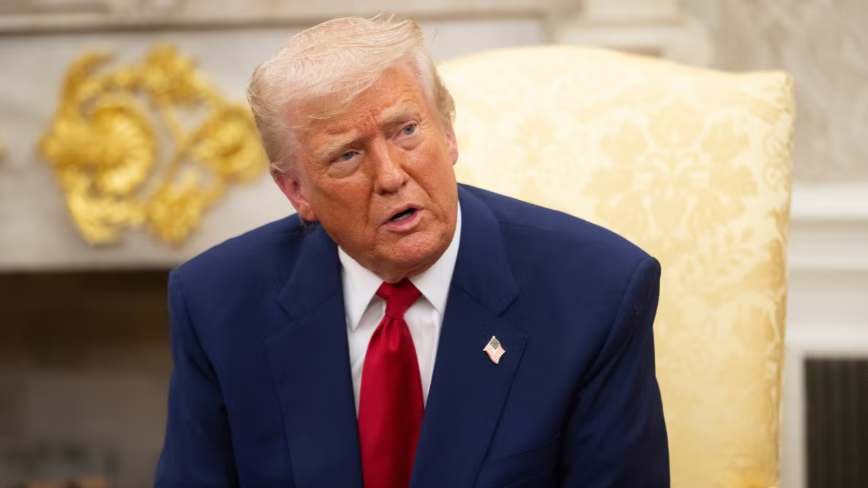
The news that Apple had agreed to make its chips in the United States did not come from Apple. It came, on Thursday, from a post by President Donald Trump on Truth Social, announcing that the company had agreed to work with Intel to design and manufacture chips on American soil. Apple, for its part, said nothing.
That asymmetry is the most telling thing about the announcement. A commercial arrangement between the world’s most valuable company and a chipmaker the federal government partly owns was disclosed by the President rather than by either firm.
Neither Apple nor Intel had confirmed the specifics by the time Trump’s post went up, and the post itself was light on them: no volumes, no timeline, no which-chips, no dollar figure.
What is on the record is the trajectory that led here. Intel and Apple have been talking for more than a year. In May, the Wall Street Journal reported that the two had reached a preliminary deal for Intel to make some chips for Apple, the product of long and intermittent discussions. Trump’s post reads less like a fresh development than a public claiming of one, timed to the administration’s own interests.
Those interests are considerable. Last year the Trump administration took a roughly 10 per cent stake in Intel and committed to investing about $10bn in the company to build and expand domestic factories, turning Washington into both Intel’s shareholder and its most vocal salesman.
Trump has personally pressed Intel’s case to Apple chief executive Tim Cook, including in a White House meeting, according to people familiar with the matter. An administration that owns a piece of the supplier has every incentive to announce the customer.
For Apple, the logic is supply, not patriotism. The company depends almost entirely on Taiwan’s TSMC for its most advanced processors, and TSMC’s leading-edge lines are now fought over by the likes of Nvidia and AMD, whose AI accelerators consume the same scarce capacity.
A second source would give Apple insurance against that crowding. It has held exploratory talks with Intel and Samsung about exactly that, and Intel’s 18A process is the first American node theoretically capable of the work.
Theoretically is carrying weight. Intel’s cost per chip runs around three times TSMC’s, and its yields trail well behind. The company’s share price has nonetheless tripled this year on the strength of its government backing and the Apple talks, a rally built on relationships rather than the manufacturing execution Intel has yet to demonstrate at scale.
Apple has internal doubts about whether non-TSMC silicon can match the yield, performance, and timing it has built its products around.
Intel is also courting other anchor customers; Google and Nvidia have eyed it as a TSMC backup for AI chips, part of a broader scramble for second sources as Taiwan’s dominance becomes a strategic liability. Whether Apple becomes the customer that proves Intel’s foundry can deliver, or another name on a list of talks, will be settled by output, not announcements.
The politics around Intel have grown unusually personal. The company’s stock has more than tripled under chief executive Lip-Bu Tan this year, a rally driven as much by Tan’s relationships with Trump, Elon Musk, and Apple as by anything happening on the factory floor. That gap between narrative and execution is the risk hanging over Thursday’s announcement.
A government that is shareholder, financier, and now public advocate has every reason to talk the partnership up; the manufacturing has to follow regardless.
There is also a question of what “Apple chips” would even mean here. Apple’s most advanced processors, the silicon in its newest iPhones and Macs, are the hardest to move off TSMC, where the company has built its product roadmap around yields and timing it trusts.
A first Intel order, if it materialises, is more likely to involve less bleeding-edge parts, a way of seeding the relationship without betting the flagship on an unproven line. Neither Trump’s post nor either company has said which chips are in scope.
For now there is a presidential post and two silent companies. The orders, if they come, will say more than the post did.
 thenextweb.com
June 18, 2026 - 7:45 am
The news that Apple had agreed to make its chips in the United States did not come from Apple. It came, on Thursday, from a post by President Donald Trump on Truth Social, announcing that the company had agreed to work with Intel to design and manufacture chips on American soil. Apple, for its part, said nothing.
That asymmetry is the most telling thing about the announcement. A commercial arrangement between the world’s most valuable company and a chipmaker the federal government partly owns was disclosed by the President rather than by either firm.
Neither Apple nor Intel had confirmed the specifics by the time Trump’s post went up, and the post itself was light on them: no volumes, no timeline, no which-chips, no dollar figure.
What is on the record is the trajectory that led here. Intel and Apple have been talking for more than a year. In May, the Wall Street Journal reported that the two had reached a preliminary deal for Intel to make some chips for Apple, the product of long and intermittent discussions. Trump’s post reads less like a fresh development than a public claiming of one, timed to the administration’s own interests.
Those interests are considerable. Last year the Trump administration took a roughly 10 per cent stake in Intel and committed to investing about $10bn in the company to build and expand domestic factories, turning Washington into both Intel’s shareholder and its most vocal salesman.
Trump has personally pressed Intel’s case to Apple chief executive Tim Cook, including in a White House meeting, according to people familiar with the matter. An administration that owns a piece of the supplier has every incentive to announce the customer.
For Apple, the logic is supply, not patriotism. The company depends almost entirely on Taiwan’s TSMC for its most advanced processors, and TSMC’s leading-edge lines are now fought over by the likes of Nvidia and AMD, whose AI accelerators consume the same scarce capacity.
A second source would give Apple insurance against that crowding. It has held exploratory talks with Intel and Samsung about exactly that, and Intel’s 18A process is the first American node theoretically capable of the work.
Theoretically is carrying weight. Intel’s cost per chip runs around three times TSMC’s, and its yields trail well behind. The company’s share price has nonetheless tripled this year on the strength of its government backing and the Apple talks, a rally built on relationships rather than the manufacturing execution Intel has yet to demonstrate at scale.
Apple has internal doubts about whether non-TSMC silicon can match the yield, performance, and timing it has built its products around.
Intel is also courting other anchor customers; Google and Nvidia have eyed it as a TSMC backup for AI chips, part of a broader scramble for second sources as Taiwan’s dominance becomes a strategic liability. Whether Apple becomes the customer that proves Intel’s foundry can deliver, or another name on a list of talks, will be settled by output, not announcements.
The politics around Intel have grown unusually personal. The company’s stock has more than tripled under chief executive Lip-Bu Tan this year, a rally driven as much by Tan’s relationships with Trump, Elon Musk, and Apple as by anything happening on the factory floor. That gap between narrative and execution is the risk hanging over Thursday’s announcement.
A government that is shareholder, financier, and now public advocate has every reason to talk the partnership up; the manufacturing has to follow regardless.
There is also a question of what “Apple chips” would even mean here. Apple’s most advanced processors, the silicon in its newest iPhones and Macs, are the hardest to move off TSMC, where the company has built its product roadmap around yields and timing it trusts.
A first Intel order, if it materialises, is more likely to involve less bleeding-edge parts, a way of seeding the relationship without betting the flagship on an unproven line. Neither Trump’s post nor either company has said which chips are in scope.
For now there is a presidential post and two silent companies. The orders, if they come, will say more than the post did.
Trump says Apple will build chips with Intel in the US
Trump says Apple has agreed to design and make chips with Intel in the US, a year after Washington took a stake in the chipmaker.
thenextweb.com

