






Research Brief: 2026/07 – SMU Market Update – Jun 2026
Source: WSTS/Future Horizons
Executive Summary
June’s WSTS Report saw April’s total semiconductor sales up 106.3 percent vs. April 2025.
Month-on-month sales were also up 22.3 percent compared with last month’s 8.5 percent
decline.
To say the chip market is undergoing a boom is by any measure an understatement, with
current annualised growth rates twice the highs recorded in either the mid-1990’s memory
market or early 2000’s dot com boom years. It would however also be a gross over-
simplification and potentially misleading.
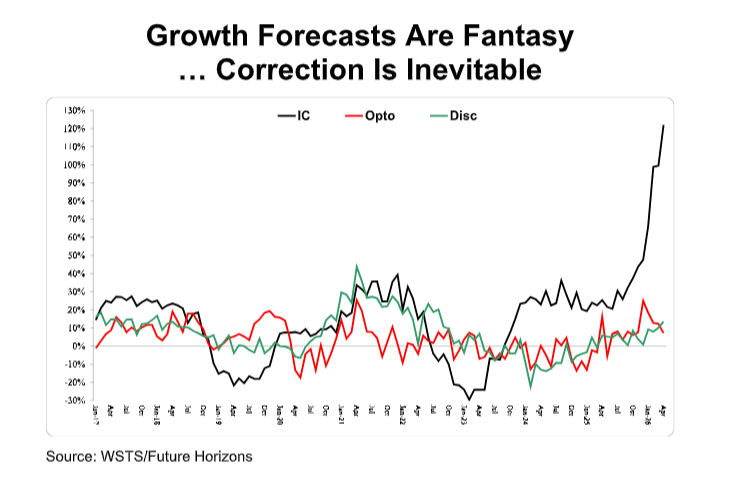
The current eye-watering 106.3 percent growth is being driven by ICs, up 121.9 percent, more
specifically by Memory, up 359.1 percent, and Logic, up 48.6 percent, each in turn driven by a
single end market application, the white-hot AI-datacenter boom.
In sharp contrast, IC growth excluding Memory was just 38.4 percent, with Analog up 17.2
percent and Micro up 26.2 percent. And in the non-IC sectors, Opto was up 7.2 percent and
Discretes up 13.5 percent.
SMU Market Update – Jun 2026
The Global Semiconductor Industry Analysts
Research Brief: 2026/07
Page 2 of 4
© Future Horizons 1989-2026, Reproduction Prohibited - All Rights Reserved
Even more disturbingly, growth is being driven by ASPs, not unit demand. This, we believe,
makes the current growth rates untenable and a downstream correction inevitable.
We are currently out on a limb and alone with this opinion; indeed, the general market euphoria
shows the opposite, calling for several more years of uninterrupted market growth, driven by the
brave new AI world, with no sign of slowing.
Such an extended bull run would be an unprecedented first in the 70 plus year industry history,
even more extraordinary considering the somewhat subdued global economic outlook.
Extended market booms are usually coincident, and driven by, strong GDP growth triggering
broader market-based demand and associated supply-side shortages.
Time alone will tell if our cautionary view is merited but if we are wrong, we will be the first to
admit it and you will read about it first here.
Market Outlook
April 2026 was the 32nd consecutive month of positive year-over-year growth making it the
second longest growth period on record, with only the 35-month June 2002-May 2005 upturn
longer.
The critical distinction, however, between this growth spurt and all previous upturns, is the fact it
is ASP-driven and not based on strong unit shipment growth.
It has also been driven by a single, highly specialist, market sector, namely AI datacenters, and
their associated, equally unique Logic, GPU and Memory device demand. It has not been
driven by a strong economic recovery or a broad-based upturn in demand.
The broader-based Discretes, Analog, Micro, Opto and Sensor product sectors and non-AI
datacenter markets have all yet to recover.
Meanwhile, the massive ‘heart vs. head’ appetite and deep pockets investors have to finance
the data centre infrastructure and computing power needed by AI powerhouse companies such
as Anthropic, OpenAI and Meta shows no sign yet of slowing, as exemplified by Apollo and
Blackstone’s recently announced project “Big Sky”, a US$35 billion private credit deal, one of
the largest private credit deals ever completed.
Yet, despite the magnitude of these current investment plans, according to Goldman Sachs,
even the planned US$765 billion spend on AI data centres this year is only the tip of the
iceberg, a tenth of the total they estimate is needed by 2031.
On the plus side, Anthropic has reported a take-off in revenue, driven by a breakthrough in the
use of AI for coding, engendering the belief that the same type of AI agents that write software
today will soon infiltrate other forms of white-collar work.
Whether this tide will lift all companies equally or whether they can service the demand
profitably are, as yet, unanswered questions, with AI model builders such as xAI, OpenAI and
Anthropic facing questions around whether they can achieve any product differentiation or
SMU Market Update – Jun 2026
The Global Semiconductor Industry Analysts
Research Brief: 2026/07
Page 3 of 4
© Future Horizons 1989-2026, Reproduction Prohibited - All Rights Reserved
pricing power amid fierce competition, particularly with cheaper, high-performance open-source
models from China.
It is also unclear how much customers will be willing to pay. The surge in token use by business
customers, for instance, has been notable, but it is not yet clear how much that will translate into
improved business performance rather than simply inflated tech bills.
There is also rising tide of anti-AI populism, driven by anxiety that the technology is developing
‘too fast’, and the prospect of an ensuing political backlash. Other concerns include privacy
violations, the potential for higher inequality and wider threats to humanity.
The challenge for proponents of AI is that the economic pain will be more frontloaded and
visible before any gains in productivity and job creation kicks in. It takes time for industries to
optimise their use of technology to create new value and openings.
History also shows governments have a poor record of managing economic transitions
consequently making the protectionist instincts of populists most appealing. With AI developing
faster than policymakers can respond, the politics surrounding the technology are starting to
feel familiar.
With the stock market’s AI party in full swing, the big question remains “do investors actually
care?” For now, clearly not, but there are the first signs of rising debt and flat revenue guidance
starting to spook some investors, with some projects experiencing demand for higher-than-
usual premiums.
Not enough yet to rain on the AI parade, it has created a very different semiconductor cycle and
risk, especially given hyperscaler CapEx is so concentrated, memory suppliers are aggressively
expanding capacity, and AI infrastructure is scaling faster than enterprise monetization.
While the long-term AI transformation is potentially real, broad adoption moves much more
slowly than capital markets expect, triggering periods of overbuilding, speculative infrastructure,
capital destruction, and architectural resets before durable economic structures emerged.
Technology can scale exponentially … real-world adoption cannot. The chip industry growth
numbers are currently; the real world is not. Squaring the circle of this predicament will one day
trigger a massive chip market correction. We just don’t know when the house of cards will come
tumbling down.
Malcolm Penn
14 Jun 2026
Stay Up To Date
Subscribe now for full detail on the facts and data behind the current market trends and
industry outlook.
For a complimentary issue e-mail mail@fuuturehorizons.com
Read The Full Report Here: https://www.futurehorizons.com/page/137/
Source: WSTS/Future Horizons
Executive Summary
June’s WSTS Report saw April’s total semiconductor sales up 106.3 percent vs. April 2025.
Month-on-month sales were also up 22.3 percent compared with last month’s 8.5 percent
decline.
To say the chip market is undergoing a boom is by any measure an understatement, with
current annualised growth rates twice the highs recorded in either the mid-1990’s memory
market or early 2000’s dot com boom years. It would however also be a gross over-
simplification and potentially misleading.
The current eye-watering 106.3 percent growth is being driven by ICs, up 121.9 percent, more
specifically by Memory, up 359.1 percent, and Logic, up 48.6 percent, each in turn driven by a
single end market application, the white-hot AI-datacenter boom.
In sharp contrast, IC growth excluding Memory was just 38.4 percent, with Analog up 17.2
percent and Micro up 26.2 percent. And in the non-IC sectors, Opto was up 7.2 percent and
Discretes up 13.5 percent.
SMU Market Update – Jun 2026
The Global Semiconductor Industry Analysts
Research Brief: 2026/07
Page 2 of 4
© Future Horizons 1989-2026, Reproduction Prohibited - All Rights Reserved
Even more disturbingly, growth is being driven by ASPs, not unit demand. This, we believe,
makes the current growth rates untenable and a downstream correction inevitable.
We are currently out on a limb and alone with this opinion; indeed, the general market euphoria
shows the opposite, calling for several more years of uninterrupted market growth, driven by the
brave new AI world, with no sign of slowing.
Such an extended bull run would be an unprecedented first in the 70 plus year industry history,
even more extraordinary considering the somewhat subdued global economic outlook.
Extended market booms are usually coincident, and driven by, strong GDP growth triggering
broader market-based demand and associated supply-side shortages.
Time alone will tell if our cautionary view is merited but if we are wrong, we will be the first to
admit it and you will read about it first here.
Market Outlook
April 2026 was the 32nd consecutive month of positive year-over-year growth making it the
second longest growth period on record, with only the 35-month June 2002-May 2005 upturn
longer.
The critical distinction, however, between this growth spurt and all previous upturns, is the fact it
is ASP-driven and not based on strong unit shipment growth.
It has also been driven by a single, highly specialist, market sector, namely AI datacenters, and
their associated, equally unique Logic, GPU and Memory device demand. It has not been
driven by a strong economic recovery or a broad-based upturn in demand.
The broader-based Discretes, Analog, Micro, Opto and Sensor product sectors and non-AI
datacenter markets have all yet to recover.
Meanwhile, the massive ‘heart vs. head’ appetite and deep pockets investors have to finance
the data centre infrastructure and computing power needed by AI powerhouse companies such
as Anthropic, OpenAI and Meta shows no sign yet of slowing, as exemplified by Apollo and
Blackstone’s recently announced project “Big Sky”, a US$35 billion private credit deal, one of
the largest private credit deals ever completed.
Yet, despite the magnitude of these current investment plans, according to Goldman Sachs,
even the planned US$765 billion spend on AI data centres this year is only the tip of the
iceberg, a tenth of the total they estimate is needed by 2031.
On the plus side, Anthropic has reported a take-off in revenue, driven by a breakthrough in the
use of AI for coding, engendering the belief that the same type of AI agents that write software
today will soon infiltrate other forms of white-collar work.
Whether this tide will lift all companies equally or whether they can service the demand
profitably are, as yet, unanswered questions, with AI model builders such as xAI, OpenAI and
Anthropic facing questions around whether they can achieve any product differentiation or
SMU Market Update – Jun 2026
The Global Semiconductor Industry Analysts
Research Brief: 2026/07
Page 3 of 4
© Future Horizons 1989-2026, Reproduction Prohibited - All Rights Reserved
pricing power amid fierce competition, particularly with cheaper, high-performance open-source
models from China.
It is also unclear how much customers will be willing to pay. The surge in token use by business
customers, for instance, has been notable, but it is not yet clear how much that will translate into
improved business performance rather than simply inflated tech bills.
There is also rising tide of anti-AI populism, driven by anxiety that the technology is developing
‘too fast’, and the prospect of an ensuing political backlash. Other concerns include privacy
violations, the potential for higher inequality and wider threats to humanity.
The challenge for proponents of AI is that the economic pain will be more frontloaded and
visible before any gains in productivity and job creation kicks in. It takes time for industries to
optimise their use of technology to create new value and openings.
History also shows governments have a poor record of managing economic transitions
consequently making the protectionist instincts of populists most appealing. With AI developing
faster than policymakers can respond, the politics surrounding the technology are starting to
feel familiar.
With the stock market’s AI party in full swing, the big question remains “do investors actually
care?” For now, clearly not, but there are the first signs of rising debt and flat revenue guidance
starting to spook some investors, with some projects experiencing demand for higher-than-
usual premiums.
Not enough yet to rain on the AI parade, it has created a very different semiconductor cycle and
risk, especially given hyperscaler CapEx is so concentrated, memory suppliers are aggressively
expanding capacity, and AI infrastructure is scaling faster than enterprise monetization.
While the long-term AI transformation is potentially real, broad adoption moves much more
slowly than capital markets expect, triggering periods of overbuilding, speculative infrastructure,
capital destruction, and architectural resets before durable economic structures emerged.
Technology can scale exponentially … real-world adoption cannot. The chip industry growth
numbers are currently; the real world is not. Squaring the circle of this predicament will one day
trigger a massive chip market correction. We just don’t know when the house of cards will come
tumbling down.
Malcolm Penn
14 Jun 2026
Stay Up To Date
Subscribe now for full detail on the facts and data behind the current market trends and
industry outlook.
For a complimentary issue e-mail mail@fuuturehorizons.com
Read The Full Report Here: https://www.futurehorizons.com/page/137/