






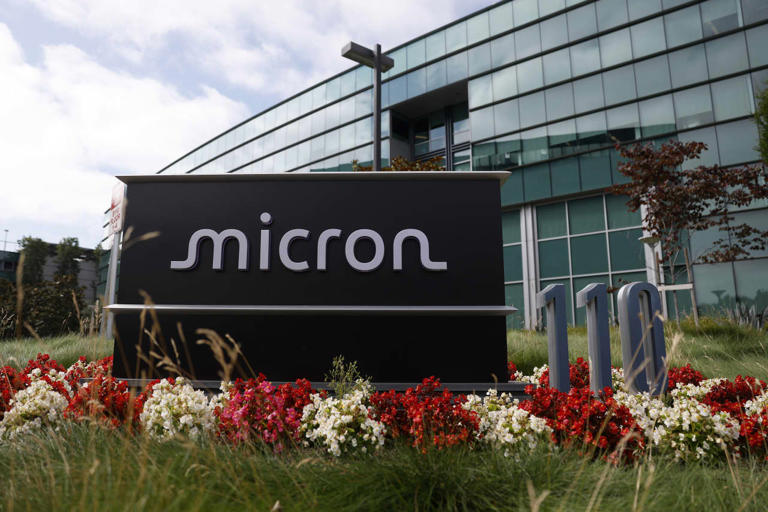
Micron Technology competes with South Korea’s Samsung Electronics and SK Hynix in the memory-chip sector.© Justin Sullivan/Getty Images
Micron Technology wants to buy a chip-making facility in Taiwan for $1.8 billion. The U.S. memory-chip company is racing its rivals to increase its manufacturing capacity amid a huge surge in demand but that could set up a glut in supply over the longer term.
Memory chips are a vital component of artificial-intelligence accelerators. In particular, a form of chip called high-bandwidth memory is necessary for processors from the likes of Nvidia.
The need for memory components in AI hardware is driving up their cost rapidly. Memory prices surged between 40% and 50% in the final quarter of 2025 and are expected to increase at a similar rate in the current quarter, according to Counterpoint Research.
Micron is the chief rival of South Korean companies Samsung Electronics and SK Hynix in making HBM chips. It is also a leader in the markets for dynamic random-access memory, or DRAM, which is used in desktop computers and servers, and for the flash memory found in smartphones and solid-state hard drives.
Micron said Saturday that it had signed a letter of intent to acquire an advanced semiconductor manufacturing fabrication site from Powerchip Semiconductor Manufacturing Corp., a major foundry in Taiwan.
“This strategic acquisition of an existing cleanroom complements our current Taiwan operations and will enable Micron to increase production and better serve our customers in a market where demand continues to outpace supply,” said Manish Bhatia, executive vice president of global operations at Micron, in a statement.
Micron shares are up 27% this year so far and have more than tripled in value over the past 12 months. The U.S. stock market is closed Monday for Martin Luther King Jr. Day.
As Barron’s has warned, memory-chip suppliers have in the past built too much capacity during the upswing of a semiconductor cycle, causing crashes later on. SK Hynix recently said it would invest $13 billion in building a processor-packaging plant in South Korea. Meanwhile, on Friday, Micron broke ground on what the company says will eventually be a $100 billion chip-making complex in Onondaga County, N.Y.
However, concerns of oversupply are unlikely to be relevant this year. SK Hynix said in late October that it had already sold out its entire inventory for all of 2026. Micron’s Bhatia said the memory-chip shortage was “unprecedented” and smartphone and PC makers were already queuing up to lock up supply beyond 2026, in an interview with Bloomberg.
“With production capacity remaining limited, this memory supercycle is expected to extend into 2026,” wrote analysts at research firm TrendForce in a recent research note. “The market has already become a seller’s market, with manufacturers continuing to raise contract prices, manage capacity expansion, and maintain high pricing levels.”
